October 26, 2026

Protesters rally against Iranian leader outside UN

THE ASSOCIATED PRESS

Demonstrators rally outside the UN headquarters to protest against controversial Iranian president Mahmoud Ahmadinejad before he is scheduled to speak at the UN General Assembly, Thursday, Sept. 22, 2011, in the Manhattan borough of New York. Former Homeland Security Secretary Tom Ridge and former UN Ambassador John Bolton were among the speakers at the event. (AP Photo/John Minchillo)

NEW YORK, (AP) — Former United Nations ambassador John Bolton said Thursday that the Obama administration is doing “almost nothing” to protect Iranians from the violence of their own regime — as represented at the U.N. by President Mahmoud Ahmadinejad.

Minutes before Ahmadinejad addressed the annual U.N. General Assembly, about 1,000 Iranian-Americans staged a protest rally in nearby Dag Hammarskjold Plaza.

Children stomped on a poster of Ahmadinejad among banners that covered the pavement. “Down With the Islamic Republic of Iran,” read one.

Bolton, who served as ambassador during George W. Bush’s presidency, told The Associated Press that the United States had failed to stop Iran from torturing and killing its own people.

“We expect that our commitment to the people of Iran is going to be upheld,” he said. “Right now, the Obama administration is doing almost nothing.”

Former UN Ambassador John Bolton speaks to the crowds at an anti-Ahmadinejad rally outside the UN headquarters before the controversial Iranian president is scheduled to speak at the UN General Assembly, Thursday, Sept. 22, 2011, in the Manhattan borough of New York. (AP Photo/John Minchillo)

He said this week’s release of two American hikers held for years by Iran was what he called “just Broadway theater.”

Some protesters were draped in the Iranian flag, while others hoisted yellow flags representing Iran’s political opposition led by Maryam Rajavi, head of the Paris-based National Council of Resistance of Iran.

Protesters say tens of thousands of the opposition group’s supporters in Iran have been executed by the regime.

Speaking live from Paris via satellite on a giant television screen, Rajavi told the crowd that Ahmadinejad does not represent the Iranian people.

She urged the U.N. and the U.S. to stand with the Iranian people and their organized opposition, including more than 3,000 U.N.-defined refugees in Camp Ashraf in Iraq, which was attacked twice, with 47 killed and about 1,000 wounded.

“There is no doubt today that the United States has clearly abandoned its international obligations toward Camp Ashraf,” Rajavi said.

Former Homeland Security Secretary Tom Ridge speaks to the crowds at an anti-Ahmadinejad rally outside the UN headquarters before the controversial Iranian president is scheduled to speak at the UN General Assembly, Thursday, Sept. 22, 2011, in the Manhattan borough of New York. (AP Photo/John Minchillo)

While addressing protesters, former Homeland Security Secretary Tom Ridge said he agreed with Bolton that the U.S. government’s policy toward Iran is inadequate — especially in how it treats the MEK, or People’s Mujahedin of Iran that is the main component of Rajavi’s resistance group.

The U.S. State Department lists it as a terrorist organization, while supporters say the group opposes Ahmadinejad.

As the nation’s first head of homeland security after the Sept. 11, 2001, attacks, Ridge said he started every day with a list of potential threats against the United States.

“Never, not once, among hundreds and hundreds and hundreds of potential terrorist threats, did I ever see the MEK as a terrorist organization,” said Ridge, who also served under Bush. “It’s about time we took them off the list.”

That position was echoed by many of the protesters, including one group busy assembling cardboard rolls into a “cage” symbolizing the one that held former Egyptian President Hosni Mubarak at his trial. Inside was a man wearing a mask resembling Iranian Supreme Leader Ayatollah Ali Khamenei.

Demonstrators rally outside the U.N. headquarters to protest against controversial Iranian president Mahmoud Ahmadinejad before he is scheduled to speak at the U.N. General Assembly, Thursday, Sept. 22, 2011, in New York. Former Homeland Security Secretary Tom Ridge and former U.N. Ambassador John Bolton were among the speakers at the event. Demonstrators hold pictures of Massoud Rajavi, president of the National Council of Resistance of Iran, and his wife Maryam Rajavi. (AP Photo/John Minchillo)

“We hope that Khameini will be in a cage like this soon, to be tried for crimes against humanity,” said Farid Ashkan, 55, an Iranian-born New York dentist.

At the entrance to the plaza, a same-sex “wedding” was staged mocking the alliance of Syria and Iran. A protester posing as ousted Libyan leader Moammar Gadhafi presided over the ceremony, with yellow cake served to onlookers, representing the uranium used to make nuclear weapons.

Read more: http://www.sfgate.com/cgi-bin/article.cgi?f=/n/a/2011/09/22/national/a102622D80.DTL#ixzz1YoUmDyMN

Will U.N. Chief Ban Ki-Moon Do the Right Thing and Protect Iranian Dissidents?

FoxNews.com

Each September, like clockwork, a bestiary of the world’s worst rogues and criminal heads of state arrive at the U.N. building on First Avenue to join in the organization’s opening of the 193-member United Nations General Assembly.  

Protestors gathered outside United Nations headquarters in New York to protest the appearance of Iranian President Mahmud Ahmadinejad at the UN General Assembly. New York, USA. 22nd September 2011

This season, the winner of the contest for “greatest rogue with diplomatic immunity” is, once again, Mahmoud Ahmadinejad of Iran – a president with blood on his hands and nukes in his dreams who will get his 8″ by 10” glossy photograph of a handshake with U.N. Secretary General Ban Ki-moon–and a P.R. platform supported by U.S. tax dollars. 

Despite Ahmadinejad’s infamy as a Holocaust denier and his wild-eyed claim that the September 11 terrorist attacks were a Western conspiracy, it’s a banner year for the Mullahs’ regime, with the Iranian ambassador soon to be seated as vice president of the U.N. General Assembly.

Unfortunately, such diplomatic bon-bons are available only to heads of state, and not to their victims.For the grieving relatives of thousands of Iranian dissidents who have been killed by the Iranian Mullahs — both in jail and during peaceful demonstrations in the streets of Teheran — there will be no photo opportunity at the U.N.

Other Iranian dissidents, in the United States and Europe, are also shut out of these rarefied U.N. precincts — despite their high status in the West as university professors, medical specialists, and entrepreneurs.

The reason is simple: these successful Iranian-American and Iranian-European dissidents have asked that the world organization and its Secretary General protect their less fortunate relatives who are currently held captive at a threatened place in Iraq called Camp Ashraf.

They are, quite simply, trying to prevent a bloodbath, but that is not high on the U.N. agenda. Twice in the last 14 months, Iraqi military forces have attacked the 3,400 unarmed residents at the Ashraf camp — using U.S.-supplied military equipment — killing dozens of unarmed protesters and wounding hundreds more. Iraq will likely soon attack again, and use their cache of automatic weapons originally supplied by the U.S. to build the Iraqi army, to finish off the camp inhabitants — despite the 2004 U.S. promise to them of a protected status as unarmed civilians under the Geneva Conventions.

The reason for this crime is simple: Iraq’s Shia prime minister Nouri al-Maliki wants to prove his usefulness to Teheran, and the Ashraf residents are anti-Mullah activists. Despite this imminent danger, the American family members of Ashraf victims have not been allowed to see the U.N. Secretary General — even for a symbolic moment — amidst his chockablock schedule of handshakes and photo-ops with creatures like Ahmadinejad.

The rebuff comes even though the Ashraf residents and their allies have supplied the international community with much of the key intelligence about the location and progress of the Iranian regime’s program to build a nuclear bomb.

How would the Secretary General explain to these desperate families why the U.N. diplomatic mission in Iraq rarely visits the camp and does not bear witness when attacks are mounted against the unarmed residents, including young women and children? 

Maliki has now announced that after December 31, Iraqi military forces will dismantle Camp Ashraf and scatter the dissidents around Iraq – for a fate easily imagined.

The Secretary General has an opportunity to use his moral platform wisely at the General Assembly, to show some courage and demand that Maliki postpone this “drop dead” deadline, so that the international community has time to work out a happier solution than the one Maliki and Tehran are preparing for the residents of Camp Ashraf, Iraq.

The United States Congress has been aghast at the U.N.’s inaction, on both sides of the aisle. House of Representatives Foreign Affairs committee chairman Ileana Ros-Lehtinen of Florida cut her teeth fighting Fidel Castro and has made Camp Ashraf a personal issue. Texas Congressman Ted Poe has linked UN appropriations to the demand for protection of Ashraf. 

Congresswoman Sheila Jackson Lee — who hailed from Jamaica, Queens, across the river from the United Nations, before she moved to Texas — is equally adamant. Senator John Kerry and Congressman Howard Berman have also condemned the violence against Camp Ashraf in the strongest terms.

The U.S. currently contributes over $6 billion a year to the U.N. at a time of record-high unemployment, skyrocketing deficits, crushing debt, and great economic challenges to our citizens. Ban Ki-moon’s obtuse snub of the Ashraf victims may provoke the Congress to snub the delivery of U.S. dollars to Turtle Bay. Even as the Secretary General talks about the “responsibility to protect” as the U.N.’s new motto, he has refused to give it teeth.

Yet it is within Ban Ki-moon’s power, by the stroke of a pen, to appoint a U.N. Special Representative for Ashraf who will travel to the camp and report on its daily condition.

It is within his power to demand an immediate meeting with Iraqi prime minister Nouri al-Maliki, not to exchange diplomatic niceties but to deliver a warning that the international community will not tolerate another attack on the camp.

And it is within Ban Ki-moon’s power to openly express his support for the dissidents in Iran and Iraq who have opposed the brutal regime of the Mullahs.

The American relatives of the Ashraf hostages are also asking the Secretary General and the U.N. mission to hire private security guards — which they will pay for — in order to protect the camp’s residents and escort the Secretary General’s representative for Ashraf. Though the U.S. pays 27 percent of U.N. peacekeeping bills, this will not require any financial contribution from the U.S. or the U.N.

And finally, it is within Ban Ki-moon’s power to tell Maliki that the December 31 deadline for the relocation of Ashraf camp residents must be postponed, for so far, they have nowhere else to go. And let’s be clear: when Maliki says deadline, he emphasizes “dead.” Ban Ki-moon could do all this. The question is whether he has the fortitude and simple decency to act boldly and to save the lives of these unarmed men, women and children of Ashraf.

Michael B. Mukasey, a former federal judge, served as Attorney General of the United States from 2007-09. Ruth Wedgwood is a member of the Hoover Institution Task Force on Law and National Security and a former member of the United Nations Human Rights Committee.

Read more: http://www.foxnews.com/opinion/2011/09/22/will-un-chief-ban-ki-moon-do-right-thing-and-meet-with-iraqs-maliki/#ixzz1YodX8VmB

Iran’s Seat Does Not Belong to Clerical Rulers

 THE HUFFINGTON POST

On Wednesday, September 21, Iran’s state-run media announced that the two American hikers held in Iran, Shane Bauer and Josh Fattal, were being released after more than two years in custody, just in time for Iranian President Mahmoud Ahmadinejad’s speech at the UN the following day. Not coincidentally, the third hiker, Sarah Shourd, was released a year ago just before Ahmadinejad’s last UN speech.

Alireza Jafarzadeh is the author of 'The Iran Threat: President Ahmadinejad and the Coming Nuclear Crisis'

Ahmadinejad brazenly claimed that both releases were “humanitarian” gestures. No surprise there. But it is shocking, not to mention shameful, that he is allowed to get away with it by the various media, that conducts interviews, exclusives and gives him extensive airtime to churn out his propaganda.

Perhaps the media should think about tagging its interviews with Ahmadinejad: “Iran’s chief hostage-taker.”

Reminiscent of the mid-1980s and early 1990s, when the Iranian regime earned and kept the title of the world’s most active state-sponsor of terror, partly because of its involvement in hostage-taking in Lebanon. Local proxy groups brandishing Kalashnikovs would take Americans and Westerners hostage, and then Tehran, acting on a “humanitarian basis,” would take the negotiating seat to get them released in exchange for the concessions Tehran needed.

The Iran-Contra fiasco during the Reagan administration evolved from the desire to arrange the release of Americans held hostage in Lebanon by pro-Tehran elements. In exchange, the erstwhile “moderates” among the ruling clerics of Iran asked for, and got, a few thousand TOW missiles and a terrorist label on Iran’s main opposition movement.

That policy has since evolved into a new form of hostage-taking. Over the past few years, particularly under Ahmadinejad, we have seen many Americans who had traveled to Iran, including journalists like Roxana Saberi, arrested, declared spies, sentenced to prison, and then eventually released.

What Tehran accomplishes is to take American foreign policy hostage. As the hostages linger in jail, the United States is dissuaded from pursuing a tougher approach regarding Iran, and persuaded to delay sanctions and drag its feet on decisions that run counter to the interests of the Iranian regime. Ultimately, Tehran’s rulers release the victims when it suits them, i.e. to coincide with Ahmadinejad’s visit to the United Nations.

Meanwhile, the entire region has been engulfed in uprisings. The world watches as the Arab Spring blossoms, and some of the mullahs’ closest allies fall or totter in Libya and Syria. To distract attention from the forces for change in the region, and in particular in Iran, Ahmadinejad puts on his dog-and-pony show, making the release of the hostages the news of the day. Does anyone remember that the hikers should have never been arrested to begin with, much less used as human shields for Tehran’s onslaught?

Ahmadinejad actions, however, cannot change the reality on the ground, where his regime is in deep trouble. At home, he struggles to deal with the internal infighting, even among the closest allies of Supreme Leader Khamenei, a moribund economy, and increased protests now spreading to ethnic areas. Over the past few weeks, anti-government demonstrations have been mounting in Western Azerbaijan Province, particularly in the city of Orumieh, where there is major discontent about the government’s destructive inaction on measures to prevent the drying of Lake Orumieh.

Discontent is widespread in Iran, where this year several more anti-government protestors and political prisoners have been sentenced to death on the bogus charge of “mohareb,” or waging war on God. Since January, the regime that Ahmadinejad presides over has killed a number of others for their association with the main organized opposition group and their participation in the 2009 uprising. Tehran has announced the hanging of over 450 people, including minors, some publicly.

In February, clashes between state security forces and hundreds of thousands of protesters wracked central Tehran. Security forces beat and fired tear gas at opposition supporters hoping to evoke an Egypt-like popular uprising.

As Ahmadinejad prepares to speak at the UN on Thursday, the media would do better to pay attention to the voices of change in Iran. Outside the UN, thousands of Iranian-Americans, many of them relatives of political prisoners in Iran or of those murdered by the Iranian regime, will stage a protest. Their message is to declare Ahmadinejad, once again, the representative of the most repressive regime in the region, and not the representative of the Iranian people.

This year, history will be made as the United Nations turns over Libya’s seat to its democratic representatives. Isn’t it time to do the same and turn over Iran’s seat to the Iranian opposition?

Alireza Jafarzadeh is the author of ”The Iran Threat’

http://www.huffingtonpost.com/alireza-jafarzadeh/iran-hikers-released_b_974686.html

Senior Panel Denounces Ahmadinejad’s Visit to the United States, Urges the U.S. to Stand with the Iranian Opposition

PRNEWSWIRE

Senior Panel Denounces Ahmadinejad’s Visit to the United States, Urges the U.S. to Stand with the Iranian Opposition

WASHINGTON, Sept. 18, 2011 /PRNewswire-USNewswire/ — On Saturday, September, 17, 2011, a senior panel of former Secretaries, Generals, and Governors, as well as State and Justice Departments officials denounced the presence of the Iranian regime’s President Mahmoud Ahmadinejad at the United Nations, and urged the removal of Iran’s main opposition, the Mujahedin-e Khalq (MEK), from the State Department’s list of Foreign Terrorist Organization, according to Human Rights and Democracy International.

The panel of former senior officials included Attorney General Michael Mukasey, Energy Secretary Spencer Abraham, Governor Ed Rendell of Pennsylvania, Commandant of the Marine Corps General James Conway, Deputy Commander of United States European Command General Charles Wald, Ambassador John Bolton, and FBI Director Louis Freeh. The continuing designation of the MEK was acting as a license for genocide at Camp Ashraf, Iraq, the officials said.

“So what can the Secretary do as Mahmoud Ahmadinejad prepares to come to New York and stage his annual obscene performance at the United Nations?” asked Judge Mukasey. “She can do what the European Union has already done; what the United Kingdom has already done and remove this evil designation and she can do it as a splendid welcome to Ahmadinejad as he comes to New York to spit in the collective face of humanity.”

Gov. Rendell added, “Not one of the sources has listed any act of violence by the MEK against the United States or any of its allies since 2001 for more than a 10 year period… We have expert witness, circumstantial evidence, opinion of another court; that ought to be enough if we follow the law, if we decide this case on the merits.  It’s overwhelmingly not guilty; delist the MEK and let’s do it now.”

“The maintenance of this organization, contrary to all the facts and the law is not just passivity. It is the basis by which we provide a license to kill to the Iranian regime and unfortunately to the Prime Minister of Iraq. And this license to kill is used on a frequent basis, whether it’s the kangaroo courts in Iran, arresting, torturing and killing people or the atrocities on April 8th. This is averting genocide and war crimes. So time here is not of the essence; time is critical,” emphasized Director Freeh.

Speaking of his personal experience with the MEK at Camp Ashraf, General Conway said, “My operations officer and battalion commander came back shaking their heads, saying these people are not terrorists, they’re no more terrorist than the framers of our own constitution. They don’t like the government of their host nation but there’s no terrorist activity that we have to be concerned about… What happened there [at Ashraf] a few months ago now is pure outrage. We as a nation had, and it has been said many times, a moral responsibility for the protection of those people.”

“I think particularly it is distressing to hear of the circumstances of camp Ashraf. Simply put the United States in my view has a moral obligation to protect the people there… At the end of the day Congress and the Administration must go beyond the resolutions and written things. We have to be a lot more forceful. This is a serious humanitarian matter and we cannot sit back,” stressed Secretary Abraham.

“One of the central elements of the opposition has been the MEK,” noted Amb. Bolton, adding, “I had a passion in the government to read intelligence… I read what I could read about the MEK… I haven’t seen anything that justifies the MEK being on the list of foreign terrorist organizations… The Director of Counterterrorism at the end of the Bush administration and Secretary Rice’s legal officer both argued with her as a matter of law and policy that the designation could not be sustained.”

“I agree with everything that’s been said mostly it is specifically on the Camp Ashraf and MEK issue,” said General Wald, emphasizing that “to make an exception for people like the MEK that aren’t at all identified with a terrorist organization, from a legal standpoint, falls in the category of immorality for me from the stand point of how we recognize citizens in our world.”

Dr. Allan Gerson, former Chief Counsel to the U.S. delegation at the U.N. moderated the event, “Averting a Humanitarian Crisis at Camp Ashraf: U.N., U.S. Obligations.” He said in part of his remarks, “The title of our conference is the obligations of the U.N. and the United States to avert a humanitarian crisis…It’s about avoiding death and slaughter. What’s looming [at Camp Ashraf] is not simply a humanitarian disaster but death and destruction and self-humiliation for the United States on the grand scale because if these people were ever to be allowed to be repatriated in some way to Iran that would be a self-humiliation for the United States that would take generations to erase.”

 SOURCE Human Rights and Democracy International

http://www.prnewswire.com/news-releases/senior-panels-denounces-ahmadinejads-visit-to-the-united-states-urges-the-us-to-stand-with-the-iranian-opposition-hrdip-conference-130093483.html

Misguided policy and bias on MEK

UNITED PRESS INTERNATIONAL

WASHINGTON, Sept. 16 (UPI) — On Aug. 26, hundreds of students and faculty from various universities in the United States, Canada and Europe joined Iranian-Americans in front of the U.S. State Department in Washington to call on Secretary of State Hillary Clinton to remove Iran’s major opposition group, the People’s Mujahedin of Iran, from the department’s list of Foreign Terrorist Organizations.

The PMOI is also known as the Mujahedin-e-Khalq.

State Department Rally to Demand MEK Delisting

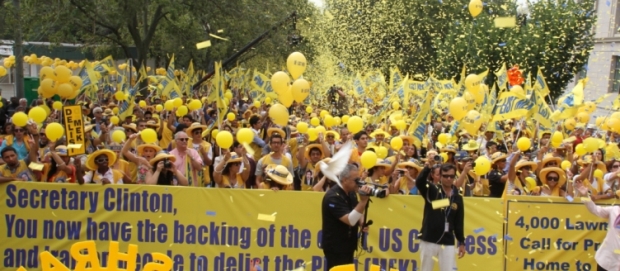
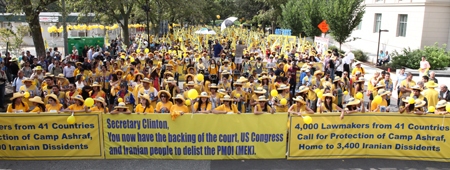
WASHINGTON - A huge crowd of Iranian American demonstrators protest during a rally in front of the US Department of State on August 26, 2011 in Washington, DC. The group was demanding the removal of the People's Mojahedin Organization of Iran from the list of terrorist organizations by the State Deptartment. (PAUL J. RICHARDS/AFP/Getty Images)

Participating students led the protesters with a banner that read, “Secretary Clinton, you now have the backing of the court, the U.S. Congress and the Iranian people to delist the MEK.”

Why does the MEK continue to draw support from universities and why the Western academia has done little to study the group, its influence on the political landscape of Iran and even the region?

Founded in the 1960s by university students, MEK opposed the shah’s rule in Iran and sought a democratic republic. From the outset, universities were the first place where most Iranians, especially women, were introduced to the MEK.

Massoud Rajavi, the sole surviving member of MEK’s original leadership, had the most popular lectures on major political issues of the day and his philosophical discourse on the origins of life and the epistemological awareness that he raised on university campuses in the early months of the 1979 revolution.

The MEK’s political platform and ideological standing as a distinctly nationalist group with a modern, progressive and profoundly anti-fundamentalist interpretation of Islam drew students and faculty en masse to the group.

By 1980, chancellors, deans and faculty of major Iranian universities declared their support for Rajavi’s platform on individual liberties, equality, pluralism and ethnic and religious freedoms.

Ayatollah Ruhollah Khomeini, threatened by the growing influence and popularity of the MEK among academia, declared the “cultural revolution” and closed universities for three years (1980-83). Campuses across the nation witnessed a brutal crackdown.

Violence ensued with thousands of students and faculty purged and executed in Khomeini’s drive to “cleanse” higher education from “anti-revolutionary influences.”

MEK’s anti-theocracy campaign has since expanded and transformed to a relentless struggle underground and in exile, making the group Tehran’s political, social and ideological arch-foe.

This has come at a heavy price. At home, tens of thousands of MEK members and sympathizers have been executed as “mohareb” — enemies of God. Tehran’s strategy to uproot the group has relied on a combination of physical intimidation and political assassinations.

Many outspoken opposition activists, including Rajavi’s brother, Professor Kazem Rajavi, have been killed by Tehran’s terror squads. Kazem Rajavi, 56, who held six doctorate degrees in the fields of law, political science and sociology from European universities, was gunned down in Switzerland by Iranian agents in 1990.

Tehran’s sustained and sophisticated campaign to demonize and discredit the MEK as a legitimate alternative to the rule of clerics has served as the other pillar of its strategy to defeat the group. It relies heavily on a plethora of lies and fabrications about the past and present of the MEK and its leadership.

According to court testimony of former agents of Iran’s Ministry of Intelligence and Security, the anti-MEK campaign has been, and still is, run from the MOIS headquarters in Tehran and then propagated through a web of agents who frequently pose as opposition activists abroad and through what Tehran considers its “assets” in Western media and academic outlets.

One significant consequence of this campaign is the bias that has been instilled among Western academics, scholars and even some non-governmental organizations who have chosen to accept the dominant paradigm in Iran without questions.

In spite of four decades of history involving students, faculty and scholars inside Iran, MEK remains understudied and continues to be misrepresented outside of Iran. The U.S. FTO designation of the MEK, and the legal consequences the label caries, has created an environment that isn’t conducive to seeing MEK as a legitimate political organization.

The MEK’s FTO designation dates to 1997 when the Clinton administration, keen on placating Tehran’s regime through various “goodwill gestures,” designated the MEK as a terrorist organization. Since then, the MEK has won every legal challenge it filed, whether in the United States, the United Kingdom, France or the European Union.

Eight European courts have reviewed thousands of pages of classified and unclassified materials and have concluded that the MEK is simply not involved in terrorism.

With the start of the new academic year, in a joint letter, Iranian and U.S. scholars from several prominent academic institutions in the United States are urging Secretary Clinton to remove the MEK from the State Department’s FTO list, citing Tehran’s use of the terror tag for executions at home, the bipartisan congressional resolution for delisting (H.R. 60) and the July 2010 U.S. Federal Court of Appeals’ ruling as grounds for de-listing.

Kazem Kazerounian, one of signatories from University of Connecticut, says: “Given the tens of thousands of university student supporters of MEK and thousands of faculty supporters executed by the Iranian regime, for their thoughts and not their acts, the issue of MEK is an issue that concerns academicians everywhere.

“Terror tagging MEK, tying their hands and having them defenseless and vulnerable against the atrocities of the ayatollahs — because it is a convenient policy against Tehran — will not be acceptable to us.”

Director of the graduate program in Negotiation and Conflict Management in the School of Public and International Affairs at the University of Baltimore, Ivan Sascha Sheehan, another signatory to the letter, says: “The latest State Department report on MEK further confirms the group’s ineligibility for FTO listing based on statutory language used to label terrorist organizations under U.S. law. MEK’s continued presence on the FTO list is a political setback and undermines a valuable non-military option for supporting indigenous democratic change in Iran.”

Through significant support from the finest minds and talents Iran has ever produced, with more than three generations of experience from different periods of Iranian political history, the MEK needs to be researched and studied free of politics and bias. That begins with their removal from the FTO list.

(Ramesh Sepehrrad is a scholar practitioner from School of Conflict Analysis and Resolution at George Mason University. She has focused her research and field work on Iranian affairs as it relates to human rights, gender equality and U.S. policy on Iran for more than two decades.)
Read more: http://www.upi.com/Top_News/Analysis/Outside-View/2011/09/16/Outside-View-Misguided-policy-and-bias-on-MEK/UPI-11101316171100/#ixzz1YAXXd5vt

Getting on the right side of history


President Obama is in a quandary over what to do about Iran. News headlines over the last few weeks illustrate this:

·    “IAEA: Increasing concerns about Iran’s warheads designed to deliver nuclear payloads.”
·   “U.S. Treasury Department: Iran is aiding Al Qaeda.”
·   “Top al-Qaeda ranks keep footholds in Iran.”
·    “Iran continues to harbor and refuses to hand over bombers of Argentine Jewish charities.”
·   “Senior U.S. officials: Iran transferred lethal new munitions to Iraq and Afghanistan for attacks on U.S. troops.”

The Iranian regime has become brazen in its defiance of multiple UN resolutions and continues to thumb its proverbial nose at the entire international community. 

Another news headline, this time from August 26, gives a clue as to what excites the mullahs:
·         “Thousands of Iranian expatriates demonstrate outside the State Department, calling for protection of Ashraf and removal of PMOI/MEK from the State Department’s terror list.”

The People’s Mojahedin Organization of Iran (PMOI/MEK) is the principal Iranian opposition movement, and Ashraf is home to 3,400 of its members, 40 miles north east of Baghdad.

While historical changes are sweeping throughout the Middle East, the U.S. misguided, and outdated policy, has put the mullahs’ mind at ease about potential change from within by shackling Tehran’s most organized opposition and possible nemesis. This outdated policy puzzled many in 2009, when the Iranian people’s nationwide uprising against the stolen presidential election rocked the foundations of the tyrannical rule of Ali Khamenei. The U.S. response was silence at first and then offering lip service to the demonstrators. That was it. America’s silence was bluntly criticized by millions demonstrating in the streets of Iranian cities when they chanted: “Obama, Obama, Ya Ba-una, Ya Ba-ma!” [Obama, Obama, either with them or with us!]

And there has not been any serious improvement on the part of Washington since then. As a result Iran is fast reaching its goal of building nuclear weapons and mechanisms for their long-range delivery.

The incoherent policy of the U.S. is nowhere more evident than the way in which Iranian dissidents have been treated.

The PMOI/MEK was blacklisted in 1997 as part of the US and West’s appeasement policy. In 2010, the Federal Court of Appeals in Washington, D.C. reviewed the terrorism designation of PMOI/MEK by the State Department, found serious flaws with it, and ordered the State department to review this designation.

More than 100 members of the U.S. congress in a bipartisan initiative have called for delisting.  Dozens of prominent American officials in the past four administrations have added their weight in favor of MEK. On August 26, thousands of Iranian-Americans demonstrated in front of the State Department echoing the same demand.

Iranian-Americans want the U.S. to observe its commitment to protect residents of Ashraf. Since, under the paramount influence of Iran, the Iraqi government has attacked Camp Ashraf twice, killing 47 defenseless residents and wounding more than 1,000. Their excuse for the massacre? The designation of the MEK by the State Department.

On the other side of Atlantic, in 2009 the European Union’s High Court, ordered the EU to remove the PMOI from its terror list because it found no evidence to support such a designation. This ruling followed a thorough procedural and contextual review by the highest judicial authority in the UK in 2008, which found the designation of PMOI/MEK as a terrorist organization totally unjustified and called it “perverse.”

Meanwhile, the Iranian regime’s lobbyists who realize the delisting of MEK will be the beginning of the end of an appeasement policy have launched a propaganda blitz, trying to discredit the MEK, and urging the State Department to maintain MEK on its list.

While the whole Middle East is turning upside down, it is high time President Obama executed a U-turn on Iran policy too. U.S. policymakers must reject the defunct policy of appeasement of Iran and get on the right side of the history.

The U.S. has the opportunity to correct its mistakes vis-à-vis the Iranian people. If it is serious about fighting terrorism and stopping Iran’s nuclear bomb, it must begin by removing the PMOI/MEK from its black list and fulfill its written commitment to protect residents of Ashraf.

The Arab Spring is a wake up call to President Obama and he should see the important signal this policy change would send to those millions in Iran who cry freedom.

Corbett is a British Labour Party politician and is chairman of the British Parliamentary Committee for Iran Freedom

http://thehill.com/blogs/congress-blog/foreign-policy/182073-getting-on-the-right-side-of-history

An Interview With Camp Ashraf Representative Shahriar Kia

TOP SECRET WRITERS

Back in May of this year, I wrote an article about a massacre that took place at Camp Ashraf in Iraq.

Camp Ashraf is the home of Iran dissidents that are currently unarmed and relatively harmless, however they have a long history of coordinating attacks against the Iran regime. Some people would call those attacks part of a long-term revolution against a terrible dictatorship, while others would call the efforts of the MEK a form of terrorism.

There are even questions about the validity of historical accounts involving the involvement of the MEK in the death of soldiers and defense contractors in the 1970s, and the takeover of the U.S. embassy in 1979, where 52 Americans were held hostage for over a year.

Shahriar Kia has been one steadfast supporter of Camp Ashraf, wants the camp to remain where it is, and refutes all efforts from foreign diplomats that want to aid residents of the camp by moving them out of the camp and disbanding the group.

I decided to interview Shahriar directly and ask hard questions about the controversial group, and to dig further into its real history.

An Interview with Shahriar Kia

TSW (TopSecretWriters): We’ll get to the current status of Camp Ashraf in a moment, but first let’s explore the history of the MEK, because that is what so many Americans have a problem with, and it is what makes it difficult to support the people of Camp Ashraf.

In the 1970s, the MEK did not like U.S. support for the pro-Western shah, so U.S. soldiers and defense contractors were killed. This is documented. Could you explain why American citizens should overlook that history and support the MEK being taken off the terrorist list today? Could you also comment on whether it’s true that the MEK supported the 1979 takeover of the U.S. Embassy where 52 Americans were held hostage for well over a year?

And finally, with the actions of your group against the Kurds and Shiites during the 1970s, it seems understandable that the MEK would not be welcome in Iraq because there is so much animosity from those groups.

How do you envision MEK members surviving if they remain in Iraq, in the face of so much hatred for those past deeds?

SK (Shahriar Kia): Before all, let me just clarify the known fact that allegations being circulated by supporters of the policy to appease the mullahs in the U.S. and Europe against the MEK – the main democratic opposition group resisting the mullahs – is, plain and simple, part of a plan organized by the Iranian Ministry of intelligence (MOIS). The MOIS appropriates great sums of money to run a campaign of disinformation with the aim of discrediting its opposition.

These measures are to deceive western governments, supply its international lobbies with added fuel and extend its life. Allegations about the killing of American officers in the 70’s, backing the invasion of the American embassy in Tehran and taking part in the suppression of Kurds and Shiites in Iraq are only partsof this campaign and, simply put, are nothing but bogus lies. (See Enclosure # 21)

In 1999, Reuters reported that Mr . Mrtin Indyk , then-Assistant Secretary of State for Near Eastern Affairs , Publicly acknowledged that “the Iranian government reminded us” to put the Iranian Resistance on the FTO list.

In August 2002, Mr.Indyk told Newsweek that “the Mojahedin’s designation was a part of Clinton’s policy of rapprochement with Tehran.”

You referred to the U.S. support for the Shah.

It’s totally true that the Iranian people were discontented with the U.S. for its support of the Shah’s dictatorship, loathed by the Iranian people, and this is exactly what caused the Iranian people to have some sort of mistrust when it came to U.S. policy.

This feeling is not limited to the people of Iran; today many officials in the U.S. admit that America’s great mistake in backing the shah is what led to the current state of affairs in Iran. There is no doubt that three decades of mullah’s rule is a direct result and offspring of the shah’s dictatorship.

The American and British led coup against Dr. Mossadeq, marginalized the middle class and the reformists and drove them out of the political landscape, and paved the way for Islamic fundamentalism to emerge as an alternative.

Khomeini’s rise to power in Iran was the building block and the beginning for the spread of fundamentalism and terrorism throughout the Middle East.

The MEK was, from the outset, the main opposing force against the religious dictatorship in Iran and throughout the past three decades has paid a heavy price for its resistance against the religious fascism ruling Iran.

The fact that MEK opposed America’s support of the shah, however, doesn’t in any way link the killing of American officers to the MEK.

The struggle for freedom and democracy against the most ruthless and brutal dictatorship of recent history, which in the name of Islam knows no boundaries in perpetrating any and all atrocities against its opponents, has taken a heavy toll on the MEK and its members.

Execution of pregnant women, execution of youth as young as 13 and 14 years, sanctioned rapes of young girls before their execution, massacre of 30 thousand supporters and members of the MEK imprisoned within a few months in 1988 are all only a portion of the mullahs’ atrocities in Iran.

The Iranian regime’s current effort to massacre the residents of camp Ashraf is, in effect, an effort to complete an unfinished genocide by mullahs started years ago against members of MEK.

These allegations, which are being disseminated by the mullahs against the MEK, are nothing new. However, since the mullahs did not succeed in eliminating the MEK and the Iranian resistance was not curtailed, the mullahs have shifted gears and begun a smear campaign with the aim of demonizing the MEK.

Their main objectives are to discredit their main opposition group, to create confusion and thus justify the execution of MEK members in Iran (MEK sympathizers who were recently executed in Iran like Ali Sare,I, Jaffar Kazemi and …) and massacre of camp Ashraf residents.

What Sort of Iran Government Does MEK Desire?

TSW: Obviously the MEK and America share common interests in removing the current Iranian regime from power, however it appears that our motives are polar opposites. It is our impression that while Americans would like to see the regime replaced with Democracy and Freedom, your group would prefer Shiism and Marxism – is this true?

Also, from what I understand, the MEK is still an anti-Iran group that seeks the overthrow of the Iran regime. Can you describe the ideal scenario that the MEK members would like to see happen in Iran? What sort of perfect government and society do you envision?

SK: The MEK aspires for democracy, freedom and the establishment of a secular government in Iran. Our foreign policy will be based on peaceful coexistence, peace, regional and international collaboration and adherence to the UN charter. We shall have relations with all nations.

The only solution to putting an end to the tragedy of the Iranian regime and preventing a human catastrophe is bringing about a regime change in Iran. This is our mutual interest. This change will not be realized neither by foreign military intervention nor by appeasing the mullahs.

As stated by Mrs. Rajavi on numerous occasions, there exists a third option of regime change by Iranian people and their Resistance. This could be reached by putting an end to the appeasement policy and removing the MEK from the FTO list.

This will set free the potential of the Iranian people and their resistance in bringing about change in Iran. One of the main obstacles in the way of change in Iran, which has harnessed the potential for change in the Iranian people, is the unjust listing of the MEK.

The Iranian people and their resistance are, undoubtedly, in the same front with the civilized and democratic society in confronting Islamic fundamentalism and terrorism, although we may have our points of disagreement. Any delay by the U.S. and the Europeans in standing by the side of the people will only have detrimental consequences for world peace.

What the MEK and residents of Ashraf desire – for the future of Iran – is democracy, freedom and the establishment of a secular government based on the principle of separation of church and state.

This charter was published by the Washington Times on March 31, 2007 and I’ve included a (Enclosure # 13).

UMaryam Rajavi’s Ten Point Platform for Future Iran

1. From our point of view, the ballot box is the only criterion for legitimacy. Accordingly, we seek a republic based on universal suffrage.

2. We want a pluralist system, freedom of parties and assembly. In Iran of tomorrow, we will respect all individual freedoms. Expression of opinion, speech and the media are completely free and any censorship or inquisition is banned.

3. In the free Iran of tomorrow, we support and are committed to the abolition of death penalty.

4. The Iranian Resistance is committed the separation of the church and the State. Any form of discrimination against the followers of all religions and denominations will be prohibited.

5. We believe in complete gender equality in political, social and economic arenas. We also committed to equal participation of women in political leadership. Any form of discrimination against women will be abolished. They will enjoy the right to freely choose their clothing.

6. We want to set up a modern legal system based on the principles of presumption of innocence, the right to defense, and the right to be tried in a public court. We also seek the total independence of judges. Cruel and degrading punishments will have no place in the future Iran.

7. We are committed to the Universal Declaration of Humans Rights, and international covenants and conventions, including the International Covenant on Civil and Political Rights, the Convention Against Torture, and the Convention on the Elimination of all Forms of discrimination Against Women.

8. We recognize private property, private investment and the market economy.

9. Our foreign policy will be based on peaceful coexistence, international and regional peace and cooperation, as well as respect for the United Nations Charter. We will establish relations will all countries.

10. We want the free Iran of tomorrow to be devoid of nuclear weapons and weapons of mass destruction.

The Impending Massacre at Camp Ashraf

TSW: Prime Minister Nuri Kamal al-Maliki has stated that the government will shut down Camp Ashraf by the end of the year. The population does not want the MEK in Iraq because of past deeds. The U.S. troops, which provided protection during the American presence there, is coming to an end. Can you truly envision any scenario other than leaving Iraq and settling somewhere that is safer for Camp Ashraf residents?

Also, how high is the threat against Camp Ashraf and how often do attacks occur? Are there currently any defenses or is the camp solely dependent upon the diminishing U.S. presence?

SK: Residents of Ashraf are on the verge of a bloody massacre at the hands of the Iranian regime and the Maliki government.

The Maliki administration has announced that it is going to close camp Ashraf by the end of 2011. At a time when a guaranteed alternative has not been proposed to the camp residents, this ultimatum only lays the ground work for Maliki to perpetrate another massacre in Ashraf which is bound to be greater in scale and bloodier than the previous.

From another standpoint, one should note that Nori Maliki owes his second term as Prime Minister to the Iranian regime. Were it not for Iran, al-Iraqiya was the victorious block and Dr. Alavi was the rightful Prime Minister.

In return for the Iranian regime’s support and the support of Iraqi parties affiliated with Tehran of Nori al-Maliki, it is required that camp Ashraf be shutdown in return and its residents extradited to Iran or massacred and the Iranian opposition must be dismantled.

This is what Tehran has officially demanded from Maliki.

There is no doubt in my mind that the mullahs in Tehran and Maliki have their minds set on carrying out another massacre in camp Ashraf. Presently, Iraqi armed forces are stationed in Ashraf with their armored personnel carriers and their guns directed towards the residents.

The inhumane siege against Ashraf continues. The 300 loudspeakers – placed in and around the camp by agents of the Iranian intelligence agency – are blaring profanity and threatening the residents around the clock; exposing the residents to psychological torture prevalent in Nazi concentrations camps.

Camp Ashraf is inhabited by 1000 Muslim women who are the prime target of Maliki’s suppressive forces and the terrorists in Iranian regime’s Qods force.

The residents are completely defenseless and unarmed in the face of a possible attack by the Iraqi forces and have no means of defending themselves.

It is unfortunate that despite the fact that each and every resident of Ashraf has signed an agreement with the U.S. in return for voluntarily handing over their arms, and despite being recognized by the U.S. as protected persons under the 4th Geneva Convention and despite U.S. assurances that pending final disposition of their case it is responsible for their protections; but time and again, when Iraqi security forces have launched attacks against the residents, the U.S. has turned a blind eye and has disregarded its responsibilities.

The U.S. government’s failure to live up to its promises and agreements with the residents of Ashraf has brought about the disapproval of American congressmen, jurists and members of parliament the world over. (Documents of hearings at the U.S. senate and congress are available per your request).

This is a practical solution for Ashraf residents:

On May 2011 a practical solution was provided by European Parliament’s delegation to settle Ashraf residents in third countries. That was a comprehensive plan but, unfortunately, the US embassy in Iraq, in bringing forward the illegal, dangerous and hopeless solution to relocate the residents inside Iraq, acted practically as an impediment to the European solution.

It is worthy to mention that the the any relocation of the residents inside Iraq is the same that Nouri-al- Maliki was seeking to carry out since two years ago. Such proposal by US Embassy in Iraq would in fact lead the 3400 inhabitants of camp Ashraf to Maliki’s slaughter house, while the US government and its embassy’s support for this solution could significantly act in favor of it.

At the hearing session dated 27 July, Congressman Ted Poe declared “Relocation inside Iraq is the joint desire of Iranian and Iraqi regimes.”

On the contrary, there is an international consensus that compulsory dislocation inside Iraq would only the way for another massacre of the Ashraf residents and this is a reality which has been proved so far.

Besides the Iraqi and Europeans’ opposition to relocation inside Iraq, on July 21stthe Foreign Affairs Committee of the U.S. House of Representatives unanimously passed an amendment to the funding bill, which obliges the US government to prevent compulsory relocation of the Ashraf residents inside Iraq’.

Congressman Dana Rohrabacher, Member of the U.S. House of representatives, announced in the same hearing session to the officials of the state department that “The U.S. State Department will be responsible for any further bloodshed in Ashraf. You, the State Department, will be held accountable for the loss of lives of unarmed civilians.”

In order to put the solution in practice:

1. A UN monitoring team should be stationed there to monitor the events and to see what is taking place there.

2. The refugee status of camp Ashraf residents should be reaffirmed by making a group determination with regard to themby the UNCHR,eventhough a temporary status,to grant them the right of international protection.

3. An immediate investigation regarding the April 8th massacre should be launched under auspices of the United Nations.

4. The iraqi government must be pushed to follow the call of United Nations Secretary General to refrain any use of violation and to end the inhuman siege and psycological torture; and to withdraw armed troops inside the camp, where there are close to 1000 muslim women.

5. United States and the European Union should support theEuropean Parliament’s solution to transfer the residents to third contries as well as providing their protection until the end of this project.

Final Words

Shahriar and supporters of Camp Ashraf provide more than enough evidence showing that the people of Camp Ashraf are currently nowhere near worthy of being included on any terror list. They turned in their arms – their only source of protection against outsiders – to the U.S. in exchange for protection.

It seems clear that the U.S. is letting them down. Even worse, as the end of the year approaches, the senseless slaughter of innocent residents at Camp Ashraf appears inevitable.

Ryan Dube is editor-in-chief of TSW and an electrical engineer in the aerospace industry. He spends his time investigating declassified government documents, legends and conspiracy theories. Ryan has 232 post(s) at Top Secret Writers

http://www.topsecretwriters.com/2011/09/interview-camp-ashraf/

US Rally Calls for Protection of Iranian dissidents

 THE HUFFINGTON POST

In an effort to prevent a humanitarian disaster, thousands of Iranians held a rally outside the US State Department to call for the protection of 3,400 Iranians resident in Camp Ashraf, Iraq and an end to the US ban on Iran’s largest opposition group, the Mujahedeen e Khalq (MEK). The issues are intertwined, because the residents of Camp Ashraf are supporters and members of the MEK.

The rally was addressed by US politicians and former national security officials who called on Secretary of State Hilary Clinton to listen to the thousands of Iranians gathered and end the US ban on the MEK. Their call was made not only because an end to the ban would allow the Camp Ashraf residents to be better protected, but because the ban is unjustified and lacking any legal basis.

Undoubtedly the US attitude towards the MEK has given the Iranian regime and its Iraqi counterparts the green light to carry out atrocities against the group. In the last two years, over 50 residents have been killed in Iraqi military assaults on the defenseless Camp and many more have been executed in Iran for their links to the group. The current US ban on the MEK has allowed the Iraqi government to do Tehran’s bidding on Iraqi soil on the US watch in that country.

Thousands of Iranian-Americans from 41 states took part in a huge rally outside the State Department on August 26, 2011, urging Secretary Clinton to act swiftly and remove the principal Iranian opposition movement, the Mujahedin-e Khalq (PMOI/MEK) from the State Department’s list of Foreign Terrorist Organizations and Ensure Protection for Camp Ashraf.

My personal story of having suffered the Iranian regime’s terrorism tells us much about the great lengths this regime in Iran will go to silence its opponents.

I narrowly escaped death in 1990 in Istanbul, Turkey, where I was assisting Iranian refugees. The regime’s terrorists ambushed our car, and I was shot several times, once very close to my heart. My liver was pierced and has suffered permanent damage. It is currently being held together in a plastic mesh. Even after the assassination attempt, the regime twice tried to end my life in hospital where I was being treated. On one occasion, the regime sent its terrorists under the cover of Turkish police officers and on another they pretended to be friends visiting me. But on both occasions my colleagues who were in the hospital and police officers at the scene managed to foil the plot at the last minute.

At that time it was I who suffered the consequences of western misguided policies and today it is the residents of Camp Ashraf. These residents are today being slaughtered on Iraqi soil with the justification that the MEK is banned in the US, a ban which has been proven in the UK and EU courts to be perverse and flawed.

For the past 14 years the MEK has been unjustifiably banned to placate the Mullahs regime, in a vain hope that the Mullahs in Iran can be moderated. The time has come to end this illegitimate ban, because it is this ban today that is being used by Iran to carry out executions and this ban which the Iraqi authorities seek as justification for the massacring of unarmed civilians at Camp Ashraf.

Now Secretary of State Clinton must do what is just. She must do what the legal system of the United States requires her to do and what the courts of the UK and EU have shown to be the legally correct path in immediately removing the MEK from the US list of banned organizations. The judgments of the British and European courts have unequivocally proven that no case exists for maintaining a ban on the MEK.

The issue of delisting the MEK and hence preventing the massacre of Ashraf residents as Mrs. Maryam Rajavi, the President elect of the National Council of Resistance has said “is the very test for the universal values that President Obama has committed himself to.”

Hilary Clinton must now answer the calls of the Iranian people and delist the MEK, sending a clear message to the people of Iran that we support their battle for freedom and democracy.

 Hossein Abedini is a Member of Parliament in exile of Iranian Resistance

http://www.huffingtonpost.co.uk/hossein-abedini/us-rally-calls-for-protec_b_949818.html

Thousands of Iranians Rally in Washington, Urge delisting of MEK

StopFundamentalism.com

I was among thousands of Iranian-Americans from 41 states across the country who took part in a huge rally and march outside the State Department last Friday, urging Secretary Clinton to act swiftly and delist the principal Iranian opposition movement, the Mujahedin-e Khalq (PMOI/MEK).

Several senior former US Government officials also spoke at the rally, including Governor Ed Rendell; Rep. Patrick Kennedy; FBI Director Louis Freeh; CIA Deputy Director for Covert Operations, John Sano; and Col. Wesley Martin, chief of counterterrorism for the Coalition forces in Iraq and commandant of Camp Ashraf in 2006. 

Thousands of Iranian-Americans from 41 states took part in a huge rally outside the State Department on August 26, 2011, urging Secretary Clinton to act swiftly and remove the principal Iranian opposition movement, the Mujahedin-e Khalq (PMOI/MEK) from the State Department’s list of Foreign Terrorist Organizations.

Aware that if the Secretary of State were to base her decision strictly on law and fact, she would have no choice other than to delist the MEK, the Iranian regime and its lobby inside the Beltway have embarked on an unprecedented campaign to distort the facts. To this end, in the past few weeks, a battery of articles have appeared in the U.S. media lashing out against the Iranian-American communities and their campaign to uphold the rule of law by calling for an objective review of the FTO status the MEK. Based on all the evidence reviewed by U.S. courts, MEK should have been delisted by now. 

Most notable among these articles is Elizabeth Rubin’s hit-piece in the New York Times on August 14, 2011, which suggests that senior former U.S. officials endorsing the MEK’s delisting have been “paid” to do so. This and other articles like it have been widely distributed via social media, and their false claims are embedded in the talking points of the pro-Tehran lobby group National Iranian American Council (NIAC) and its head, Trita Parsi.

To set the record straight, we are proud to fund the activities of our own community in the exercise of our First Amendment rights and aimed at bringing democracy to Iran. The Iranian regime has spent millions of dollars in an attempt to delegitimize the MEK. They have many willing accomplices.

Ms. Rubin is the sister of Jamie Rubin, who served as Assistant Secretary of State in the Clinton Administration that listed the MEK at the behest of Tehran, unsurprisingly failed to cite a single act of terrorism, and parrots the Iranian regime’s party line. She ignores the fact that the European Union and the United Kingdom have already removed the group from their lists, and a U.S. Federal Court of Appeals ruled the State Department had violated the MEK’s due process rights.

Rubin cites a RAND Corporation report to justify her arguments. That report was spearheaded by none other than James Dobbins, who has a long history of involvement with NIAC and Trita Parsi, and a former Iranian Ambassador to the United Nations. Not surprisingly, she fails to mention a thorough rebuttal to that report published shortly afterward.

Ms. Rubin’s piece can only be used to justify the killing of 47 unarmed civilians in Camp Ashraf in July 2009 and April 2011. About 1,000 residents were also injured. Her assertions encourage the Iraqi Army to attack the camp again, presumably to “free” the residents.

Ms. Rubin implicitly endorses the use of violence against the residents of Camp Ashraf and portrays the residents–most of whom were former political prisoners in Iran — as individuals who deserve to be mistreated.

It is no coincidence that Ms. Rubin went to Tehran before her Ashraf visit in 2003, and described the then president of the Iranian regime, Mohammad Khatami, as “a moderate” and “Iran’s Mikhail Gorbachev.”

The regime and its allies, particularly NIAC, have undertaken an unprecedented campaign against the delisting of the MEK. They are a good company. The despotic and cruel Iranian theocracy has adopted as its instrument of influence in the U.S. an outfit that is itself facing widespread accusations of illegal lobbying. Their complicity has cost lives: in Camp Ashraf, in Evin Prison, and throughout Iran. The New York Times should be ashamed for enabling its continued collaboration.

Ahmad Moein is an Electronics Engineer in Silicon Valley and Executive Director of the Iranian American Community of Northern California (info@iacnorcal.com)

UN envoy disputes Iraq’s PM on Iranian exiles

ASSOCIATED PRESS

BAGHDAD (AP) — The departing head of the U.N. mission in Iraq on Monday bluntly disputed Prime Minister Nouri al-Maliki’s account of their farewell meeting, saying he did not embrace the government’s efforts to deport a group of Iranian exiles by the end of the year.

The public disavowal was rare for the U.N. office in Baghdad, which goes to great lengths to avoid engaging in political disputes.

At issue is a group of several thousand Iranian exiles who live at the remote Camp Ashraf in Iraq’s eastern Diyala province. The Ashraf residents were formally allied with Iraq’s Saddam Hussein in resisting Tehran’s clerical regime, and have been a thorn in al-Maliki’s side as he bolsters ties with Iran.

A deadly April raid on the camp by Iraqi forces drew international criticism of Baghdad’s treatment of the group, and al-Maliki responded by pledging to deport the Ashraf residents by the end of the year.

U.N. monitors have been among the only people the Iraqi government has allowed to go inside the camp since the April raid. But they have made very few, if any, public comments about the raid or the government’s plan to deport the Ashraf residents.

In a statement after they met to say goodbye Sunday, al-Maliki said U.N. envoy Ad Melkert affirmed U.N. support on a bevy of matters, “including the issue of Camp Ashraf and the necessity of implementing the Cabinet’s decree to deport its residents outside Iraq by the end of this year.”

In one of his last acts after two years as envoy to Iraq, the mild-mannered Melkert flatly said that was not true.

“The U.N. continues to advocate that Camp Ashraf residents be protected from forcible deportation, expulsion or repatriation,” Melkert’s office said in a statement Monday. It said Melkert reiterated the position during his meeting Sunday with the prime minister.