October 26, 2026

Iranian Americans call on U.S. to protect Iranian exiles in Iraq

THE WASHINGTON POST

Hundreds of Iranian Americans rallied outside the White House on Saturday, saying they’re worried that the Obama administration’s newly announced plan to withdraw U.S. troops from Iraq by year’s end will leave 3,400 Iranian exiles vulnerable in a settlement outside Baghdad.

The protesters also called on the Obama administration to remove Mujahedin-e Khalq, or MEK, the group affiliated with the exiles, from the State Department’s list of foreign terrorist organizations. The designation, protesters said, gives the Iraqi government an excuse to persecute residents of Camp Ashraf, which has been more like a small city, 40 miles north of Baghdad, since the mid-1980s.

Supporters from the Washington area and across the country said Iraqi forces are not allowing medicine into the 10-square-mile Ashraf compound and have twice attacked its unarmed residents since July 2009, killing about 45 people and injuring hundreds. Many protesters said they fear a massacre there after U.S. troops leave Iraq.

Former Secretary of Homeland Security Tom Ridge speaks to a crowd of hundreds protesting in front of the White House in Washington Saturday, Oct. 22, 2011. Ridge spoke in support of the call for the de-listing of an Iranian opposition group, Mujahedin-e Khalq (MEK) from the U.S. terror list. The group also called on President Barack Obama to protect Ashraf, the Iranian refugee camp in Iraq. (AP Photo/Jose Luis Magana)

“Whenever the U.S. says ‘Don’t execute these people’ or ‘Don’t send them back to Iran,’ they [Iraqi authorities] can say ‘Why not? We’re killing terrorists for you,’ ” said Amir Emadi, a graduate student from San Diego. His parents and 19 relatives live in Ashraf.

MEK formed in Iran in the 1960s to overthrow the U.S.-backed shah, and in the 1970s it assassinated several U.S. military personnel and American civilians working in Tehran, according to a 2007 State Department report. It also “supported the violent takeover in 1979 of the U.S. Embassy in Tehran,” the report said.

In the mid-1980s, the group moved to Iraq, where it helped Saddam Hussein’s regime fight in Iraq’s war against Iran.

After the 2003 invasion of Iraq, the United States agreed to protect the residents of Ashraf if MEK gave up its weapons. The United States transferred Ashraf to Iraqi control in 2009. Iraq’s government, eyeing MEK’s past affiliation with Hussein, has tried to make the Ashraf residents leave.

Obama administration officials have said the MEK, headquartered in Paris, has been listed as a foreign terrorist organization since 1997 because of its history of violence. The State Department reportsaid “MEK’s leadership and members across the world maintain the capacity and will to commit terrorist acts in Europe, the Middle East, the United States, Canada and beyond.”

On Saturday, joined by former Homeland Security secretary Tom Ridge and former Pennsylvania governor Ed Rendell, several protesters said recent allegations of an Iranian plot to kill the Saudi ambassador to Washington prove that the Obama administration needs to take a harder line.

“You cannot negotiate with Iran!” Ridge exclaimed to cheers, beating drums and chants of “MEK, yes. Mullahs, no! They are terrorists. They must go!”

Since renouncing violence in 2001, protesters said, MEK has not been linked to any attacks.

Demonstrators chant during a march in Washington after rallying in front of the White House Saturday, Oct. 22, 2011. Hundreds of people rallied, demanding that an Iranian opposition group, Mujahedin-e Khalq (MEK) be removed from a U.S. terror list. (AP Photo/Jose Luis Magana)

At Homeland Security, Ridge was given a daily list of terrorist threats, he said. “Never once did I see a threat to the people of the U.S. from the people of Camp Ashraf,” he told the crowd.

A similar protest outside the State Department in August drew thousands. Saturday’s protesters on Pennsylvania Avenue hoisted yellow flags saying “De-list MEK” and “Protect Ashraf,” as curious tourists looked on. The rally was organized by the Iranian American Professionals and Scholars of Maryland.

Rally leaders said the United States should protect Ashraf with its own troops or urge United Nations security forces to guard it until the exiles can be repatriated.

“We gave our word to protect these people,” Rendell said.

Majid Sadeghpour, a pharmacist who lives in Falls Church, said his brother was executed in Iran in 1989 after being imprisoned for carrying an MEK newspaper. The MEK’s listing as a terrorist group undermines the work of those who want to see Iran governed by a secular democracy, he said.

“We can’t do that,” Sadeghpour said, “when our most organized, capable resistance has been tagged as terrorists.”

http://www.washingtonpost.com/local/iranian-americans-call-on-us-to-protect-iranian-exiles-in-iraq/2011/10/22/gIQAJotj7L_story.html

Hundreds Rally For Iranian Opposition

WAMU Radio

Hundreds of Iranian Americans rallied in front of the White House Saturday demanding the Obama administration do more to help the Iranian resistance movement.

The protestors are asking the U.S. government to take the Mujahedin-e Khalq (MEK) off the State Department’s list of terrorist organizations. The group was once allied with Saddam Hussein’s Iraqi regime, but MEK officials say they renounced violence a decade ago.

Former Homeland Security Secretary Tom Ridge was among the protesters. He says U.S. officials haven’t been helping the process.

Demonstrators chant during a march in Washington after rallying in front of the White House Saturday, Oct. 22, 2011. Hundreds of people rallied, demanding that an Iranian opposition group, Mujahedin-e Khalq (MEK) be removed from a U.S. terror list. (AP Photo/Jose Luis Magana)

“The State Department has been horribly naïve – not just this administration but the previous administration – thinking that you negotiate with Iran,” says Ridge.

Amir Emadi traveled to D.C. from San Diego to pressure the administration to assist protestors in Iran.

“I think that the Iranian people deserve a lot more attention than does the Iranian government,” says Emadi.

International attention came back on Iran after U.S. officials foiled an alleged plot to assassinate the Saudi Arabian ambassador at a restaurant in D.C. But for these Iranian Americans their native country never left their minds.

http://wamu.org/news/11/10/23/hundreds_rally_for_iranian_opposition

Hundreds rally in support of Iranian opposition

ASSOCIATED PRESS

WASHINGTON (AP) — Hundreds of people rallied outside the White House on Saturday, calling on President Barack Obama to remove an Iranian opposition group once allied with Saddam Hussein’s Iraqi regime from the U.S. list of terrorist organizations.

Former Pennsylvania Govs. Tom Ridge and Ed Rendell were among the speakers urging the U.S. to take the Mujahedin-e Khalq off the State Department’s list. Ridge, a Republican, was the nation’s first homeland security secretary. Rendell is a top Democrat who helped elect Obama.

“The only group that should be on the list is the country of Iran itself, under the rule of the mullahs,” Ridge said, noting recent U.S. allegations of a foiled Iranian plot to assassinate Saudi Arabia’s ambassador in Washington.

The U.S. added MEK to its terrorist list in 1997. But last year a federal court ordered the State Department to reconsider and meanwhile the group has rallied many members of Congress and former high-ranking U.S. officials to its cause.

Delisting would allow the Paris-based group to raise money and operate in the U.S., which it is currently prohibited from doing.

The MEK carried out a series of bombings and assassinations against Iran’s clerical regime in the 1980s and fought alongside Saddam’s forces in the Iran-Iraq war. But the group says it renounced violence in 2001.

Ridge and Rendell said the MEK has not been linked to any terrorist attacks since that time. They pointed out that the European Union and the United Kingdom have concluded that the MEK is not a terrorist organization and called on Obama to reach the same decision.

Critics of the MEK say it has cult-like characteristics and that delisting it would be seen even by moderate Iranians as an endorsement by the U.S. of terrorism. A 2010 State Department report on the MEK said: “The group’s worldwide campaign against the Iranian government uses propaganda and terrorism to achieve its objectives.”

Demonstrators protest in front of the White House during a freedom rally outside in Washington Saturday, Oct. 22, 2011. Hundreds of people rallied, demanding that an Iranian opposition group, Mujahedin-e Khalq (MEK) be removed from a U.S. terror list. (AP Photo/Jose Luis Magana)

MEK spokesman Ali Safavi called the State Department’s description “a political statement and not a factual one.” He said the group would not have such broad Congressional support if it was engaged in terrorist activities.

Saturday’s noisy protest took place outside the wrought iron gates of the White House.

“We want President Obama to hear us,” said Rendell, a former Democratic Party national chairman.

Obama left the White House for the drive to Andrews Air Force Base in suburban Maryland to play golf as the demonstration began, and it’s not clear if he heard any of it.

During the rally, the mostly Iranian-American crowd broke into regular chants of “MEK, yes. Mullahs, no. They are terrorists. They must go,” and “President Obama, listen to us. MEK listing is unjust.”

The event was organized by the Iranian American Professionals and Scholars of Maryland.

Organizers say the MEK was put on the terror list to appease Iranian leaders, but that has only given the regime an excuse to arrest and kill dissidents in Iran and Iraq. They contend that delisting would strengthen a major Iranian opposition group.

The MEK has revealed the existence of several important Iranian nuclear facilities.

U.S. officials say that Iran is laying the groundwork for a nuclear weapons program, although its leaders may not have decided to build a bomb. Iran says its nuclear ambitions are entirely peaceful.

Speakers at the protest also urged the U.S. to continue supporting more than 3,000 former MEK fighters and others living at Camp Ashraf near Iraq’s border with Iran. The Iraqi government wants to close the camp and Iraqi security forces have twice raided Ashraf, most recently in April. The U.N. said at least 34 people were killed in that incident.

The U.S. has pledged to protect camp residents from violence, but those rallying outside the White House said Obama’s announcement of a complete pullout of U.S. troops from Iraq by the end of the year could make that promise difficult to keep.

Iran exiles demand delay of Iraq camp closure

Demonstrators holds up petitions to President Barack Obama to protect the Iranian Ashraf refugee camp in Iraq during a freedom rally in front of the White House in Washington on Saturday, Oct. 22, 2011. (AP Photo/Jose Luis Magana)

AGENCE FRANCE PRESSE

WASHINGTON, October 22, 2011 (AFP) – Hundreds of protesters gathered Saturday at the White House to demand that the closure of a refugee camp for Iranian exiles in Iraq be postponed, arguing that a massacre will occur when US troops leave.

Wearing yellow hats and waving banners demanding “protection for Camp Ashraf,” the demonstrators also called on US President Barack Obama to remove the People’s Mujahedeen of Iran group from a blacklist of terror groups.

“By illegally insisting on the continued listing of the PMOI, the United States has blocked the path to change in Iran while paving the way for a massacre in Ashraf,” the movement’s leader Maryam Rajavi said in a message broadcast live from Paris, where she lives in exile.

Rajavi has previously said that Iraqi forces have finished training for an assault on the camp, home for the past 30 years to 3,400 Iranian dissidents who are facing expulsion by year’s end on the orders of the Baghdad government.

On Saturday, she asked the United States, United Nations and other governments to pressure Iraq to push back the December 31 deadline for closure of the camp, and also asked that UN monitors be sent to Ashraf.
A similar demonstration took place earlier this week in Brussels.

The camp, which has become a mounting international problem, has been in the spotlight since an April raid by Iraqi security forces left 34 people dead and scores injured, triggering sharp condemnation.

The camp was set up when Iraq and Iran were at war in the 1980s by the People’s Mujahedeen and later came under US control until January 2009, when US forces transferred security for the camp to Iraq.

The group has been on the US government terrorist list since 1997.

http://en.cumhuriyet.com/?hn=287680

Demonstrators Call for Iranian Opposition Group to Be Removed From US List of Terrorist Organizations

FoxNews

[oqeygallery id=2]


WASHINGTON –  Hundreds of people rallied outside the White House on Saturday, calling on President Barack Obama to remove an Iranian opposition group once allied with Saddam Hussein’s Iraqi regime from the U.S. list of terrorist organizations.

Former Pennsylvania Govs. Tom Ridge and Ed Rendell were among the speakers urging the U.S. to take the Mujahedin-e Khalq off the State Department’s list. Ridge, a Republican, was the nation’s first homeland security secretary. Rendell is a top Democrat who helped elect Obama.

“The only group that should be on the list is the country of Iran itself, under the rule of the mullahs,” Ridge said, noting recent U.S. allegations of a foiled Iranian plot to assassinate Saudi Arabia’s ambassador in Washington.

The U.S. added MEK to its terrorist list in 1997. But last year a federal court ordered the State Department to reconsider and meanwhile the group has rallied many members of Congress and former high-ranking U.S. officials to its cause.

Delisting would allow the Paris-based group to raise money and operate in the U.S., which it is currently prohibited from doing.

The MEK carried out a series of bombings and assassinations against Iran’s clerical regime in the 1980s and fought alongside Saddam’s forces in the Iran-Iraq war. But the group says it renounced violence in 2001.

Ridge and Rendell said the MEK has not been linked to any terrorist attacks since that time. They pointed out that the European Union and the United Kingdom have concluded that the MEK is not a terrorist organization and called on Obama to reach the same decision.

Critics of the MEK say it has cult-like characteristics and that delisting would be seen even by moderate Iranians as a U.S. endorsement of terror. A 2007 State Department report said the MEK maintained “the capacity and will” to mount attacks in the Middle East, Europe and the U.S.

Saturday’s noisy protest took place outside the wrought iron gates of the White House.

“We want President Obama to hear us,” said Rendell, a former Democratic Party national chairman.

Obama left the White House for the drive to Andrews Air Force Base in suburban Maryland to play golf as the demonstration began, and it’s not clear if he heard any of it.

During the rally, the mostly Iranian-American crowd broke into regular chants of “MEK, yes. Mullahs, no. They are terrorists. They must go,” and “President Obama, listen to us. MEK listing is unjust.”

The event was organized by the Iranian American Professionals and Scholars of Maryland.

Organizers say the MEK was put on the terror list to appease Iranian leaders, but that has only given the regime an excuse to arrest and kill dissidents in Iran and Iraq. They contend that delisting would strengthen a major Iranian opposition group.

The MEK has revealed the existence of several important Iranian nuclear facilities.

U.S. officials say that Iran is laying the groundwork for a nuclear weapons program, although its leaders may not have decided to build a bomb. Iran says its nuclear ambitions are entirely peaceful.

Speakers at the protest also urged the U.S. to continue supporting more than 3,000 former MEK fighters and others living at Camp Ashraf near Iraq’s border with Iran. The Iraqi government wants to close the camp and Iraqi security forces have twice raided Ashraf, most recently in April. The U.N. said at least 34 people were killed in that incident.

The U.S. has pledged to protect camp residents from violence, but those rallying outside the White House said Obama’s announcement of a complete pullout of U.S. troops from Iraq by the end of the year could make that promise difficult to keep.

Read more: http://www.foxnews.com/world/2011/10/22/demonstrators-call-for-iranian-opposition-group-to-be-removed-from-us-list/#ixzz1beyorfku

Misguided policy and bias on MEK

UNITED PRESS INTERNATIONAL

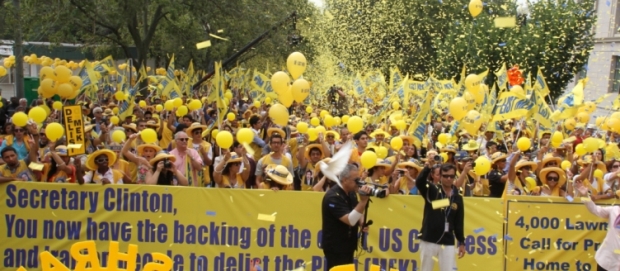
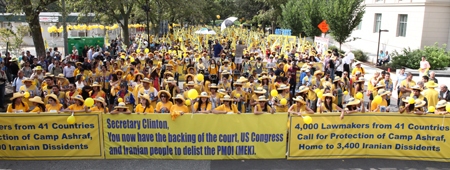
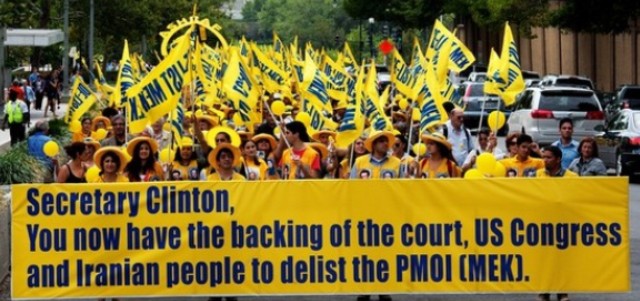
WASHINGTON, Sept. 16 (UPI) — On Aug. 26, hundreds of students and faculty from various universities in the United States, Canada and Europe joined Iranian-Americans in front of the U.S. State Department in Washington to call on Secretary of State Hillary Clinton to remove Iran’s major opposition group, the People’s Mujahedin of Iran, from the department’s list of Foreign Terrorist Organizations.

The PMOI is also known as the Mujahedin-e-Khalq.

State Department Rally to Demand MEK Delisting

WASHINGTON - A huge crowd of Iranian American demonstrators protest during a rally in front of the US Department of State on August 26, 2011 in Washington, DC. The group was demanding the removal of the People's Mojahedin Organization of Iran from the list of terrorist organizations by the State Deptartment. (PAUL J. RICHARDS/AFP/Getty Images)

Participating students led the protesters with a banner that read, “Secretary Clinton, you now have the backing of the court, the U.S. Congress and the Iranian people to delist the MEK.”

Why does the MEK continue to draw support from universities and why the Western academia has done little to study the group, its influence on the political landscape of Iran and even the region?

Founded in the 1960s by university students, MEK opposed the shah’s rule in Iran and sought a democratic republic. From the outset, universities were the first place where most Iranians, especially women, were introduced to the MEK.

Massoud Rajavi, the sole surviving member of MEK’s original leadership, had the most popular lectures on major political issues of the day and his philosophical discourse on the origins of life and the epistemological awareness that he raised on university campuses in the early months of the 1979 revolution.

The MEK’s political platform and ideological standing as a distinctly nationalist group with a modern, progressive and profoundly anti-fundamentalist interpretation of Islam drew students and faculty en masse to the group.

By 1980, chancellors, deans and faculty of major Iranian universities declared their support for Rajavi’s platform on individual liberties, equality, pluralism and ethnic and religious freedoms.

Ayatollah Ruhollah Khomeini, threatened by the growing influence and popularity of the MEK among academia, declared the “cultural revolution” and closed universities for three years (1980-83). Campuses across the nation witnessed a brutal crackdown.

Violence ensued with thousands of students and faculty purged and executed in Khomeini’s drive to “cleanse” higher education from “anti-revolutionary influences.”

MEK’s anti-theocracy campaign has since expanded and transformed to a relentless struggle underground and in exile, making the group Tehran’s political, social and ideological arch-foe.

This has come at a heavy price. At home, tens of thousands of MEK members and sympathizers have been executed as “mohareb” — enemies of God. Tehran’s strategy to uproot the group has relied on a combination of physical intimidation and political assassinations.

Many outspoken opposition activists, including Rajavi’s brother, Professor Kazem Rajavi, have been killed by Tehran’s terror squads. Kazem Rajavi, 56, who held six doctorate degrees in the fields of law, political science and sociology from European universities, was gunned down in Switzerland by Iranian agents in 1990.

Tehran’s sustained and sophisticated campaign to demonize and discredit the MEK as a legitimate alternative to the rule of clerics has served as the other pillar of its strategy to defeat the group. It relies heavily on a plethora of lies and fabrications about the past and present of the MEK and its leadership.

According to court testimony of former agents of Iran’s Ministry of Intelligence and Security, the anti-MEK campaign has been, and still is, run from the MOIS headquarters in Tehran and then propagated through a web of agents who frequently pose as opposition activists abroad and through what Tehran considers its “assets” in Western media and academic outlets.

One significant consequence of this campaign is the bias that has been instilled among Western academics, scholars and even some non-governmental organizations who have chosen to accept the dominant paradigm in Iran without questions.

In spite of four decades of history involving students, faculty and scholars inside Iran, MEK remains understudied and continues to be misrepresented outside of Iran. The U.S. FTO designation of the MEK, and the legal consequences the label caries, has created an environment that isn’t conducive to seeing MEK as a legitimate political organization.

The MEK’s FTO designation dates to 1997 when the Clinton administration, keen on placating Tehran’s regime through various “goodwill gestures,” designated the MEK as a terrorist organization. Since then, the MEK has won every legal challenge it filed, whether in the United States, the United Kingdom, France or the European Union.

Eight European courts have reviewed thousands of pages of classified and unclassified materials and have concluded that the MEK is simply not involved in terrorism.

With the start of the new academic year, in a joint letter, Iranian and U.S. scholars from several prominent academic institutions in the United States are urging Secretary Clinton to remove the MEK from the State Department’s FTO list, citing Tehran’s use of the terror tag for executions at home, the bipartisan congressional resolution for delisting (H.R. 60) and the July 2010 U.S. Federal Court of Appeals’ ruling as grounds for de-listing.

Kazem Kazerounian, one of signatories from University of Connecticut, says: “Given the tens of thousands of university student supporters of MEK and thousands of faculty supporters executed by the Iranian regime, for their thoughts and not their acts, the issue of MEK is an issue that concerns academicians everywhere.

“Terror tagging MEK, tying their hands and having them defenseless and vulnerable against the atrocities of the ayatollahs — because it is a convenient policy against Tehran — will not be acceptable to us.”

Director of the graduate program in Negotiation and Conflict Management in the School of Public and International Affairs at the University of Baltimore, Ivan Sascha Sheehan, another signatory to the letter, says: “The latest State Department report on MEK further confirms the group’s ineligibility for FTO listing based on statutory language used to label terrorist organizations under U.S. law. MEK’s continued presence on the FTO list is a political setback and undermines a valuable non-military option for supporting indigenous democratic change in Iran.”

Through significant support from the finest minds and talents Iran has ever produced, with more than three generations of experience from different periods of Iranian political history, the MEK needs to be researched and studied free of politics and bias. That begins with their removal from the FTO list.

(Ramesh Sepehrrad is a scholar practitioner from School of Conflict Analysis and Resolution at George Mason University. She has focused her research and field work on Iranian affairs as it relates to human rights, gender equality and U.S. policy on Iran for more than two decades.)
Read more: http://www.upi.com/Top_News/Analysis/Outside-View/2011/09/16/Outside-View-Misguided-policy-and-bias-on-MEK/UPI-11101316171100/#ixzz1YAXXd5vt

US Rally Calls for Protection of Iranian dissidents

 THE HUFFINGTON POST

In an effort to prevent a humanitarian disaster, thousands of Iranians held a rally outside the US State Department to call for the protection of 3,400 Iranians resident in Camp Ashraf, Iraq and an end to the US ban on Iran’s largest opposition group, the Mujahedeen e Khalq (MEK). The issues are intertwined, because the residents of Camp Ashraf are supporters and members of the MEK.

The rally was addressed by US politicians and former national security officials who called on Secretary of State Hilary Clinton to listen to the thousands of Iranians gathered and end the US ban on the MEK. Their call was made not only because an end to the ban would allow the Camp Ashraf residents to be better protected, but because the ban is unjustified and lacking any legal basis.

Undoubtedly the US attitude towards the MEK has given the Iranian regime and its Iraqi counterparts the green light to carry out atrocities against the group. In the last two years, over 50 residents have been killed in Iraqi military assaults on the defenseless Camp and many more have been executed in Iran for their links to the group. The current US ban on the MEK has allowed the Iraqi government to do Tehran’s bidding on Iraqi soil on the US watch in that country.

Thousands of Iranian-Americans from 41 states took part in a huge rally outside the State Department on August 26, 2011, urging Secretary Clinton to act swiftly and remove the principal Iranian opposition movement, the Mujahedin-e Khalq (PMOI/MEK) from the State Department’s list of Foreign Terrorist Organizations and Ensure Protection for Camp Ashraf.

My personal story of having suffered the Iranian regime’s terrorism tells us much about the great lengths this regime in Iran will go to silence its opponents.

I narrowly escaped death in 1990 in Istanbul, Turkey, where I was assisting Iranian refugees. The regime’s terrorists ambushed our car, and I was shot several times, once very close to my heart. My liver was pierced and has suffered permanent damage. It is currently being held together in a plastic mesh. Even after the assassination attempt, the regime twice tried to end my life in hospital where I was being treated. On one occasion, the regime sent its terrorists under the cover of Turkish police officers and on another they pretended to be friends visiting me. But on both occasions my colleagues who were in the hospital and police officers at the scene managed to foil the plot at the last minute.

At that time it was I who suffered the consequences of western misguided policies and today it is the residents of Camp Ashraf. These residents are today being slaughtered on Iraqi soil with the justification that the MEK is banned in the US, a ban which has been proven in the UK and EU courts to be perverse and flawed.

For the past 14 years the MEK has been unjustifiably banned to placate the Mullahs regime, in a vain hope that the Mullahs in Iran can be moderated. The time has come to end this illegitimate ban, because it is this ban today that is being used by Iran to carry out executions and this ban which the Iraqi authorities seek as justification for the massacring of unarmed civilians at Camp Ashraf.

Now Secretary of State Clinton must do what is just. She must do what the legal system of the United States requires her to do and what the courts of the UK and EU have shown to be the legally correct path in immediately removing the MEK from the US list of banned organizations. The judgments of the British and European courts have unequivocally proven that no case exists for maintaining a ban on the MEK.

The issue of delisting the MEK and hence preventing the massacre of Ashraf residents as Mrs. Maryam Rajavi, the President elect of the National Council of Resistance has said “is the very test for the universal values that President Obama has committed himself to.”

Hilary Clinton must now answer the calls of the Iranian people and delist the MEK, sending a clear message to the people of Iran that we support their battle for freedom and democracy.

 Hossein Abedini is a Member of Parliament in exile of Iranian Resistance

http://www.huffingtonpost.co.uk/hossein-abedini/us-rally-calls-for-protec_b_949818.html

Thousands of Iranians Rally in Washington, Urge delisting of MEK

StopFundamentalism.com

I was among thousands of Iranian-Americans from 41 states across the country who took part in a huge rally and march outside the State Department last Friday, urging Secretary Clinton to act swiftly and delist the principal Iranian opposition movement, the Mujahedin-e Khalq (PMOI/MEK).

Several senior former US Government officials also spoke at the rally, including Governor Ed Rendell; Rep. Patrick Kennedy; FBI Director Louis Freeh; CIA Deputy Director for Covert Operations, John Sano; and Col. Wesley Martin, chief of counterterrorism for the Coalition forces in Iraq and commandant of Camp Ashraf in 2006. 

Thousands of Iranian-Americans from 41 states took part in a huge rally outside the State Department on August 26, 2011, urging Secretary Clinton to act swiftly and remove the principal Iranian opposition movement, the Mujahedin-e Khalq (PMOI/MEK) from the State Department’s list of Foreign Terrorist Organizations.

Aware that if the Secretary of State were to base her decision strictly on law and fact, she would have no choice other than to delist the MEK, the Iranian regime and its lobby inside the Beltway have embarked on an unprecedented campaign to distort the facts. To this end, in the past few weeks, a battery of articles have appeared in the U.S. media lashing out against the Iranian-American communities and their campaign to uphold the rule of law by calling for an objective review of the FTO status the MEK. Based on all the evidence reviewed by U.S. courts, MEK should have been delisted by now. 

Most notable among these articles is Elizabeth Rubin’s hit-piece in the New York Times on August 14, 2011, which suggests that senior former U.S. officials endorsing the MEK’s delisting have been “paid” to do so. This and other articles like it have been widely distributed via social media, and their false claims are embedded in the talking points of the pro-Tehran lobby group National Iranian American Council (NIAC) and its head, Trita Parsi.

To set the record straight, we are proud to fund the activities of our own community in the exercise of our First Amendment rights and aimed at bringing democracy to Iran. The Iranian regime has spent millions of dollars in an attempt to delegitimize the MEK. They have many willing accomplices.

Ms. Rubin is the sister of Jamie Rubin, who served as Assistant Secretary of State in the Clinton Administration that listed the MEK at the behest of Tehran, unsurprisingly failed to cite a single act of terrorism, and parrots the Iranian regime’s party line. She ignores the fact that the European Union and the United Kingdom have already removed the group from their lists, and a U.S. Federal Court of Appeals ruled the State Department had violated the MEK’s due process rights.

Rubin cites a RAND Corporation report to justify her arguments. That report was spearheaded by none other than James Dobbins, who has a long history of involvement with NIAC and Trita Parsi, and a former Iranian Ambassador to the United Nations. Not surprisingly, she fails to mention a thorough rebuttal to that report published shortly afterward.

Ms. Rubin’s piece can only be used to justify the killing of 47 unarmed civilians in Camp Ashraf in July 2009 and April 2011. About 1,000 residents were also injured. Her assertions encourage the Iraqi Army to attack the camp again, presumably to “free” the residents.

Ms. Rubin implicitly endorses the use of violence against the residents of Camp Ashraf and portrays the residents–most of whom were former political prisoners in Iran — as individuals who deserve to be mistreated.

It is no coincidence that Ms. Rubin went to Tehran before her Ashraf visit in 2003, and described the then president of the Iranian regime, Mohammad Khatami, as “a moderate” and “Iran’s Mikhail Gorbachev.”

The regime and its allies, particularly NIAC, have undertaken an unprecedented campaign against the delisting of the MEK. They are a good company. The despotic and cruel Iranian theocracy has adopted as its instrument of influence in the U.S. an outfit that is itself facing widespread accusations of illegal lobbying. Their complicity has cost lives: in Camp Ashraf, in Evin Prison, and throughout Iran. The New York Times should be ashamed for enabling its continued collaboration.

Ahmad Moein is an Electronics Engineer in Silicon Valley and Executive Director of the Iranian American Community of Northern California (info@iacnorcal.com)

Iranian Dissidents Gather High-profile Support

THE WASHINGTON POST

Politicians, former national security officials and thousands of others gathered outside the State Department on Friday to call for the removal of the Mujahedin-e Khalk, an Iranian opposition group, from the list of foreign terrorist organizations.  

Politicians, former national security officials and thousands of others gathered outside the State Department on Friday to call for the removal of the Mujahedin-e Khalk, an Iranian opposition group, from the list of foreign terrorist organizations. WASHINGTON POST

Beethoven’s “Ode to Joy” blasted from large speakers and doves and clouds of confetti flew into the air as former congressman Patrick J. Kennedy (D-R.I.) introduced the group’s leader, Maryam Rajavi, to speak by video link from Paris.

“I salute your protest and gathering, which symbolizes an uprising for the freedom of the Iranian people,” said Rajavi, speaking in Farsi.

The controversial group, usually called by the acronym MEK, is made up of exiled Iranian dissidents who organized in the 1960s and now are mounting a political and legal campaign to end their designation as terrorists.

The group violently opposed the rule of the shah and initially supported the Islamist regime that came to power in 1979, but they became disillusioned with the theocracy and eventually fled amid growing hostility.

Some went to Europe, and others went to Iraq, where they built a heavily fortified base, called Camp Ashraf, northeast of Baghdad. MEK fought with Saddam Hussein’s forces against Iran. The U.S. designated MEK a terrorist group in 1997 after blaming it for attacks on Iranian government institutions in which dozens were killed, including Americans working in Tehran.

Kennedy said the group does not nowcommit acts of terrorism or pose a threat to the United States. He and others hailed the group as a legitimate alternative to Iran’s repressive government.

“How much worse can we do than the mullahs in Tehran now?” Kennedy asked. “Does it make sense to shackle the primary opposition group internationally? You may not like them. They may not have a lot of support. . . . But we ought to be on the opposite side of what Tehran favors as a matter of principle.”

Retired Army Col. Wesley Martin said: “The opposition in Iran has been sent to the gallows or prison. [MEK is] the only external organization with influence.”

A growing number of high-profile figures support removing the MEK from the list of terrorist groups. Those who have spoken in support of the move include retired Army Gen. Hugh Shelton and retired Marine Gen. Peter Pace, both former chairmen of the Joint Chiefs of Staff; retired Marine Gen. James L. Jones, who was President Obama’s national security adviser; and former Vermont governor Howard Dean (D).

Lawmakers from both parties have criticized the Obama administration for not moving swiftly to clear MEK’s name or to facilitate a move to a country outside Iraq. Administration officials say there remains concern about the group’s nature.

“This is a group that has a lot of blood on its hands, including American blood,” said a senior administration official, who insisted on anonymity because legal and political decisions were being made about MEK. “We don’t want to be in a position where we later determine that a de-listed group has returned to violence.”

Many people in the Iranian diaspora support MEK, but within Iran, it has limited support even among opposition movements.

After the 2003 invasion, MEK members were offered American protection in exchange for giving up their weapons, but they are reviled by the Iraqi government because of their association with Saddam Hussein. About 3,400 members still live at Camp Ashraf, where there have been clashes with Iraqi government forces.

Speaking at the event Friday, former FBI director Louis J. Freeh called for American support for the group as U.S. troop levels decline in Iraq. He said abandoning MEK to Iraqi Prime Minister Nouri al-Maliki, whom he accused of collusion with the Iranian regime, could lead to a massacre “worse than Srebrenica,” a reference to a notorious 1995 atrocity during the war in Bosnia.

Iraqi authorities have long called for MEK to leave the country. Members would likely face detention and punishment in Iran, and it is difficult to resettle them in other countries as long as the United States designates them as terrorists.

“I think the U.S. should be willing to take at least some of these people, because we have agreements with them,” said Rep. Dana Rohrabacher (R-Calif.), who in most cases is a hard-liner on immigration issues. He said the group had provided intelligence on Iran to the United States.

Rohrabacher said he had received campaign donations from individuals linked to the group. Many other officials, including Freeh, have received money for speaking at events supporting MEK. Freeh said he received no compensation for attending Friday’s event.

“The issue is whether the group should be on the list,” he said. “Are these people being paid to say something they do not believe in? Absolutely not.”

MEK says it receives money largely from wealthy Iranian American families who support its cause, but it does not disclose the names of donors.

Alireza Jafarzadeh, a spokesman for MEK, said the group should be removed because it does not currently support terrorism and poses no threat to the United States.

There were large numbers of people at the demonstration Friday, but some seemed confused about its purpose.

“We need to go out and let our voices be heard,” said David Smith, 27, who had traveled from New York on a bus with other members of his church after their pastor encouraged them to attend. Smith said he did not know the name of the organization holding the rally or the country it is from. 

Staff writer Joby Warrick contributed to this article.

http://www.washingtonpost.com/world/national-security/iranian-dissidents-gather-high-profile-support/2011/08/26/gIQAIuREhJ_story.html

Protesters hope to end terrorist label for Iranian group

THE MCCLATCHY NEWSPAPERS

WASHINGTON — Thousands of supporters of Iran’s leading opposition group rallied outside the State Department on Friday, calling on the agency to take the group off its list of terrorist organizations.
 
Former Pennsylvania Gov. Ed Rendell and several other politicians addressed the mostly Iranian-American crowd, which gathered at midmorning in support of the People’s Mujahedeen of Iran, commonly referred to by the initials of its Farsi name, MEK.

The State Department has classified the MEK as a terrorist organization since 1997, citing its alleged involvement in multiple assassinations of Americans in the 1970s and the 1979 takeover of the American Embassy in Tehran. From 1986 through the U.S.-led invasion of Iraq, the group relied on the late Iraqi dictator Saddam Hussein for funding and military support, according to a State Department report released this year.   

Thousands of supporters of Iran's leading opposition group rallied outside the State Department on Friday, calling on the agency to take the MEK off its list of terrorist organizations. MCCLATCHY NEWSPAPERS

Supporters of the group, however, say it’s posed no threat to the United States for years. They say it serves the U.S.’s national interest to back the group, which ultimately could help topple Iran’s dictatorship as opposition groups have done in Tunisia, Egypt and Libya.

“The evidence is overwhelming,” Rendell, a Democrat, told the demonstrators Friday as he called on the State Department to delist the MEK. “The time is now.”

Demonstrators — decked in the MEK’s blue and yellow — heard a similar message from Patrick Kennedy, a former Democratic congressman for Rhode Island.

“The future of Iran is right in here in front of me,” Kennedy said. “Your cause is our cause, is the cause of democracy and human rights.”

The State Department is reviewing the MEK’s designation, but no final decision has been made, spokesman Mark Toner said last month at a news briefing. Reached late Friday afternoon, a department spokesman declined to comment about the day’s protest.
 
The rally brought Iranian-Americans to Washington from across the country. Hoora Mostashari, 50, flew in from Orange County, Calif., to protest what she sees as American appeasement of Iran’s leaders.

“It’s a failed policy from Neville Chamberlain until now,” she said, in reference to the former British prime minister who favored appeasement over confrontation with Adolf Hitler.

Mostashari said she was hopeful that the Arab Spring revolutions would reach Iran, a country she left for the United States in 1976.

“It is coming our way,” she said.

http://www.mcclatchydc.com/2011/08/26/122145/protesters-hope-to-end-terrorist.html#ixzz1WB3PQ3x9