October 26, 2026

Iranian dissidents and a U.S. dilemma

REUTERS NEWS AGENCY

WASHINGTON — Call it the coalition of the baffled — a diverse group of prominent public figures who challenge the U.S. government’s logic of keeping on its terrorist blacklist an Iranian exile organization that publicly renounced violence a decade ago and has fed details on Iran’s nuclear programme to American intelligence.

On the U.S. Department of State’s list of 47 foreign terrorist organizations, the Mujahedin-e-Khalq is the only group that has been taken off similar lists by the European Union and Britain, after court decisions that found no evidence of terrorist activity in recent years. In the U.S., a court last July ordered the State Department to review the designation. Nine months later, that review is still in progress and supporters of the MEK wonder why it is taking so long.

The organization has been on the list since 1997, placed there by the Clinton administration at a time it hoped to open a dialogue with Iran, whose leaders hate the MEK for having sided with Saddam Hussein in the Iraq-Iran war.

Calls to hasten the delisting process rose in volume after Iraqi troops raided the base of the MEK northeast of Baghdad, near the Iranian border, in an operation on April 8 that left at least 34 dead, according to the United Nations Human Rights chief, Navi Pillay. In Washington, the chairman of the Senate Foreign Relations Committee, John Kerry, called the raid a “massacre.” Video uploaded by the MEK showed gut-wrenchingly graphic images of dead and wounded, some after being run over by armoured personnel carriers.

The raid drew cheers from officials in Iran, where the group is also classified as terrorist, one of the few things on which Washington and Tehran agree. The word schizophrenia comes to mind here. Iran is one of four countries the U.S. has declared state sponsors of terrorism. The MEK’s stated aim is the peaceful ouster of the Iranian theocracy. Isn’t there something wrong with this picture?

In response to the April 8 violence, MEK supporters organized a seminar in Washington whose panelists highlighted the bipartisan nature of those critical of the terrorist label. It’s not often that you see the former chairman of the Democratic National Committe, Howard Dean, a liberals’ liberal, sitting next to Rudolf Giuliani, the arch-conservative former mayor of New York.

At a similar event in Paris on the same day, the podium was shared by Nobel peace prize winner Elie Wiesel, Gen. James Jones, U.S. President Barack Obama’s former national security adviser, former NATO commander Wesley Clark and MEK leader Maryam Rajavi. The theme at both events – take the MEK off the list and protect the around 3,400 Iranians in Iraq, who live in Ashraf, a small town surrounded by barriers and security fences.

To hear Dean tell it in Washington, the April 8 raid was evidence that the Iraqi government is becoming “a satellite government for Iran,” with the terrorist designation used to justify “mass murder.” Dean is not alone in ascribing this and a previous attack that killed 11 in Ashraf in July 2009 to the growing influence of Iran as the U.S. prepares to withdraw most of its troops from Iraq by the end of the year.

WHAT NEXT?

What then? You don’t have to be a pessimist to anticipate more raids, more bloodshed and a humanitarian crisis. Until the end of 2008, the U.S. was responsible for the security of Ashraf and its residents enjoyed the status of “protected persons” under the Geneva Convention. That changed when the U.S. transferred control of Ashraf to the Iraqi government which provided written assurances of humane treatment of its residents.

They don’t seem to be worth the paper they are written on. The Iraqi raid on April 8 came a day after U.S. Secretary of Defense Robert Gates was in Baghdad for talks with Prime Minister Nouri al-Maliki. One of the topics Gates raised — Iran’s influence in the region.

That Ashraf and the terrorist label for its inhabitants would put the United States in an awkward position after the transfer of responsibility was spelt out with remarkable clarity in February 2009 in a cable from the U.S. embassy in Baghdad. Marked secret and released through Wikileaks, the cable said harsh Iraqi action would place the U.S. in “a challenging dilemma.”

“We either protect members of a Foreign Terrorist Organization against actions of the ISF (Iraqi Security Forces) and risk violating the U.S.-Iraqi Security Agreement or we decline to protect the MEK in the face of a humanitarian crisis, thus leading to international condemnation of both the USG (U.S. government) and the GOI (government of Iraq).”

Which raises a question. How could the U.S. fail to protect unarmed Iranian dissidents opposed to a dictatorship but go to war to protect Libyans in a conflict between armed rebels and a dictatorship? Unlike the Libyan rebels, of whom little is known, the Iranians in Ashraf were all subject to background checks by the American military in the six years it was in control of the camp.

If there’s logic in protecting one but not the other, it’s not easy to see.

Iranian dissidents and a U.S. dilemma

No Good Options for Iranian Dissidents in Iraq

PolicyWatch #1797

By Patrick Clawson

April 19, 2011 

In an April 8 confrontation at Camp Ashraf, Iraq — home to some 3,400 members of the Iranian dissident organization Mujahedin-e Khalq (MEK) — Iraqi army forces killed at least thirty-four people, according to UN High Commissioner for Human Rights Navi Pillay. The clash highlighted an ongoing problem: what to do about the presence of several thousand people the Iraqi government badly wants to be rid of, when no other country to which they are willing to go will accept them. Distasteful as the current situation is, the status quo may be best.

The Confrontation

When Iraqi forces entered Camp Ashraf on April 8, Baghdad initially claimed that no shots had been fired. The government later changed its story, however, stating that three people had been killed in clashes between rock-throwing residents and security forces had simply been redeploying. On the day of the attack, the U.S. State Department announced, “Although we do not know what exactly transpired early this morning at Ashraf, this crisis and the loss of life was initiated by the Government of Iraq and the Iraqi military.

Under pressure, Baghdad allowed a UN team into Ashraf after a five-day delay. According to Pillay, “It now seems certain that at least 34 people were killed…including seven or more women…Most were shot, and some appear to have been crushed to death, presumably by vehicles…There is no possible excuse for this number of casualties.” Pillay’s account was consistent with footage released by the MEK showing columns of Iraqi armored personnel carriers entering the camp; vehicles are seen running down residents, and riflemen are seen shooting from close range, including at women. Camp witnesses have stated that 2,500 soldiers from eight battalions of Iraq’s Ninth and Fifth Divisions participated in the attack.

As Iraqi forces remain in position to launch further military action, a recent statement by an Iranian official called for additional assaults. According to a report by the Fars News Agency — often regarded as being close to the Islamic Revolutionary Guard Corps — Supreme Leader Ali Khamenei’s advisor for military affairs, Maj. Gen. Yahya Rahim Safavi, “praised the Iraqi army for its recent attack on the strongholds of the anti-Iran terrorist [MEK] and asked Baghdad to continue attacking the terrorist base until its destruction.”

MEK Background

Designated by the State Department as a Foreign Terrorist Organization, the MEK was an underground opposition group in the shah’s Iran during the 1960s and 1970s. After the 1979 Islamic Revolution, the group fell out with the new regime, which imprisoned, tortured, and killed thousands of its members. The remnants fled to Iraqi sanctuaries, where they formed an armed force against Tehran during the Iran-Iraq War. There also is evidence that Saddam Hussein used the MEK against his domestic opponents, though the group denies this.

Today, Tehran loathes the MEK and continues to arrest, imprison, and execute accused members. The regime tends to blame the group for a great deal of Iranian dissident activity, including in cases where there is little evidence of any such link. In fact, the group disarmed following Saddam’s overthrow in 2003, and no credible evidence exists showing MEK military action since then. The MEK formally renounced violence in 2004, which provided the basis for U.S. acknowledgement of a ‘protected persons’ status. Initially protected by U.S. forces, Camp Ashraf has been under Iraqi control since 2009.

Alternatives

Washington has repeatedly stated its interest in resolving the Ashraf situation. As State Department spokesman Mark Toner put it on April 12, “We’re prepared to consider any assistance that we can — that is requested by the Government of Iraq to develop and execute a negotiated plan to address the future of Camp Ashraf.” Preparing such a plan will not be easy, however, because each available option is deeply flawed.

Repatriation to Iran. Camp residents have announced that their first choice would be to go to Iran, but only if the Islamic Republic agreed not to jail or persecute them for their past opposition efforts. Yet securing a guarantee that satisfied the residents would probably be difficult. And forcing MEK members to return to Iran against their will would violate several international agreements to which Iraq is party.

In 2007, UNHCR cautioned Baghdad to refrain from any action that could endanger the lives or security of camp residents, such as deportation to another country or forced displacement inside Iraq. Similarly, the International Committee of the Red Cross reminded Baghdad of its obligation to act in accordance with the principle of nonrefoulement — that is, refugees should not be dispersed to a place where they would fear persecution. Washington reiterated these concerns on April 12, noting how Iraqi authorities “have provided written assurances that Camp Ashraf residents would be treated humanely” and that none of them would be “forcibly transferred to any other country where they might face persecution.”

Settlement in a third country. If safe return to Iran proves impossible, camp leaders have stated that their second preference is to go to a European Union member country or the United States. But none of these countries is willing to take them. The State Department’s continued designation of the MEK as a terrorist entity makes resettling group members in the United States impossible. It also considerably weakens Washington’s leverage in urging other countries to accept them instead. The issue of whether the MEK actually belongs on the terrorism list was discussed in PolicyWatches 1366 and 1643. Here, it is appropriate to point out that the designation poses an important complication in resolving the diplomatic quandary over Ashraf.

A puzzling development is that UNCHR spokesman Andrej Mahecic recently said that agency is ready to accept applications for refugee status from camp residents if they sign individual statements renouncing violence as a means of achieving their goals. Although he contends that Ashraf residents have been unwilling to do so, the MEK disputes this.

Formal status in Iraq. If resettling in the West proves untenable as well, camp leaders have stated that they wish to remain in Iraq near the Iranian border in order to promote nonviolent resistance and keep hope alive for a return to Iran when the regime collapses. Yet formally accepting the presence of Ashraf residents is politically unacceptable to some of the largest parties in the Iraqi governing coalition, including those closest to Iran. Tehran has made the MEK presence a major issue in bilateral relations, and harassing the group is one way for Baghdad to cultivate better ties with the Islamic Republic.

The MEK and its allies have long held unrealistic expectations about what Washington might do on behalf of Ashraf residents, such as opposing the 2009 handover of security responsibility for the camp perimeter to the Iraqi government. U.S. supporters of the group argue that continued protection of the MEK presence in Ashraf should be an American objective in negotiations regarding post-2011 cooperation with Baghdad. Yet Washington is unlikely to take on a cause so controversial in Iraqi politics on behalf of a group the State Department insists is a terrorist organization.

Status Quo Better than Alternatives

Barring the emergence of another alternative, the most feasible way forward is for the MEK members to remain in Ashraf, provided there are no further attacks against the residents. When acting Iranian foreign minister Ali Akbar Salehi visited Baghdad in January, Iraqi foreign minister Hoshyar Zebari announced that Baghdad was “determined to deal with this [MEK] issue,” adding, “There are some humanitarian commitments to which our government is loyal, but fulfilling these undertakings should not harm Iraq’s national sovereignty.” That is a good formulation; now it is up to Washington to work with Baghdad to ensure that practice on the ground meets that standard. Toward that end, the United States should urge the UN Assistance Mission for Iraq (UNAMI) to enhance its involvement. For example, the MEK and its friends in the U.S. Congress allege — and Baghdad denies — that the camp residents have been subject to harassment, psychological pressure from hundreds of loudspeakers, and medical restrictions. UNAMI or a similar agency could prove helpful as a neutral third-party arbiter able to report on the situation firsthand.

Patrick Clawson is director of research at The Washington Institute.

http://www.washingtoninstitute.org/templateC05.php?CID=3350

Obama, Iran and a push for policy change

REUTERS NEWS AGENCY

Could the administration of President Barack Obama hasten the downfall of Iran’s government by taking an opposition group off the U.S. list of terrorist organizations? To hear a growing roster of influential former government officials tell it, the answer is yes.

The opposition group in question is the Mujadeen-e-Khalq (MEK) and the growing list of Washington insiders coming out in its support include two former Central Intelligence Agency chiefs (James Woolsey and Michael Hayden), two chairmen of the Joint Chiefs of Staff (Peter Pace and Hugh Shelton), former Attorney General Michael Mukasey, former Homeland Security chief Tom Ridge and former FBI head Louis Freeh.

The MEK was placed on the terrorist list in 1997, a move the Clinton administration hoped would help open a dialogue with Iran, and since then has been waging a protracted legal battle to have the designation removed. Britain and the European Union took the group off their terrorist lists in 2008 and 2009 respectively after court rulings that found no evidence of terrorist actions after the MEK renounced violence in 2001.

In Washington, initial support for “de-listing” came largely from the ranks of conservatives and neo-conservatives but it has been spreading across the aisle and the addition of a newcomer of impeccable standing with the Obama administration could herald a policy change not only on the MEK but also on dealing with Tehran.

The newcomer is Lee Hamilton, an informal senior advisor to President Obama, who served as a Democratic congressman for 34 years and was co-chairman of the commission that investigated the events leading to the September 11, 2001 attacks on Washington and New York.

“This is a big deal,” Flynt Leverett and Hillary Mann Leverett, two prominent experts on Iran, wrote on their blog. “We believe that Hamilton’s involvement increases the chances that the Obama administration will eventually start supporting the MEK as the cutting edge for a new U.S. regime change strategy towards Iran.” The Leveretts think such a strategy would be counter-productive.

But speakers at the February 19 conference in Washington where Hamilton made his debut as an MEK supporter thought otherwise. Addressing some 400 Iranian-Americans in a Washington hotel, retired General Peter Pace said: “Some folks said to me … if the United States government took the MEK off the terrorist list it would be a signal to the Iranian regime that we changed from a desire to see changes in regime behavior to a desire to see changes in regime. Sounds good to me.”

The Obama administration’s policy is not regime change but the use of sanctions and multi-national negotiations to persuade the government in Tehran to drop its nuclear ambitions. So far, that has been unsuccessful. Two rounds of talks between Iran, the U.S., China, Russia, France, Britain and Germany in January ended without progress and did not even yield agreement on a date for more talks.

NO POLICY CHANGE BUT SHARPER RHETORIC
That did not change Washington’s “no regime change” stand. What has changed is the tone of public American statements on Iran since a wave of mass protests swept away the authoritarian rulers of Tunisia and Egypt and forced the governments of Jordan, Bahrain, Yemen, Algeria and Saudi Arabia to announce reforms. In contrast, Iran responded to mass demonstrations with violent crackdowns.

Secretary of State Hillary Clinton declared that the U.S.  “very clearly and directly support the aspirations of the people who are in the streets” of Iranian cities agitating for a democratic opening as they did in 2009, when Washington stayed silent.

Like the U.S., Iran labels the MEK a terrorist organization and has dealt particularly harshly with Iranians suspected of membership or sympathies. In the view of many of its American supporters, the U.S. terrorist label has weakened internal support for the MEK. How much support there is for the organization is a matter of dispute among Iran watchers, many of whom consider it insignificant.

At last week’s Washington conference, however, speaker after speaker described it as a major force, feared and hated by the Iranian government. General Shelton called it “the best organized resistance group.” Dell Daley, the State Department’s counter-terrorism chief until he retired in 2009, said the MEK was “the best instrument of power to get inside the Iran mullahs and unseat them.”

The decision to give legitimacy, or not, to the group is up to Hillary Clinton. Last July, a federal appeals court in Washington instructed the Department of State to review the terrorist designation, in language that suggested that it should be revoked. Court procedures gave her until June to decide.

Human bargaining chips in deals with Iran

REUTERS NEWS AGENCY

Seven summers ago, in a crowded conference room of a Washington hotel, an Iranian exile leader gave the first detailed public account of Iran’s until-then secret nuclear projects at the cities of Natanz and Arak. It greatly turned up the volume of a seemingly endless international controversy over Iran’s nuclear intentions.

The disclosures, on August 14, 2002, did little to earn the group that made them, the National Council of Resistance of Iran (NCRI), merit points from the U.S. government. A year later, the Washington office of the NCRI, the political offshoot of Iran’s Mujahideen-e-Khalq (MEK) resistance movement, was shut. The State Department placed the group on its list of terrorist organizations. (The MEK, also known as the People’s Mujahideen Organization of Iran, had been given that designation in 1997).

Now, another five summers later, two dozen MEK supporters are on hunger strike across from the White House to exhort the U.S. government to stick to promises to protect some 3,500 members of the organization in a camp north of Baghdad. Iraqi forces stormed Camp Ashraf in late July and the MEK says nine residents were killed in the initial assault. Two have since died of their injuries.

Hunger strikes in solidarity with the residents of Camp Ashraf were also taking place in Berlin, London, Brussels and Ottawa and at the camp itself. They draw attention to an arrangement that was both unique and bizarre – an enclave of people labeled terrorists by Washington but protected by U.S. military forces – and speak volumes about erratic U.S. policies on a group hated by Iran’s theocracy.

Those at Camp Ashraf, including around 1,000 women, have become, in effect, bargaining chips in the complicated relationship between the United States, Iraq and Iran. The raid on the camp coincided with a visit to Iraq by U.S. Secretary of Defense Robert Gates. What better way for Iraqi Prime Minister Nouri al-Maliki to demonstrate  that the Iraqis, not the Americans, are in charge now that Iraqi troops have assumed control under the Status of Forces Agreement signed last year?

What better way, too for Maliki, once derided as an American puppet, to show Iran’s hard-liners and President Mahmoud Ahmadinejad that Iraq’s Shi’ite-dominated government wants to tighten relations with Tehran? The raid on Camp Ashraf drew applause from Iranian officials, including Ali Larijani, the hard-line speaker of parliament. “Praiseworthy,” he said, “even though it is rather late.”

The MEK was founded in 1965 by leftist students and intellectuals opposed to the Shah of Iran, and it played a part in the Islamic revolution that toppled his rule in 1979. But it soon fell out with the Ayatollah Ruhollah Khomeini and was banned in 1981, when it began a campaign of bombings and assassinations of government officials.

WARNINGS OF HUMANITARIAN DISASTER

In 1986, under an agreement with Saddam Hussein, it established bases in Iraq from where it launched cross-border raids into Iran.

Since 2003, when U.S. forces disarmed MEK guerrillas in Camp Ashraf and took over its protection, the government in Iran has repeatedly demanded that they be turned over to Iran. Their prospects there would be bleak, more so at a time when the Iranian government is staging mass trials of people who demonstrated against Ahmadinejad’s disputed re-election in June.

In an open letter to President Barack Obama, in the form of a full-page advertisement in the Washington Times, MEK supporters this week warned of a humanitarian disaster unless U.S. forces reassumed control, at least temporarily. “The long-term solution to the problem is the presence in Ashraf of United Nations forces or at least a U.N. monitoring mission.”

This is not the first time that the MEK has served as a bargaining chip in Middle Eastern politics. The group was placed on the U.S. list of terrorist organizations in 1997 at a time when the Clinton administration hoped the move would facilitate opening a dialogue with Iran and its newly elected president, Mohammad Khatami, who was seen as a moderate.

The European Union put the MEK on its terrorist blacklist five years later. Critics of the decision saw it as kowtowing to Iranian demands to avoid harming important trade relations. After years of legal wrangling, the EU took the MEK off its list of banned terrorist organizations on Jan. 26, a decision that infuriated Tehran.

Somewhat ironically for a country described as the world’s “most active state sponsor of terrorism” by the U.S. State Department, Iran said the EU’s decision meant Europe had “distanced itself from the path of the international community in fighting terror.”

The Obama administration has shown no sign of even considering taking the MEK off the terrorist list and thus further complicate its already complicated relations with Iran. Is abandoning the people at Camp Ashraf to an uncertain fate an option?

http://blogs.reuters.com/great-debate/2009/08/20/human-bargaining-chips-in-deals-with-iran/

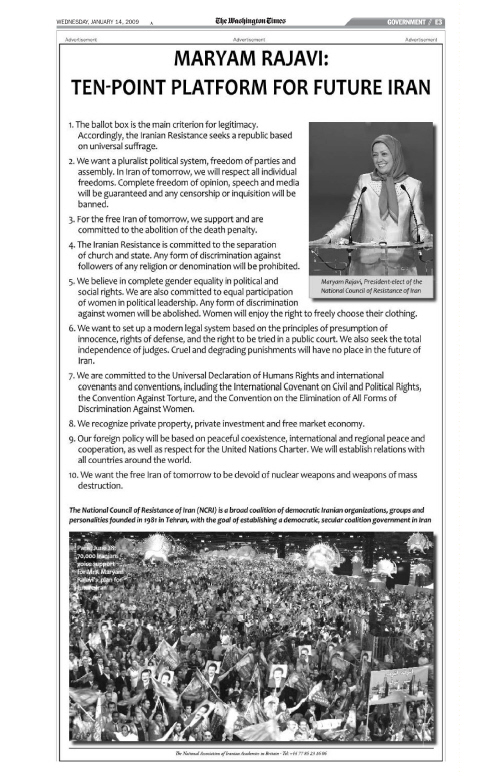
Washington Times, January 14, 2009: 10 Point Plan for Future of Iran


Washington Times, January 14, 2009: 10 Point Plan for Future of Iran

Increasing Pressure on Iranian Opposition in Iraq

PolicyWatch #1394
By Raymond Tanter
August 4, 2008

Throughout summer 2008, Iraqi politicians tied to Tehran have put increasing political pressure on the U.S. government to allow Baghdad to control Camp Ashraf, the base housing Iran’s main opposition — the Mujahedin e Khalq (MEK). Options regarding Iraqi-based MEK members are limited, but include the following: sending them to the United States; allowing them to stay in Iraq under Iraqi control; dispersing them to surrounding countries, including Iran; or maintaining the status quo with the continued protection of the U.S. military. Since each option is problematic, finding a solution is neither easy nor simple.

Escalating Pressure

On July 4, 2008, Iran’s Fars News Agency reported that Abdul Aziz al-Hakim, head of the Supreme Islamic Iraqi Council, called for MEK’s expulsion from Iraq, adding that the group “instigates tribal conflicts, interferes in the internal affairs of Iraq, and creates hostility between the parliament and government of Iraq and the Iraqi electorate.” On July 8, Iraqi government spokesman Abbas Bayati told al-Zaman: “The presence of the Mujahedin Organization in Iraq is illegal. We will ask the United States to put Camp Ashraf, the [MEK’s] bastion, under the control of the Iraqi government.”

On July 9, an English language agency of the Iranian regime, Press TV, reported, “Iraqi foreign minister Hoshyar Zebari has declared the imminent expulsion of members of Mujahedin-e Khalq from Iraq.” And on July 10, Iran’s ambassador to Iraq, Hassan Kezemi-Qomi, told Press TVthat “an Iraqi committee has been formed to expel the . . . [MEK] from the country.”

International Law

International humanitarian law is vital to the MEK issue, especially if the group’s adversaries succeed in their efforts. Coalition forces recognize the residents of Ashraf as “protected persons” under the Fourth Geneva Convention, as does the International Committee of the Red Cross (ICRC). In 2004, the ICRC reiterated its position in a letter stating: “Those persons who are protected under the Fourth Geneva Convention remain protected by the Fourth Geneva Convention.”

And in March 2007, the ICRC reminded relevant authorities “of their obligations to act in accordance with the principle of non-refoulement [a term in international law that concerns the protection of refugees dispersed to countries where they would face persecution] when transferring persons to another state or authority.” This statement is an acknowledgment of the nontransferable status of the protection of Ashraf under the present circumstances.

During the same year, the office of the UN High Commissioner for Refugees (UNHCR) reiterated its position that “bodies of international law, particularly international humanitarian law and human rights law, have positive relevance to the Ashraf situation and could confer protections on individuals who fear serious risks if returned to their country of origin.” As such, UNHCR cautioned Iraqi authorities and the coalition “to refrain from any action that could endanger the life or security of these individuals, such as their forcible deportation from Iraq or their forced displacement inside Iraq.”

In February 2006, Maj. Gen. John D. Gardner, the coalition’s deputy commanding general, reiterated the protected-persons status of the people of Ashraf. He acknowledged coalition responsibilities regarding the Geneva Convention relative to the treatment of civilians, stating, “The coalition remains deeply committed to the security and rights of the protected people of Ashraf and the principle of non-refoulement.”

Problematic Options

Assuming a transfer of MEK members were possible, many questions remain regarding their destination. There are many reasons why it would be difficult for the European and U.S. governments, or Iraq’s Kurdish regional bloc, to accept the MEK en masse to their territories.

Moving the group’s members to the United States, for instance, is currently impossible because of MEK’s status as a foreign terrorist organization. This status could change, however, if the designation is lifted in October 2008 when the Department of State performs a regular review process. This appears to be a viable possibility given recent developments in the United Kingdom, where the British government was forced to remove the group from its terrorist list after an independent judicial commission — one ratified by a British appeals court — determined that such a designation was no longer appropriate.

If Ashraf’s security responsibilities were transferred to Iraqi security forces, as demanded by the Iranian regime, it would be a flagrant violation of international laws and conventions. Since it is widely reported that the Iranian regime has infiltrated Iraqi military and security forces, and wields significant influence within the government, such a move would certainly invite a humanitarian catastrophe. No U.S. president would want to leave such a legacy.

Moreover, dispersing the MEK, in addition to being illegal, is likely to decrease the international community’s leverage over the Iranian regime. Because the regime pays more attention to the opposition in Iraq than all other opposition groups combined, a case could be made to rely on the MEK as leverage to encourage Tehran to give up its quest for nuclear weapons capability.

Conclusion

If MEK members remain in Iraq under the protection of U.S. forces, such an arrangement should be explicit in agreements negotiated between Iraq and the United States. Given that military components of the Iraqi government cannot be trusted to provide security for Ashraf and guarantee protected persons status conferred under the Fourth Geneva Convention, transfer to Iraqi control would risk a humanitarian disaster.

The argument for protecting the human rights of MEK members need not be based on a favorable view of the organization. One need not accept or reject the claim by some that the group provides useful intelligence, or that it is an important means to unsettle Tehran.

It would be especially unfortunate if the treatment of the MEK was harsher because of a desire to secure concessions from Tehran on the nuclear impasse. Not only is it inappropriate to abandon the principles of human rights for concessionary purposes, but such an approach would be counterproductive on the nuclear front. This strategy would show Iran that its nuclear program has won it leverage on unconnected issues — thus reducing Iran’s incentive to abandon its program — and it would destroy what is arguably Tehran’s main opposition.

Raymond Tanter, a visiting professor of government at Georgetown University, is an adjunct scholar at The Washington Institute, researching U.S. policy options toward Iran.

http://www.washingtoninstitute.org/templateC05.php?CID=2919

West should back Iranians

United Press International
February 1, 2008
By BARONESS GOULD OF POTTERNEWTON

LONDON, Feb. 1 (UPI) — Iran under the mullahs is the only country in the world that continues to hang children, and it has an equally sinister track record over its treatment of women.
On Jan. 15, Amnesty International said in a report that nine women and two men in Iran are waiting to be stoned to death, adding that the “horrific practice” was “specifically designed to increase the suffering of the victims.”

“The majority of those sentenced to death by stoning are women. Women suffer disproportionately from such punishment. One reason is that they are not treated equally before the law and courts, in clear violation of international fair trial standards,” Amnesty International said.

Rahele Zamani, 27, was hanged in Evin Prison in Tehran in December. Her 3-year-old son and 5-year-old daughter are now orphans.

At least 113,454 women were detained by state security forces for being “improperly dressed” over the summer in the Iranian capital alone, according to Tehran police chief Ahmad-Reza Radan.

Maltreatment of women is indoctrinated in the regime’s ideology. The mullahs’ Supreme Leader Ali Khamenei said last July, “We are witnessing in our country that some women activists and some men are trying to play with Islamic laws … in order to harmonize them with international conventions related to women. This is wrong. … They shouldn’t see the solution in changing Islamic jurisprudence laws.”

Earlier this month Ibrahim Lotfollahi, a 27-year-old student from Payam Nour University in the western Iranian city of Sanandaj, was tortured to death by agents of the regime’s notorious Ministry of Intelligence and Security. Local authorities tried to pass off the cold-blooded murder as suicide and they refused permission to Lotfollahi’s parents to exhume the corpse of their son who had been buried without their knowledge. The revelations regarding the true surroundings of Lotfollahi’s tragic death came from Iranian opposition activists.

The case serves as a stark reminder of what life can be like for those brave people in Iran who choose to speak their minds and take a stand against the theocratic dictatorship. But, in an unforgivable incongruity, the British government has thus far chosen to side with the mullahs instead of the millions of Iranians longing for change.

For years, our government has been appeasing the regime in exchange for lucrative trade deals in the vain hope of convincing the mullahs to abandon their terrorist tactics abroad. The climax came in 2001, when our Home Secretary Jack Straw accepted the regime’s demand that he ban its main democratic opposition movement, the People’s Mojahedin Organisation of Iran.

Turning a blind eye to the execution of 120,000 PMOI sympathizers by the regime, our government went so far as to persuade the EU to ban the PMOI as well.

When in December 2006, the European Court of Justice annulled the EU’s ban on the PMOI, our government shamefully pressured the EU Council of Ministers to ignore the verdict of Europe’s highest court. But in November 2007, following an appeal by 35 parliamentarians from all aisles, the United Kingdom’s Proscribed Organisations Appeal Commission ruled that the government’s ban on the PMOI was “flawed” and “perverse.” It ordered the new Home Secretary Jacqui Smith to immediately submit an Order to Parliament lifting the ban on the group.

Whereas one could not be blamed for thinking that justice had prevailed, the government has since announced that it would appeal the decision despite losing its application for grounds to appeal.

On Jan. 23, the Parliamentary Assembly of the Council of Europe described POAC’s verdict on the PMOI case as a “slap in the face” for the government and called on the EU/U.K. to “implement immediately the decisions of competent European and national judicial institutions affecting the status of the listed persons or entities.”

It remains unclear what the government’s next step will be. Meanwhile in Tehran, the regime continues to torture and execute political prisoners. When challenged over its brutal practices, it simply responds that it is killing those who the EU/U.K. class as terrorists.

The people of Iran deserve freedom. While military action against Iran is out of the question, we in the United Kingdom should be assisting the Iranian people by exposing the mullahs’ barbaric practices and urging the U.N. Security Council to impose trade sanctions on the regime for its gross violations of human rights. But the first step in getting on the side of the Iranian people is for the government to lift the ban on the PMOI immediately.

(Baroness Gould of Potternewton is a Labor Peer. She has been a deputy speaker of the House of Lords since 2002.)