October 26, 2026

Iranian exiles say Iraq poised to attack Camp Ashraf

Agence France Presse

(BRUSSELS) – Iraqi forces are preparing to attack the Ashraf Camp in Iraq housing thousands of outlawed Iranian dissidents, the leader of an Iranian opposition group, Maryam Rajavi, told AFP on Wednesday.

Maryam Rajavi, President-elect of the National Council of Resistance of Iran

The attack is “imminent”, said Rajavi, who heads the National Council of Resistance of Iran. She warned of a potential “bloodbath” and added she was acting on information received “from within” Iran’s elite Revolutionary Guards.

She said that according to the information, Iraqi forces had finished training for an assault on the camp, home for the past 30 years to 3,400 Iranian dissidents, now facing expulsion by year’s end.

She called on the United Nations to send observers to the camp.

The camp, which has become a mounting international problem, has been in the spotlight since an April raid by Iraqi security left 34 dead and scores injured, triggering sharp condemnation. Iraq wants its closure by December 31.

It was set up when Iraq and Iran were at war in the 1980s by the then Iranian People’s Mujahedeen and later came under US control until January 2009, when US forces transferred security for the camp to Iraq.

The camp’s residents are being assessed individually by the office of the UN High Commissioner for Refugees after applying for refugee status, to allow them to resettle elsewhere, but fears are that the process cannot be completed within the time-frame set by Baghdad.

At a gathering of hundreds of exiles in Brussels on Tuesday, Rajavi urged quick international action “to cancel the suppressive deadline set by the Iraqi government.”

“The US remains morally responsible for the people of Ashraf,” said former Democratic presidential candidate Howard Dean at the Tuesday protest.

“We have 74 days left until the deadline,” he added. “We have 74 days left until all the American troops are withdrawn and there is no protection left.”

http://www.eubusiness.com/news-eu/iraq-iran-us.czh

Iranian-Americans to Obama: “Thank you for foiling the terrorist plot, now stand with Iranian people in their quest for regime change”

PRNewswire

Urging America to get on the “Right Side of History”, Groups Ask Obama to Unshackle Main Democratic Opposition Against the Regime

LOS ANGELES, Oct. 19, 2011 /PRNewswire-iReach/ — Iranian-American communities in the United States are applauding the Obama administration and U.S. law enforcement agencies for their work in foiling the plot hatched by the Iranian regime to assassinate on U.S. soil the Saudi Ambassador to the United States.

Iran Freedom March across the White House, October 22, 2011, 11 AM. Click on the image for the high resolution PDF version.

“This brazen plot to murder the Saudi diplomat and plant bombs in public places in the nation’s capital show the extent to which Iran has undertaken a clandestine war on America’s streets,” said Nasser Sharif, of the Californian Society for a Democratic Iran. “It is clear that no amount of political concessions or economic incentives will seduce the regime into moderating its behavior. The mullahs are getting a message of weakness from the West. It’s time for the U.S. to lead in undermining and removing this hostile regime by untying the hands of the main Iranian opposition.”

Indeed, a range of concessions combined with ineffectual punitive measures such as economic sanctions applied by the west against regime have been met with increased domestic crackdowns in Iran, terrorist meddling in Iraq, the U.S. and elsewhere, and an unabated dash toward nuclear weapons.

“The current policy of ‘engagement’ rests on naïve hope rather than hard experience. The U.S. must expand its range of options in dealing with this irredeemable regime, which now include only ineffectual sanctions to unrealistic military strikes. The litmus test of this policy change is the unshackling of the principal Iranian opposition movement, the Mujahedin-e Khalq (MEK), which was a concession made by the U.S. to the regime 14 long and unproductive years ago.”

The MeK was put on America’s list of “Foreign Terrorist Organizations” (FTO) in 1997. The highest courts in the United Kingdom, the European Union and France have struck down the terrorist designation of the MEK as perverse, resulting in the group’s delisting in the UK and the EU in 2008 and 2009 respectively. The Federal Court of Appeals in Washington, DC, rendered a judgment in July 2010, telling the State Department that it had erred in maintaining MEK’s designation. Some 450 days after the court remanded the case to the Secretary, the Department is yet to make a decision, flouting the rule of law in the process.

“The MeK is a key player to topple the regime and ensure a democratic, non-nuclear future in Iran.  The FTO designation has acted as a license to kill members and sympathizers of the MEK in Iran and Iraq. Several have been hanged by the Iranian regime; the government of Nuri al-Maliki has attacked its members in Camp Ashraf in Iraq twice, killing 47 and wounding more than 1,000 residents,” added Mr. Sharif,

The communities, which represent thousands of Iranians from Alabama, Arizona, Arkansas, California, Colorado, Connecticut, Florida, Georgia, Illinois, Indiana, Kansas, Kentucky, Louisiana, Massachusetts, Maryland, Michigan, Minnesota, Missouri, Nebraska, Nevada, New Jersey, New Mexico, New York, North Carolina, Ohio, Oklahoma, Oregon, Pennsylvania, South Carolina, Tennessee, Texas, Utah, Virginia, Washington, and Wisconsin, will hold a major rally outside the White House on Saturday, October 22, to urge the administration to abandon the policy of engagement and embrace regime change by Iranians in dealing with the theocracy ruling Iran.

Media Contact: Nasser Sharif California Society for Democracy in Iran, 562 221 8000, california.csdi@yahoo.com

News distributed by PR Newswire iReach: https://ireach.prnewswire.com

 SOURCE California Society for Democracy in Iran

Iranian exiles urge delay of Iraqi Camp Ashraf closure

AGENCE FRANCE PRESSE

BRUSSELS — Iranian dissidents, backed by Belgian, European and US politicians, Tuesday urged the international community to press Iraq to postpone the closure of a camp housing thousands of outlawed Iranians.

“The US remains morally responsible for the people of Ashraf,” said former Democratic presidential candidate Howard Dean, referring to Camp Ashraf, home for the past 30 years to 3,400 Iranian dissidents, now facing expulsion by year’s end.

“We have 74 days left until the deadline,” he told a gathering of hundreds in Brussels. “We have 74 days left until all the American troops are withdrawn and there is no protection left.”
The camp, which has become a mounting international problem, has been in the spotlight since an April raid by Iraqi security left 34 dead and scores injured, triggering sharp condemnation. Iraq wants its closure by December 31.

It was set up when Iraq and Iran were at war in the 1980s by the then Iranian People’s Mujahedeen and later came under US control until January 2009, when US forces transferred security for the camp to Iraq.

The camp’s residents are being assessed individually by the UN High Commissioner for Refugees after applying for refugee status, to allow them to resettle elsewhere, but fears are that the process cannot be completed within the time-frame set by Baghdad.

Maryam Rajavi, who heads the National Council of Resistance of Iran, urged quick international action “to cancel the suppressive deadline set by the Iraqi government”.

Last month, EU foreign policy chief Catherine Ashton appointed an advisor to help resolve the issue and the head of a European parliament group on Iraq, MEP Struan Stevenson, said “Ambassador De Ruyt should visit Ashraf as soon as possible”.

http://www.google.com/hostednews/afp/article/ALeqM5iCyMRHQf6W8oirE-6I9IKzx5tkag

USCCAR Demands US and UN Intervention as Iraq Sabotages Efforts to Resolve Camp Ashraf Humanitarian Crisis

PRNewswire

WASHINGTON, Oct. 18, 2011 /PRNewswire-USNewswire/ — The US Committee for Camp Ashraf Residents (USCCAR) deplores Iraqi government’s nefarious actions which pave the way for another massacre at Camp Ashraf through sabotaging the efforts of the United Nations High Commissioner for Refugees (UNHCR), which seeks to ensure the safe and secure resettlement of the residents of Camp Ashraf in third countries.

Families and friends of Cam Ashraf residents in Washington, DC, call for immediate intervention of the United Sates following the April 8, 2011 massacre at the camp by the Iraqi forces.

USCCAR calls on President Obama to intervene immediately and compel the Iraqi Prime Minister Nuri al-Maliki to end the barbaric siege of Camp Ashraf and cooperate with the UNHCR.

Similarly, USCCAR calls on the UN Secretary General Ban Ki-moon to declare null and void the December 2011 deadline set by Maliki to close down Camp Ashraf. The arbitrary deadline serves as a prelude to another deadly assault on Camp Ashraf.

Maliki’s goal is to carry out an all-out crackdown at the camp before the year’s end by creating a deadlock through impeding UNHCR’s efforts and ensuring that the residents have no other place to go.  The planned assault entails the occupation of another part of Ashraf.

Last month, UNHCR announced it had officially recognized the residents as “asylum seekers” and that it intended to interview each applicant as the first step to determine their refugee status. It called on the Iraqi government to extend the December 2011 deadline so that the interview process could be completed in accordance with UNHCR standards.

Alarming information, however, indicates that the Maliki’s government, in collusion with the Iranian regime, is working to obstruct the UNHCR’s humanitarian efforts. Instructed by Qassem Soleimani, Iran’s notorious Quds Force commander, and Hassan Danaifar, Tehran’s ambassador to Iraq, Maliki has refused to grant the extension demanded by UNHCR. It has also brazenly and publicly rebuffed all attempts by the European Union’s Special Envoy on Ashraf, Jean de Ruyt, to travel to Iraq and visit Camp Ashraf.

With the arbitrary deadline looming, President Obama and Secretary Ban Ki-moon must publicly call on Maliki to extend the December 31 deadline in order to allow UNHCR to complete its task.

Camp Ashraf is home to 3,400 unarmed members of the main Iranian opposition movement, the Mujahedin-e Khalq (PMOI/MEK) and their families who were recognized by the United States as “Protected Persons” under the Fourth Geneva Convention in 2004.

 SOURCE US Committee for Camp Ashraf Residents (USCCAR)

http://www.prnewswire.com/news-releases/usccar-demands-us-and-un-intervention-as-iraq-sabotages-efforts-to-resolve-camp-ashraf-humanitarian-crisis-132068668.html

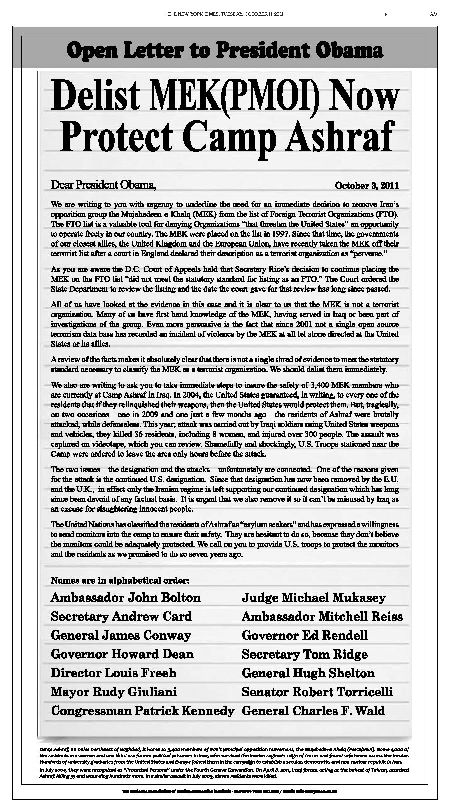
New York Times: Delist MEK (PMOI) Now, Protect Camp Ashraf

(Click on the image for the PDF version of the letter)
 

NEW YORK TIMES: 14 Senior US National Security and Policy figures write an open letter to President Obama to Delist MEK (PMOI) and Protect Camp Ashraf

Taking Iranian Opposition Group Off U.S. Terror List

THE NEW YORK TIMES

It is a valid observation that a majority of Iraqis, including Shiites, hate the Iranian regime (“Vacuum Is Feared as U.S. Quits Iraq, but Iran’s Deep Influence May Not Fill It,” news article, Oct. 9). Yet Tehran, worried about the consequences of the Arab Spring and faced with a growing domestic crisis and isolation, still seeks to manipulate Iraq by controlling its security apparatus and supporting paramilitary groups.

Under the circumstances, the regime and the pro-engagement crowd are paranoid over the likelihood of the removal of the principal Iranian opposition movement, the Mujahedeen Khalq, or MEK, from the State Department’s Foreign Terrorist Organizations list.

In July 2010, the United States Court of Appeals for the District of Columbia ruled that there was no legal basis for the designation. And a bipartisan Congressional initiative and a growing roster of former senior political, military, and national security officials have urged delisting of the MEK. In a demonstration in August in front of the State Department, thousands of Iranians echoed the Iranian people’s disdain for the designation. The European Union and Britain delisted MEK in 2009 and 2008.

“An Iranian Cult and Its American Friends,” by Elizabeth Rubin (Sunday Review, Aug. 14), repeated discredited allegations against the MEK in urging maintenance of the designation, which senior American officials acknowledged had been a good-will gesture to Tehran in 1997.

Scores of independent reports, including those by several delegations of the European Parliament, the Iran Policy Committee in Washington and Dick Armey, the former majority leader of the House of Representatives, clearly show that these allegations, particularly those implicating MEK in suppressing Iraqi Kurds in 1991, are unfounded.

Despite repeated denials by the Iranian resistance, the Op-Ed writer claimed that the Iranian resistance’s president-elect, Maryam Rajavi, ordered crushing the Kurds under tanks. This is another desperate attempt to discredit the person who is a point of hope for Iranians seeking freedom, and a major part of Tehran’s demonizing campaign against the MEK.

Hoshyar Zebari, foreign minister of Iraq, stipulated in an affidavit in 1999, when he was the head of international affairs for Iraq’s Kurdistan Democratic Party, that MEK had no role in suppressing Iraqi Kurds.

SHAHIN GOBADI
Paris, Oct. 10, 2011

The writer is spokesman for the National Council of Resistance of Iran, which includes the MEK.

http://www.nytimes.com/2011/10/11/opinion/taking-iranian-opposition-group-off-us-terrorist-list.html

Why Tehran Cannot Stop Nuclear Enrichment

 OfficialWire.com

Iran has posed the most serious nuclear challenge to the international community, and experts believe that it is only steps away from getting the nuclear weapons capability. Yet, international efforts have to date failed to stop the mullahs and evidence shows that they are carrying out secret work to further enrich uranium.

It is also too clear that Tehran does not need nuclear energy. Iran is the second-largest crude producer in the Organization of Petroleum Exporting Countries (OPEC) after Saudi Arabia. The country’s Deputy Oil Minister Ahmad Qalebani said that Iran’s oil reserves has reached 155 billion barrels following the recent discovery of new onshore oil and gas fields in southern and western Iran with reserves of 500,000 million oil barrels and five trillion cubic feet gas respectively.

Sounding worried about Iran’s nuclear activities, this is what the former deputy director of the International Atomic Energy Agency in Vienna, Olli Heinonen, said in an interview with Spiegel on October 6th, explaining how he felt they were tricked and misled:

“It’s undeniable that Iran’s nuclear program is far more advanced than it was in 2003, when the discovery of the Natanz facility brought it to the IAEA’s attention. At the time, uranium enrichment tests were being carried out in secret on a small scale. But at the end of 2003, the Iranians admitted they were also planning to set up a heavy-water reactor in Arak to generate plutonium.

Today the facts are as follows: The conversion plant in Isfahan has produced 371 tons of uranium hexafluoride. Some 8,000 centrifuges in Natanz are being used to enrich this raw material. In February 2010, Iran began increasing enrichment to 20 percent. That’s a significant step closer to making an atomic bomb because it takes only a few months to turn that into weapons-grade material.”

 In september, the  head of the United Nations nuclear agency announced plans to publish new information backing up his belief that Iran may be working on a nuclear warhead—developments that leaves his organization “increasingly concerned.” 

There are two important questions that need to be answered:

One. Why does Tehran not accept to stop nuclear enrichment?

Two. Does Iran have an Achilles’ heel to force it stop its drive to become a nuclear power?          

To answer the above questions, we need to look inside Iran.

First: The mullahs are facing a very young population (more than 70% below 30 years of age), who are almost entirely against the regime. The protests in the Iranian streets two years ago, showed the threat facing Tehran. The demonstrations have to date been stopped by brutal crackdown and wide spread torture of those arrested in the prisons, but the wind of changes in the Arab world is certainly not blowing against the regime in Iran.

The mullahs utterly need a way out. Capability to produce nuclear weapons is being seen as a solution to create crisis and survive. Tehran is too weak and is surrounded by too many problems to be able to negotiate stopping nuclear enrichment, no matter how many carrots it is offered.

Second: Tehran has a very hurt able Achilles’ heel that it has to be attentive of. The weakness, which is well recognized by the mullahs themselves, is their main opposition group, the MEK.

Shackling the MEK is a must for the mullahs as they feel the threat facing them inside country and they experienced it two years ago on the streets of the capital. The opposition must be kept under maximum pressure no matter what and that is the reason why the mullahs lobbies in Europe and the US, have clear-cut outlines to work with. The MEK was put in the FTO list in 1997 when the Clinton administration, keen on placating Tehran’s regime through various “goodwill gestures,” designated the group as a terrorist organization. Since then, the MEK has won every legal challenge it filed, whether in the United States, the United Kingdom, France or the European Union. Eight European courts have reviewed thousands of pages of classified and unclassified materials and have concluded that the MEK is simply not involved in terrorism.

The correct policy towards the mullahs in Iran is to recognize their Achilles’ heel. Tehran’s threat is too real but it does not need to be stopped by a war. The impasse can be opened by unshackling the mullahs’ opposition and delisting the MEK before it is too late.

Kambiz Assai is a scholar of Iranian politics living in exile in Britain and a former political prisoner of the religious dictatorship in Iran. He writes about Iranian current events and human rights issues extensively and dreams of returning to a free and democratic Iran.

EU names adviser to help resolve Camp Ashraf issue

REUTERS

BRUSSELS – The European Union has named a senior Belgian diplomat to work with the United Nations, Iraq and others to help resolve the plight of more than 3,000 opponents of the Iranian government living at a camp in Iraq.

Jean De Ruyt, a former Belgian ambassador to the EU, will act as an adviser to EU foreign policy chief Catherine Ashton on Camp Ashraf, a spokesman for Ashton said on Monday.

The camp, some 65 km (40 miles) from Baghdad, is the base of the People’s Mujahideen Organisation of Iran (PMOI), which mounted attacks on Iran before the U.S.-led removal of Iraqi leader Saddam Hussein in 2003.

The future of its more than 3,000 residents became uncertain after the United States, which considers the PMOI a terrorist organisation, turned the camp over to the Iraqi government.

Baghdad plans to close it before the end of this year and Ashraf has been the scene of bloody clashes between residents and the Iraqi security forces.

The rights group Amnesty International says the residents are subject to harassment by the Iraqi government and denied access to basic medicine. More than 30 residents were killed in a clash with Iraqi security forces in April.

De Ruyt will liaise with EU states and organisations including the United Nations, Ashton’s spokesman said.

He said the European Union, which removed the PMOI from its terrorism list in 2009, wanted a high-level diplomatic approach.

“We need a peaceful and realistic solution and the security and safety of residents is the priority,” he said.

Washington has proposed moving Ashraf residents temporarily to a new location in Iraq but they have rejected this, saying it would lead to a massacre.

Struan Stevenson, head of the European Parliament delegation on Iraq, called De Ruyt’s appointment an “apparent breakthrough.”

“The unarmed, civilian residents of Camp Ashraf have suffered years of psychological torture and harassment at the hands of the Iraqi government, aided and abetted by their sponsors in Tehran,” he said in a statement.

“The appointment of Ambassador De Ruyt … has underlined the seriousness of this issue. I look forward to working with him to ensure that we can avoid a Srebrenica-style catastrophe occurring at Ashraf,” he said, referring to the 1996 massacre of Muslims by Bosnian Serb forces in the former Yugoslavia.

Stevenson said the United Nations was assessing the 3,400 residents for refugee status and the intention was to resettle them in EU states and third countries, but this process could not be completed by year-end. He called the Iraqi deadline to close the camp “ludicrous.”

http://uk.reuters.com/article/2011/09/26/uk-iraq-ashraf-eu-idUKTRE78P24820110926

EU joins bid to help end Iraqi Camp Ashraf standoff

AGENCE FRANCE PRESSE

EU foreign policy chief Catherine Ashton has appointed an advisor to mull over the fate of thousands of outlawed Iranians facing expulsion from a camp in Iraq, their home for 30 years.

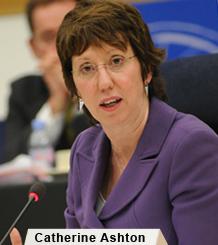
Catherine Ashton, EU foreign policy chief

A spokesman for Ashton said Monday that Jean De Ruyt, Belgium’s former ambassador to the EU, will act in Brussels “as an advisor on the European Union’s response” to Camp Ashraf, located near the border with Iran and home to some 3,400 Iranian dissidents.

The camp, which has become a mounting international problem, has been in the spotlight since an April raid by Iraqi security left 34 dead and scores injured, triggering sharp condemnation. Iraq wants its closure by year’s end.

It was set up when Iraq and Iran were at war in the 1980s by the then Iranian People’s Mujahedeen and later came under US control until January 2009, when US forces transferred security for the camp to Iraq.

Maryam Rajavi, head of the dissidents, the National Council of Resistance of Iran, on Monday called for the new nominee to visit Ashraf and to demand Iraq drop its bid to close the camp by the end of 2011.

And in a statement, the head of a European parliament group on Iraq, MEP Struan Stevenson, said “Ambassador De Ruyt should visit Ashraf as soon as possible.”

Stevenson said the camp’s residents were being assessed individually by the UN High Commissioner for Refugees after applying for refugee status, which would allow them to resettle elsewhere.

“This major operation cannot be completed within the timescale set by Prime Minister Nouri Al-Maliki,” he added, referring to the December 31 deadline for closure.


What Ahmadinejad Didn’t Say

THE HUFFINGTON POST

Once again, Iranian president Mahmoud Ahmadinejad has used the United Nations podium to churn out his misinformation and half-truths. And once again, the American media accepted his invitation for a fancy luncheon afterwards, enabling a ruthless murderer to wage his not-so-charm offensive. Apparently, some media outlets just want Ahmadinejad to say something, anything, as long as they get their story.

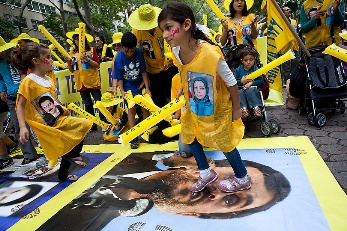
Children at an anti-Ahmadinejad rally outside the UN headquarters stomp on a poster of the controversial Iranian president before he is scheduled to speak at the UN General Assembly, Thursday, Sept. 22, 2011, in the Manhattan borough of New York. A few hundred demonstrators turned out to hear former Homeland Security Secretary Tom Ridge and former UN Ambassador John Bolton speak. (AP Photo/John Minchillo)

Has no one learned anything from the free passes provided to Ahmadinejad’s allies, such as Moammar Qaddafi of Libya and Bashar Assad of Syria?

Ahmadinejad allocated almost the entirety of his speech to just about anything unrelated to the clerical rulers of Iran. He talked about flooding in Pakistan, famine in Somalia, how a large percentage of the world’s population earns so little, and how a small percentage of the world’s population has so much. Sounds pretty good, doesn’t it?

Next he took on an authoritative posture, portraying himself as an engineer who knows that the two planes that hit the Twin Towers could not have brought those buildings down. (Huh!) Of course, one might wonder when he practiced his sophisticated engineering skills, in that he has spent pretty much all of his adult life first as a chief thug, organizing hooligans to attack and beat up students in the early days after the revolution, then as a notorious torturer in Evin prison, and later as a commander of the terrorist Qods Force during the Iran-Iraq war.

But what is more important is what Ahmadinejad did not address. He addressed numerous problems around the world, held America responsible for much of the world’s misery, but did not talk about the Arab Spring; no mention of Libya, Syria, Egypt, Tunisia, Bahrain, or Yemen.

He attacked world powers for intervening in other countries’ affairs, but stayed off the topic of his Revolutionary Guards’ helping Bashar Assad to violently suppress the revolt in Syria; and avoided details of how his regime used violence, bribery, intimidation, and blackmail to put Iraq’s defeated Prime Minister Nuri al-Maliki back in office and deny the winning candidate, Ayad Allawi, a substantive role in the political process in Iraq.

Nor did he mention his use of proxies in the Iraqi Government to kill dozens of Iranian dissidents and former political prisoners who had taken refuge across the border in Camp Ashraf, Iraq in 2009 and 2011. No wonder that while most of the delegations left the General Assembly Hall when Ahmadinejad started speaking, the Iraqi delegation remained, cheering him on.

Ahmadinejad expressed concern about three billion people in the world not earning enough to live, but failed to mention the fact that as many as 80 percent of the Iranian population live below the poverty line; the official figures put it at 55 percent. He attacked the West for making exorbitant profits, but said nothing about his own closest allies in Iran, the ruling clerics and their cronies, who are plundering billions of dollars, dominating the nation’s industry, and running or taking a cut from all business in the country.

And lastly, he said nothing about the rising rate of executions in Iran, this year’s numbers close to 490 so far, higher even than last year. Since he spoke at the last General Assembly session, his State Security Forces and the Iranian Judiciary have sentenced to death or already executed more Iranian dissidents whose only crime was peaceful participation in the anti-government demonstrations in Iran.

But let’s not be picky about the facts. Especially since again this year, prominent American media were invited to a fancy lunch after his ranting at the UN, for a taste of more of his rhetoric. The attendees are expected to throw him soft balls, and some went so far as to praise Ahmadinejad for being impressive, “well-prepared,” and speaking “confidently.”

But while Ahmadinejad spoke inside the UN, and hosted some journalists, the story outside was very different. He may be able to suppress the voices of dissent in Iran, escalate violence in Iraq, help Assad quash dissent in Syria, and defy international demands to desist enriching uranium, but in New York he was confronted by thousands of Iranian-Americans, who called him a murderer and insisted that he is not representative of the Iranian people.

That should have grabbed the headlines.

Alireza Jafarzadeh is author of ‘The Iran Threat’.

http://www.huffingtonpost.com/alireza-jafarzadeh/ahmadinejad-un-speech_b_978812.html