October 26, 2026

Who’s afraid of the Iranian opposition?

THE AMERICAN THINKER

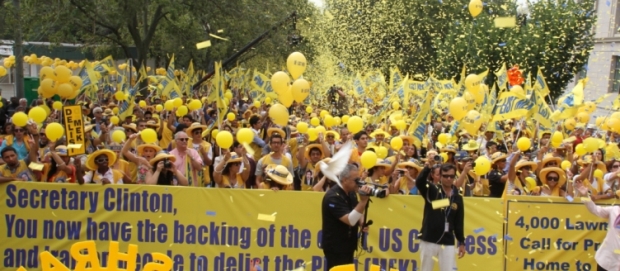
Iranian American demonstrators protest during a rally in front of the US Department of State on August 26, 2011 in Washington, DC. The group was demanding the removal of the People's Mojahedin Organization of Iran from the list of terrorist organizations by the State Deptartment. (Photo credit should read PAUL J. RICHARDS/AFP/Getty Images)

The West has spent more than thirty years looking for incentives for compromise with the Islamist regime in Iran.  After the takeover of the alleged reformer Khatami in 1997, things looked brighter than ever before.  In what U.S. diplomat Martin Indyk described as a “goodwill gesture,” the Clinton administration put the Iranian opposition group the Mullahs fear most — the “Peoples Mujahedin Organization of Iran” (MEK) — on their list of “Foreign Terrorist Organizations.”

The European Union followed suit with a similar decision in 2001, but had to remove the MEK of their list of terrorist organizations in 2009.  The many accusations that have been brought forward against the MEK could not bear examination.  Several verdicts of the British and the European Courts of Justice considered the listing as a violation of the rule of law.

Only the U.S. government keeps the MEK on its terrorist list, despite the obvious failure of the engagement policy with the Iranian regime.  Now a revision of the decision to keep the MEK on the list or remove it is expected in the near future.

The MEK was founded in 1965 as a group based on a leftist-Islamic ideology, fighting the rule of the emperor Mohammad Reza Shah.  In 1979 they supported the Islamic Revolution, but their refusal of Khomeini’s totalitarian principle of the guardianship of the Islamic jurists led to the rupture with the new regime.  Thousands of MEK members have been killed by the tyrants of Tehran since then.  In 1981 the MEK took up arms against the Islamic Republic; their leaders fled to Paris.  After their expulsion from France they accepted the invitation of Saddam Hussein to build their headquarters in Iraq, called Camp Ashraf.  When Saddam Hussein was overthrown in 2003, the MEK surrendered its arms to the U.S. Army and their members were closely monitored by American military personnel.  The U.S. finally granted the Ashraf inhabitants the status of protected persons under the Fourth Geneva Convention based on the United States investigators’ conclusions that none of them had committed a crime under any United States laws.

For the mullah regime, the terrorist designation of the MEK has been a priceless tool against the whole Iranian opposition.  Anyone who speaks up for the end of the religious dictatorship in Iran can be easily labeled as terrorist by the regime and its apologists regardless of his ideological background.  Executions of dissenters in Iran have been justified with an alleged MEK membership of the victims.  The regime countered Western protest by the claim that it just killed people who are seen as terrorists even by the American government.

The same argument is used by Tehran’s ally in Iraq, president Nouri al-Maliki.  His soldiers have murdered dozens of Iranian expats in two attacks on Camp Ashraf in 2009 and 2011, which enraged Iranians regardless of their attitude towards the MEK.  The justification for this slaughter against unarmed members of the MEK has also been a supposed fight against terrorism.  Maliki’s government has announced to erase Camp Ashraf until the end of the year — a clear menace to the lives of its 3,400 inhabitants.

U.S. public debate on this topic is divided.  On one side of the issue are politicians like John Bolton, Rudolph Giuliani, and Patrick Kennedy, who advocate for an end of the Islamic dictatorship and support regime change in Iran.  They spoke out for a de-listing of the MEK as a signal of support to the Iranian people and a clear sign of an end to the engagement policy towards the Islamic Republic.

At a conference in France, Elie Wiesel, political scientist and Holocaust survivor, expressed his solidarity with the residents of Ashraf.  He condemned the silence of the Western media about the atrocities committed in Iraq on orders of Khamenei, which appalled him.  Prince Reza Pahlavi, the son of the Shah of Persia and surely the most important competitor of the MEK under exiled Iranians, also voiced protest against the killing of Iranian refugees in Ashraf by Iraqi forces.

On the other hand, there is a campaign to keep the MEK on the list headed by Trita Parsi, leader of the “National Iranian American Council,” the “Iranian lobby in Washington” according to Iranian regime media.  But also political scientists like Michael Rubin and Kenneth R. Timmerman spoke out against the de-listing of the MEK, claiming that it is an anti-American, anti-Zionist, “Islamo-Marxist” organization.  Beyond the question of whether this would be enough to label an organization as “terrorist,” this argument ignores the fact that the MEK has provided invaluable information about the Iranian nuclear program obtained under mortal danger to the American authorities and therefore proved to cooperate in a pragmatic way with Western powers.  The organization also refrains from the sort of anti-Israeli propaganda that Islamist reformists and old-school leftists still engage in.

The hope that negotiations with the Iranian Islamists could help to stop the mullahs’ atomic program or their support for international terrorism has proven to be futile.  The leaders of the Islamic Republic have been frank about their terrorist intentions from the beginning, and they do not hide their fears, either: a possible de-listing of the MEK is one of their main concerns.

The question of the de-listing of the MEK is not only and not mainly a question about the future of the organization itself.  It goes far beyond and points to two possible scenarios:

An ongoing demonization of the MEK will be understood as a signal of support for the Iranian regime — a green light for more brutal crimes against humanity in- and outside Iran.  This will discourage the Iranian opposition and strengthen the regime, helping the mullahs to become nuclear, with all the catastrophic consequences of that development.

A de-listing of the MEK would lift the taboo surrounding this group and provide the opportunity for a free debate in the West about the political strategies and goals of the Iranian opposition.  In Iran, the mullahs dictate the rules of engagement and the suppression of the protests of 2009 highlighted that the will for freedom is not enough to end the dictatorship in Iran.  As during the fight against Nazism in Europe, a well-organized and determined coalition will be necessary to bring down the clerical regime.  The de-listing of the MEK would be a clear signal of solid support for democracy in Iran.

The writers are founding members of the German chapter of the European coalition Stop the Bomb.

http://www.americanthinker.com/2011/09/whos_afraid_of_the_iranian_opposition.html

Misguided policy and bias on MEK

UNITED PRESS INTERNATIONAL

WASHINGTON, Sept. 16 (UPI) — On Aug. 26, hundreds of students and faculty from various universities in the United States, Canada and Europe joined Iranian-Americans in front of the U.S. State Department in Washington to call on Secretary of State Hillary Clinton to remove Iran’s major opposition group, the People’s Mujahedin of Iran, from the department’s list of Foreign Terrorist Organizations.

The PMOI is also known as the Mujahedin-e-Khalq.

State Department Rally to Demand MEK Delisting

WASHINGTON - A huge crowd of Iranian American demonstrators protest during a rally in front of the US Department of State on August 26, 2011 in Washington, DC. The group was demanding the removal of the People's Mojahedin Organization of Iran from the list of terrorist organizations by the State Deptartment. (PAUL J. RICHARDS/AFP/Getty Images)

Participating students led the protesters with a banner that read, “Secretary Clinton, you now have the backing of the court, the U.S. Congress and the Iranian people to delist the MEK.”

Why does the MEK continue to draw support from universities and why the Western academia has done little to study the group, its influence on the political landscape of Iran and even the region?

Founded in the 1960s by university students, MEK opposed the shah’s rule in Iran and sought a democratic republic. From the outset, universities were the first place where most Iranians, especially women, were introduced to the MEK.

Massoud Rajavi, the sole surviving member of MEK’s original leadership, had the most popular lectures on major political issues of the day and his philosophical discourse on the origins of life and the epistemological awareness that he raised on university campuses in the early months of the 1979 revolution.

The MEK’s political platform and ideological standing as a distinctly nationalist group with a modern, progressive and profoundly anti-fundamentalist interpretation of Islam drew students and faculty en masse to the group.

By 1980, chancellors, deans and faculty of major Iranian universities declared their support for Rajavi’s platform on individual liberties, equality, pluralism and ethnic and religious freedoms.

Ayatollah Ruhollah Khomeini, threatened by the growing influence and popularity of the MEK among academia, declared the “cultural revolution” and closed universities for three years (1980-83). Campuses across the nation witnessed a brutal crackdown.

Violence ensued with thousands of students and faculty purged and executed in Khomeini’s drive to “cleanse” higher education from “anti-revolutionary influences.”

MEK’s anti-theocracy campaign has since expanded and transformed to a relentless struggle underground and in exile, making the group Tehran’s political, social and ideological arch-foe.

This has come at a heavy price. At home, tens of thousands of MEK members and sympathizers have been executed as “mohareb” — enemies of God. Tehran’s strategy to uproot the group has relied on a combination of physical intimidation and political assassinations.

Many outspoken opposition activists, including Rajavi’s brother, Professor Kazem Rajavi, have been killed by Tehran’s terror squads. Kazem Rajavi, 56, who held six doctorate degrees in the fields of law, political science and sociology from European universities, was gunned down in Switzerland by Iranian agents in 1990.

Tehran’s sustained and sophisticated campaign to demonize and discredit the MEK as a legitimate alternative to the rule of clerics has served as the other pillar of its strategy to defeat the group. It relies heavily on a plethora of lies and fabrications about the past and present of the MEK and its leadership.

According to court testimony of former agents of Iran’s Ministry of Intelligence and Security, the anti-MEK campaign has been, and still is, run from the MOIS headquarters in Tehran and then propagated through a web of agents who frequently pose as opposition activists abroad and through what Tehran considers its “assets” in Western media and academic outlets.

One significant consequence of this campaign is the bias that has been instilled among Western academics, scholars and even some non-governmental organizations who have chosen to accept the dominant paradigm in Iran without questions.

In spite of four decades of history involving students, faculty and scholars inside Iran, MEK remains understudied and continues to be misrepresented outside of Iran. The U.S. FTO designation of the MEK, and the legal consequences the label caries, has created an environment that isn’t conducive to seeing MEK as a legitimate political organization.

The MEK’s FTO designation dates to 1997 when the Clinton administration, keen on placating Tehran’s regime through various “goodwill gestures,” designated the MEK as a terrorist organization. Since then, the MEK has won every legal challenge it filed, whether in the United States, the United Kingdom, France or the European Union.

Eight European courts have reviewed thousands of pages of classified and unclassified materials and have concluded that the MEK is simply not involved in terrorism.

With the start of the new academic year, in a joint letter, Iranian and U.S. scholars from several prominent academic institutions in the United States are urging Secretary Clinton to remove the MEK from the State Department’s FTO list, citing Tehran’s use of the terror tag for executions at home, the bipartisan congressional resolution for delisting (H.R. 60) and the July 2010 U.S. Federal Court of Appeals’ ruling as grounds for de-listing.

Kazem Kazerounian, one of signatories from University of Connecticut, says: “Given the tens of thousands of university student supporters of MEK and thousands of faculty supporters executed by the Iranian regime, for their thoughts and not their acts, the issue of MEK is an issue that concerns academicians everywhere.

“Terror tagging MEK, tying their hands and having them defenseless and vulnerable against the atrocities of the ayatollahs — because it is a convenient policy against Tehran — will not be acceptable to us.”

Director of the graduate program in Negotiation and Conflict Management in the School of Public and International Affairs at the University of Baltimore, Ivan Sascha Sheehan, another signatory to the letter, says: “The latest State Department report on MEK further confirms the group’s ineligibility for FTO listing based on statutory language used to label terrorist organizations under U.S. law. MEK’s continued presence on the FTO list is a political setback and undermines a valuable non-military option for supporting indigenous democratic change in Iran.”

Through significant support from the finest minds and talents Iran has ever produced, with more than three generations of experience from different periods of Iranian political history, the MEK needs to be researched and studied free of politics and bias. That begins with their removal from the FTO list.

(Ramesh Sepehrrad is a scholar practitioner from School of Conflict Analysis and Resolution at George Mason University. She has focused her research and field work on Iranian affairs as it relates to human rights, gender equality and U.S. policy on Iran for more than two decades.)
Read more: http://www.upi.com/Top_News/Analysis/Outside-View/2011/09/16/Outside-View-Misguided-policy-and-bias-on-MEK/UPI-11101316171100/#ixzz1YAXXd5vt

MeK, Iran and the War for Washington

THE NATIONAL INTEREST

There is an escalating war for influence over U.S. policy toward Iran: It is a dispute among university scholars, think-tank analysts and former American officials. Reverberations of this war are not confined to the Washington beltway but have profound significance for the Middle East. As Arab republics like Egypt and Tunisia fall from popular protests, internally inspired regime-change scenarios abound. While largely peaceful protests brought down regimes in Cairo and Tunis, state suppression resulted in violent pushback in Libya, Syria and Yemen.

Secretary of State Hillat Clinton. Image by Harald Dettenborn

Although Arab republics are the immediate targets of their populations, Arab kingdoms like Bahrain, and to a much lesser degree Jordan and Saudi Arabia, are feeling the heat of popular unrest. Because there is generally a lack of consensus on how to transfer power in Arab republics, they are less stable than kingdoms. “The king is dead; long live the (new) king,” does not easily translate into “The president of the republic is dead; long live his son.”

Just as conflicts over succession occur among the Arab republics, so a succession crisis is likely to arise in the Islamic Republic of Iran. We should use the lens of such a conflict in Iran when viewing the war in Washington about an Iranian dissident organization—the Mujahedeen-e-Khalq (MeK). Saddam Hussein’s takedown by foreign militaries highlights the need for a homegrown antidote to Iranian rulers because external regime change is off the table in the aftermath of the Iraq War.

Secretary of state Hillary Rodham Clinton is poised to announce the MeK designation in fall 2011, a decision long overdue. Nothing is likely to be more decisive in reducing the strategic threat from Tehran than having a vigorous democratic opposition in Iran; it is critical to have a coalition of prodemocracy dissidents working together to weaken the regime from within and replace it; the MeK can play an enhanced role in the prodemocracy movement if it is removed from the State Department terrorist list. But above and beyond the potential international benefit of facilitating internal regime change for Iran, the MeK simply deserves to be delisted on the basis of facts and law alone.

A search of U.S. government and private electronic and media sources by scholars in the Iran Policy Committee reveals an absence of evidence to support the inference that the MeK engages in terrorist activities or terrorism or has the capability and intent to do so. The databases are: the U.S. Worldwide Incident Tracking System; Department of Homeland Security-sponsored Global Terrorism Database; and U.S. government-supported RAND Database of Worldwide Terrorism Incidents. In these major databases, there are no confirmed associations of the MeK with any military action after 2001.

Given the absence of unclassified evidence of MeK involvement in terrorist activities during the course of nine years (2001-2010), any countervailing evidence in the classified record should be viewed with skepticism and subject to scrutiny for credibility. An assumption here is that terrorist incidents are too public not to appear in databases or in newspapers of record.

On 4 December 2008, the Court of First Instance of the European Communities issued a judgment annulling the MeK designation, and the European Union cleared the MeK of terrorist conduct in January 2009. The United Kingdom removed the group from its list of proscribed organizations in June 2008. In addition, the French judiciary dismissed all terrorism and terrorism-financing charges against the group in May 2011.

Two issues before the American court have been whether the State Department provided due process of law to the MeK and credibility of evidence in support of allegations against it. In a July 2010 ruling regarding a MeK appeal of its continued designation in January 2009, the U.S. Court of Appeals for the DC circuit faulted the decisionmaking process of the secretary of state.

The court questioned the credibility, sources and legal relevance of evidence in the Secretary’s January 2009 decision to maintain the designation and ordered the State Department to give the MeK an occasion to rebut some of the declassified material used in the re-designation. On 20 May 2011, the department released ten documents. Five were unclassified, mostly wire service reports from the Associated Press, Radio Farda and Azeri Press Agency. They concern allegations, such as MeK’s “cult-like” behavior and supposed lack of popular support within Iran. Such false, nonlegal allegations are no grounds on which to base a terrorist tag.

For the MeK to be re-designated absent any terrorist activity or terrorism, the State Department has to demonstrate that the group has both the capability and the intent to engage in terrorist activity or terrorism and that it either threatens U.S. national security or the security of American citizens.

In the Department of State Country Reports on Terrorism (CRT) 2007, 2008, 2009 and 2010, a CRT 2006 accusation that the MeK has “capacity and will” to commit terrorist activities or engage in terrorism does not recur, and there are no terrorist activities or terrorist events cited during the legally relevant period of two years prior to the last re-designation decision of January 2009. In fact, no such actions are listed since 2001.

In view of the convergence of historical circumstances and the law in favor of delisting, consider the political origins of the MeK designation. The roots are in the Iran-Contra affair of the mid-1980s: In exchange for release of American hostages held in Lebanon by one of Tehran’s proxies, Hezbollah, the State Department alleged without evidence that MeK members used terrorism and violence as “standard instruments of their politics.” Thus began the use of that designation primarily as a tool to achieve foreign-policy aims rather than antiterrorism goals.

Martin Indyk, who served as assistant secretary of state for Near Eastern affairs in 1997, said one of the reasons the MeK was put on the terrorism list was part of a “two-pronged” diplomatic strategy. It included increasing pressure on Saddam Hussein by linking him to a “terrorist group,” the MeK. The other “prong” was the Clinton administration’s interest in opening a dialogue with Tehran. On 8 June 1997, Mohammad Khatami was elected president of Iran, and the administration viewed him as a moderate. Clinton officials saw cracking down on the MeK as a way to strengthen Khatami at the expense of so-called hardliners. But this political use of the terrorist designation failed; Tehran pocketed the concession without reciprocity.

Because law and facts converge for removing the designation of the MeK, those who oppose delisting fall back on political grounds buttressed by vague factual allegations for a continuation of the terrorist tag. There is an unfounded claim that the MeK is unpopular within Iran because of “numerous terrorist attacks against innocent Iranian civilians.” Then there is an invalid policy conclusion: “Removing the MeK from the Foreign Terrorist Organization [sic] list and misconstruing its lack of democratic bona fides and support inside Iran will have harmful consequences on the legitimate, indigenous Iranian opposition.” The allegation of MeK unpopularity is false. Support within the expatriate Iranian community suggests popularity in Iran; no other dissident organization can mobilize similar numbers of expat supporters.

Some who believe delisting would limit Washington’s ability to reach out to the Iranian street are wrong; the disproportionate number of protestors arrested and hanged because of association with the MeK indicates the organization’s significant presence on the Iranian street. Those who oppose delisting the MeK and hold a dim view of the effectiveness of Iranian dissidents to bring about regime change weaken their opposition to removal of the tag on the MeK. An argument in support of delisting on foreign-policy grounds is that it would reinforce the democratic opposition in Iran.

In most of the arguments opposed to delisting the MEK, no statutory fact is presented. So opponents of removing the terrorist tag resort to irrelevant non-legal arguments to overshadow lack of evidence of its engagement in terrorist activities or terrorism. In effect, those in favor of maintaining the MeK listing want Secretary Clinton to disregard the facts and the law entirely. With a simple signature delisting the group, Secretary Clinton would not only bring her Department in line with law and facts; she also would help empower the Iranian people to change the regime and open a political option between failed engagement and ineffective sanctions, on one hand, and problematic military action on the other.

Raymond Tanter served on the senior staff of the National Security Council and as personal representative of the Secretary of Defense to arms control talks in Europe in the Reagan-Bush administration. He is currently an adjunct professor at Georgetown University and a professor emeritus at the University of Michigan.

http://nationalinterest.org/commentary/meks-war-washington-5889

Washington Times: 100 Iranian-American Scholars & Experts Call for Delisting of MEK

(Click on the image for the PDF version of the letter)
 

Washington Times: In a Letter to Secretary Clinton,100 Iranian-American Scholars & Experts Call for Delisting of MEK


The US State Department Positioned on the Wrong Side of History

THE WOMEN’S INTERNATIONAL PERSPECTIVE 

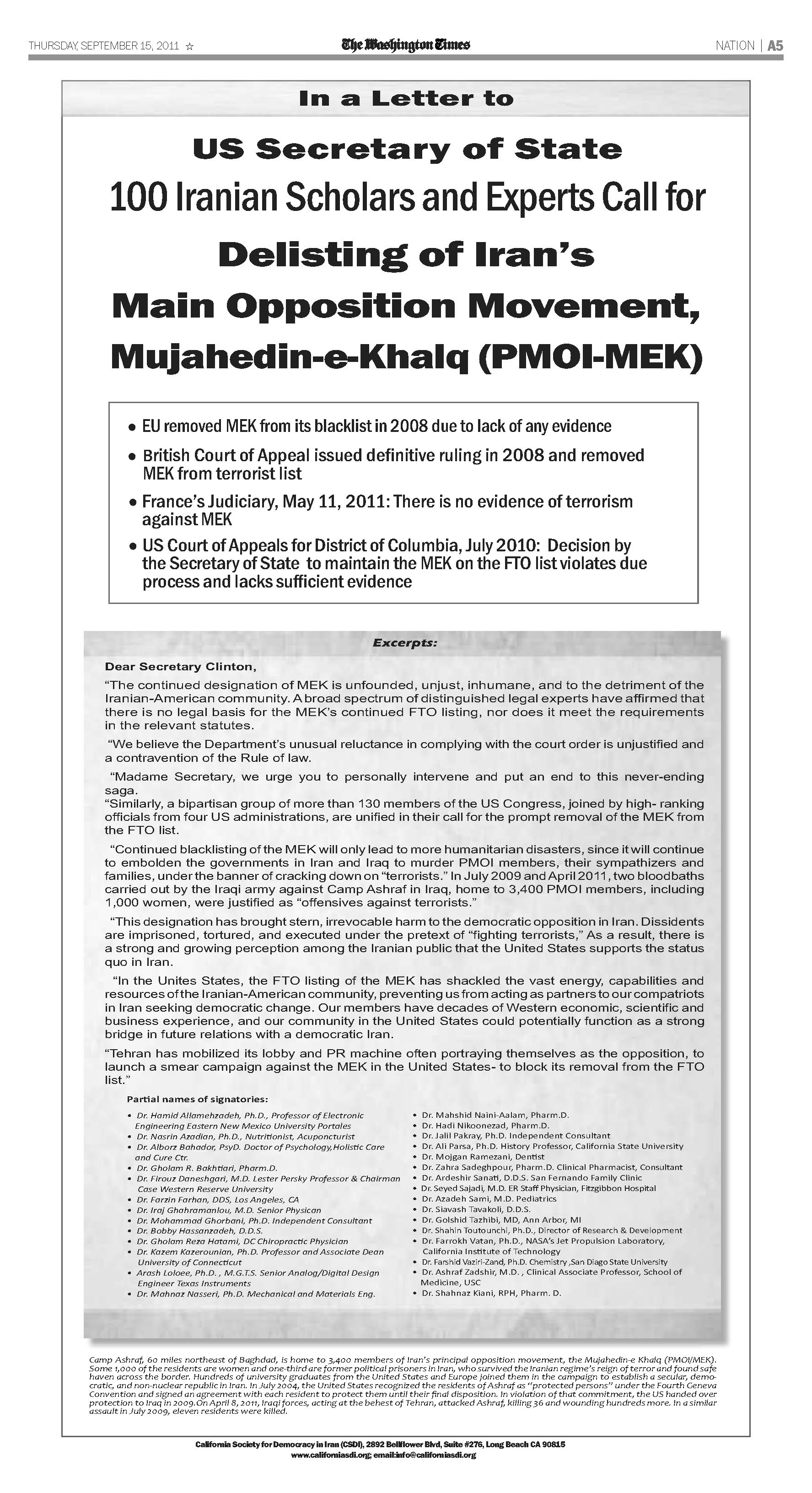
Secretary Hillary Clinton! Who’s to be held accountable for the death of my brother who was killed by Iraqi forces when they raided Ashraf in July 2009?

Are you aware that we, in Camp Ashraf, are paying the price for the “goodwill gesture” the State Department made to the mullahs in labeling the MeK? We are paying the price with our bodies and souls, with the pierced hearts and blood soaked bodies of our beloved!

Hanif Immami and Asefeh Immami in Camp Ashraf

Can you even begin to imagine how my heart was scarred when I stood before the dead body of my beloved brother and 46 other friends in Camp Ashraf? They had all trusted the U.S. government and had relinquished their weapons, as part of an effort to ‘secure’ Iraq, and were hence rendered defenseless before the Iranian regime and its proxies in Iraq – hoping that in return the U.S. would remain committed to protecting them. Indeed my heart has been scarred; a deep scar, as deep and as painful as the lessons learned in history, to be sadly enough, repeated again when justice is compromised time and again for meager political gains. As the beacon of hope for a nation yearning for freedom, what is the crime of the Iranian people’s resistance and residents of Ashraf? Is it not the simple fact that they have persisted in their struggle for freedom and for having their sacrificed everything?

Ever since the responsibility for our security was handed over by the U.S. government in 2009, we, the 3,400 Iranian dissidents residing in Camp Ashraf, Iraq, including 1000 women, have consistently been subjected to acts of aggression, non-stop psychological torture, a comprehensive and inhumane siege, violence and murder at the hand of the Iraqi government. Iraqi forces have injured more than a third of the residents. Injuries that have yet to heal in light of hindrances by the Iraqi Committee for Suppression of Ashraf in denying the residents access to proper medical treatment. I, myself, was injured twice during the course of these hostilities. During this period, since 2009, and in the course of two deadly attacks perpetrated by Nouri Al Maliki, the Iraqi PM at the behest of the Iranian regime, we have lost 47 of our dearest friends. The henchmen justify their crimes against residents of Ashraf by saying, “you are on the U.S. terror list!”

It goes without saying that this designation is a betrayal of the Iranian people and their just resistance movement which is striving for freedom and democracy and only serves the Iranian regime – the leading state sponsor of terrorism – by conceding to the wishes of the mullahs and it lacks any legal merit.

Almost a year has passed since a Washington district court of appeals ordered the State Department to reevaluate its decision to list the MeK. But unfortunately, and since there are elements within the State Department who are have positioned themselves on the wrong side of history, nothing has changed in the futile policy of appeasing the mullahs. In the meantime, the Iranian people and their resistance continue to pay the price with their blood, each and every day. The bitter fruit of maintaining the MeK on the list is consolidation of the mullah’s grip on power; a gift to the Iranian regime, Iraq, and anyone else who hopes that one day the residents of Ashraf are annihilated and, each day, they are conspiring to realize this dream.

While expressing my deepest discontent at this unjust designation, I ask Secretary Clinton to immediately remove the MeK from the list. The list is the proper place for the terrorist regime ruling Iran not the Iranian resistance. Delisting the MeK, also, guarantees the security and safety of residents of Camp Ashraf and sends a message of solidarity to the Iranian people: the U.S. State Department, as in nations affected by the “Arab Spring”, supports them in their struggle for democracy and freedom.

Delisting the MeK has been delayed long enough and keeping them on the list is no longer acceptable. Each second and each day that passes, and they remain on the list, we suffer another cherished human life.

Having signed an agreement with each and every resident of Ashraf, including my brother Hanif, the United States is specifically responsible for protecting their lives; a responsibility it has, unfortunately, turned its back on when it was needed the most – when the residents were attacked and under a barrage of gun fire and explosion of grenades and when they were rammed by humvees and armored personnel carriers – instead of protecting them, America stood idly by and looked on as the blood of innocent people was spilled in Camp Ashraf. The U.S. government will be held accountable for any foreseeable atrocity that occurs in Ashraf.

http://thewip.net/talk/2011/09/the_us_state_department_positi.html

Take Iran opponent MEK off terror list

CNN Opinion

Editor’s note: Louis Freeh served as director of the FBI from 1993-2001; Lord Corbett of Castle Vale heads the British Parliamentary Committee for Iran Freedom; and Rt. Hon. Lord Waddington QC is a former British home secretary and leader of the House of Lords. Freeh has received payment for travel expenses and speaking at conferences organized by groups that want People’s Mujahedeen Organization of Iran removed from the State Department’s list of foreign terrorist organizations.

(CNN) — Congressional leaders and former top U.S. officials are pressing Secretary of State Hillary Clinton to remove Iran’s main opposition group, the People’s Mujahedeen Organization of Iran, from the State Department’s list of foreign terrorist organizations. So what should Clinton do?

Let’s consider the background. The People’s Mujahedeen, also known as the MEK, is the Iranian mullahs’ worst nightmare. Since 1981 it has waged a costly and deadly battle to unseat the ayatollahs’ regime, but it is a battle for the soul of Iran of which it can be immensely proud.

In 1997, the Clinton administration added the MEK to the State Department’s blacklist in what a senior administration official, according to the Los Angeles Times, described as a good will gesture to Iran — thought at the time to be moving toward a more moderate form of government. The Bush administration maintained the ban, which many saw as an effort to persuade the Iranians to abandon their nuclear weapons program. But Iran is no closer to moderation and its nuclear ambitions get closer and closer to fulfillment.

Former U.S. officials calling for the MEK to be de-listed include former Homeland Security Secretary Tom Ridge, three former chairmen of the Joint Chiefs, two former directors of the CIA, former commander of NATO Wesley K. Clark, two former U.S. ambassadors to the U.N., former U.S. Attorney General Michael Mukasey, a former White House chief of staff, a former commander of the Marine Corps, former U.S. National Security Adviser Fran Townsend, now a CNN contributor; and even President Obama’s recently retired National Security Adviser Gen. James Jones. Their call is backed by 93 members of Congress, who have signed a bipartisan resolution urging the president to revoke the designation, and by prominent Democratic and Republican leaders such as Howard Dean and Rudy Giuliani.

In deciding whether to delist the MEK, Clinton should consider the following:

First, the decision to classify an organization as a terrorist group must be based on fact. Up until now, 10 courts in Britain, France, the European Union and the United States have looked at the evidence and ruled that the group is not involved in terrorism. Britain’s Proscribed Organisations Appeal Commission and later the Court of Appeal looked at the U.S. State Department’s reasons for listing the group as a terror organization in great detail and rejected them as irrelevant or found that the allegations’ sources and accuracy could not be established. The courts confirmed that the MEK halted armed activities against Iran in 2001 and voluntarily disarmed in 2003.

Second, the ban has put the lives of 3,400 MEK members at Camp Ashraf, Iraq, at great risk. In April, Iraq’s Prime Minister Nuri al-Maliki, a close ally of Iran, ordered an armed raid on the camp that left 36 residents dead and 350 injured. But when a bipartisan congressional delegation questioned al-Maliki in Baghdad about the incident, he said the United States had no right to complain about such violence when it was directed at a group the State Department itself called terrorist. Lifting the ban would remove any pretext for another military assault against the unarmed and defenseless MEK members at Camp Ashraf.

Finally, there is the broader issue of relations with Iran. Proponents of engagement with Iran claim that lifting the ban on the MEK would all but destroy any chance of future dialogue with Tehran. But what would be the point of such dialogue? Does anyone seriously believe the mullahs could be persuaded to throw away their attempt to obtain a nuclear weapon when the achievement of their ambitions is so close? And what would be the time frame for the talks, when Iran is believed to be less than one year from reaching nuclear breakout capability?

Delisting the MEK would send a strong signal to the millions in Iran who seek democratic change that the United States is on their side and has shunned the regime. It will tell the mullahs that the United States seriously intends to stop their outlawed activities and support democratic change in Iran just when Tehran is trying to use its influence to keep its anti-democratic and anti-Western partners in power in Syria and Iraq.

Delisting the MEK would lift the restrictions on the region’s largest Muslim group with a secular agenda and a democratic platform, whose moderate interpretation of Islam strongly threatens the mullahs’ fundamentalism.

The State Department, which has been unable to offer the courts any sound legal arguments for maintaining the ban on the MEK, now has a legal, moral and political duty to delist the MEK so it is not hampered in its work as the representative of those yearning for democratic change in Iran.

The opinions expressed in this commentary are solely those of the writers.

http://www.cnn.com/2011/OPINION/09/12/freeh.corbett.waddington.mek/

President Obama; MEK Blacklisting Has Justified Murder Of My Daughter

OfficialWire.com

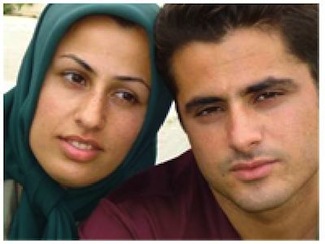
It is exactly 5 months since my daughter Saba was murdered, along with 35 others in a massacre lead by Al-Maliki forces at the behest of Tehran.
Global protest, sit-ins and campaigns are still ongoing.

The bloodbath in the Camp along with tens of clandestine arrests and kidnappings of MEK families in Iran is on also ongoing, justified by the US State Department’s blacklisting of MEK.

Furthermore, in July 2010, the US Court of Appeals for the District of Colombia Circuit ordered that the State Department re-examine the decision to keep the PMOI in the FTO list. Thirteen months on, the Department’s unusual reluctance in complying with the court order is unjustified and a contravention of the Rule of law.

In early 2004 a 16-month investigation period at camp Ashraf,60 miles north of Baghdad and home to some 3400 members of the MEK, was performed by nine US agencies including the FBI, the State Department, the Department of Justice, the Immigration Office, the DIA.

The objective was to screen every single resident of the camp. According to the New York Times on July 27, 2004, the US government announced: “U.S. Sees No Basis to Prosecute Iranian Opposition ‘Terror’ Group Being Held in Iraq”.

Following the D.C circuit court of appeals on July 16th 2010 ruled that the case be reviewed, a strong voice in the US congress has urged Secretary Clinton to put an end to the flawed policy of appeasing the mullahs in Tehran and the blacklisting of the MEK.
 
Since 2008 twenty courts in Europe issued definitive ruling for delisting MEK due to lack of evidence, which was later carried out. France’s judiciary in 2011 announced there is no evidence of terrorism against the MEK.

Yet, while the US State Department is still tendentious towards appeasing the mullahs, the “vociferous mediatic rage” by Iranian regime’s supporters and pundits in capitol hill is at its highest to persuade the Whitehouse to keep the MEK on the terrorist list. 

The past 4 week engineered campaign with its thread back in Tehran has proved to any neutral bystander, that such efforts are part of a campaign to prevent regime change in Iran.
 
Meanwhile concerns by lawmakers and analysts worldwide is understating Whitehouse independent decision making regarding the delisting of MEK.
 
Both failed policy to push for dialogue or engage in change of attitude with a dead regime and using the terror tag on MEK as bate for the already dead and illegitimate clerics ruling Iran is a laid out chess game planned by Tehran .

Iranian officials’ interpretation of the policy to “engage” with the vicious tyrants in Iran has overtly been mocked as a sign of weakness on behalf of the Whitehouse.
 
Nevertheless my daughter, Saba, has paid the price for such misguided policy with her life. MEK is the only movement, whose rights according to international laws and principles of human rights have been deliberately overlooked under the pretext of “National Security” and the “US list of foreign terrorist Organizations.”
 
When it comes to understanding “realpolitik” the recent winds of change; ousting dictators one after the other will definitely reach the mullahs in Tehran.
 
The bitter truth for clerical regime pundits is that it is finally the opposition which will proceed to bring about a change in the turbulent country.  
 
Despite the push to keep the Iranian pro- democracy opposition (MEK/PMOI) in the US black list, and disregard of millions spent in a ferocious – but repetitious smear campaign against MEK , the latest show of legitimacy by the organization in its election of a new Secretary General as well as several last gatherings has proved efforts futile.
 
The fruit of the argument could be read between the lines of a speech given by Mr. Jean Ziegler, Vice-President of the Advisory Committee of the UN Human Rights Council in a meeting in July this year: “Camp Ashraf is a source of inspiration and hope for the Iranian people in achieving democracy. If camp Ashraf doesn’t survive, one must say that for the Arab revolutions, for Arab revolutionaries who are looking for a reference, who are looking for an example, this would be a tragedy.”

He added that: “It is clear that from Egypt to the Nafous Mountains in eastern Libya and to Tunisia, all these youth are looking for a reference and an example. Ashraf is the illustration of what they are in search of.”

Any delays to end the policy of appeasement would come at the price of more lives being lost in camp Ashraf. The MEK must be delisted; the survival of human rights and democratic values is a necessity of the 21th century against dictators.  The US must change its policy towards the Iranian regime and side with the Iranian people and its resistance.

Saba Haftbaradaran , (born 21 February 1982 , was former student of Law graduate , who was killed in an attack on the refugee Camp Ashraf, April 8, 2011. Reza Haftbaradaran, one of the Ashraf residents and father of Saba is a politcal activist.

http://news.officialwire.com/main.php?action=posted_news&rid=204689

Iranian opposition group not involved in terrorism

HOUSTON CHRONICLE

In recent months, the Iranian government in Tehran has waged an unprecedented misinformation campaign against its main organized opposition, the Mujahedin-e Khalq, or MEK, in order to influence the pending decision by U.S. Secretary of State Hillary Clinton regarding the status of the group.

The U.S. Court of Appeals-D.C. Circuit struck down the decision in January 2009 by the secretary to maintain the MEK on the list of Foreign Terrorist Organizations (FTO) as flawed and in violation of the due process rights of the group and ordered a new review. After 14 months, there has been no decision.

The court has made it very clear that unless there is substantial support in the administrative record to show that the group has engaged in the past two years in terrorism or terrorist activity or has the capability and intent to engage in such activity that threatens the national security of the United States, the secretary must vacate the designation.

The MEK ceased its operations targeting Iranian military figures in 2001, renounced violence and terrorism, and turned over all the weapons it had for its protection in 2003 to the U.S. military. In return, it was promised the protection of its 3,400 members at Camp Ashraf under the Fourth Geneva Convention.

Since the U.S. handed over that protection to the Iraqi government in 2009, Iraqi forces have attacked the unarmed members of the camp, killing 47 and wounding 1,047 in what U.S. Sen. John Kerry described as a “massacre.”

President George W. Bush and other senior administration officials confirmed that the MEK revealed the existence of Tehran’s nuclear program, which triggered, for the first time, the inspection of Iranian nuclear sites by the International Atomic Energy Organization. Senior U.S. military commanders have confirmed that MEK’s intelligence has exposed Iran’s deadly meddling in Iraq.

Seven European courts have voted unanimously that the MEK is not a terrorist organization; the group was delisted in 2008 and 2009 in the United Kingdom and the European Union.

In the United States, House Resolution 60, introduced by Congressman Ted Poe, R-Humble, is co-sponsored by a bipartisan group of 93 members of the House, including in the Texas delegation Democrat Sheila Jackson Lee, Al Green and Gene Green and Republicans Louie Gohmert, Ralph Hall, Kenny Marchant and Pete Olson. It urges the secretary of state to delist the MEK.

When the MEK was first designated in 1997, a House majority and 32 senators, including Texas Sen. Kay Bailey Hutchison, protested the action, describing the MEK as a “legitimate resistance movement.”

While the Arab Spring has brought down dictators, the prospect of an empowered opposition in Iran with the imminent delisting of the MEK is a nightmare scenario for the ruling ayatollahs loathed by a vast majority of the Iranians. This explains why Iran has been waging a frenzied campaign to maintain the MEK on the terrorist list.

Absent evidence of terrorist activities, Tehran’s functionaries have been targeting journalists in Washington and elsewhere, posing as legitimate opposition and attacking the MEK with unfounded accusations, such as having “cult-like” behavior. If that were to be the standard, the cult of Mac (Apple) would have been designated as an FTO.

An independent study by a former assistant secretary of state, Ambassador Lincoln Bloomfield, has unveiled an extensive operation by Iran’s intelligence service to disseminate misinformation. John Sano, the CIA’s former deputy for clandestine operations, told a National Press Club audience on Aug. 18 that through a sophisticated campaign, Iran’s Intelligence Ministry has shaped U.S. public opinion about the MEK.

Tehran has widely propagated that MEK killed the Iraqi Kurds in 1991. However, the current foreign minister of Iraq told a European Court in 1999 that the MEK was in no way involved in suppression of the Kurds.

Independent studies have shown that the MEK had no links to the assassination of six Americans in Iran nearly 40 years ago and that a self-styled Marxist splinter group, which also murdered MEK members, was responsible.

Tehran’s lobby suggests that the MEK has funded the activities of Iranian-American communities; this completely disregards the extensive contribution of the Iranian-Americans to this nation, as many of them are prominent business owners, executives, academics, professionals, engineers and artists.

Now is the time for the Unites States to stand with the Iranian people and with the values upon which this country was founded.

To this end, delisting the MEK is the first order of business.

Ali Soudjani is president of Apple Finance Company and president of the Iranian American Society of Texas.

http://www.chron.com/opinion/outlook/article/Iranian-opposition-group-not-involved-in-terrorism-2163611.php

Ignore Iranian regime’s lies on opposition group

THE PHILADELPHIA INQUIRER 

While Secretary of State Hillary Clinton edges closer to deciding to remove the Iranian opposition group, the Mujahedeen e Khalq (MEK), from a U.S. list of banned organizations, the international media has been awash with Iranian regime propaganda attempting to demonize the group.

In an attempt to counteract this tendentious public relations campaign, the group’s supporters, including senior figures in U.S., British, and European political circles, have waged their own media campaign to counter the Iranian propaganda.

Indeed, a recent independent assessment by a former senior State Department official debunked virtually all of the stale allegations that have been regurgitated by Tehran’s lobby inside the Beltway in recent weeks.

In the midst of this punch and counterpunch media campaign, it is crucial that Clinton’s decision be based upon genuine evidence. De-listing the MEK is a legal issue and Clinton must act on facts within the correct legal framework.

The MEK has fought similar legal cases in the United Kingdom and the European Union, and after numerous appeals it has been successful in being removed from those entities’ lists of banned organizations.

The British courts found that allegations made against the group were untrue and in some cases were initially propagated from Iran’s intelligence ministry. WikiLeaks revealed that, lacking any credible claim to maintain the ban on the MEK, the British government’s continued defiance was more about how Tehran would react rather than what its legal system required it to do. In fact, the British Court of Appeal told us much about how the MEK had been mistreated, finding that the British labeling of the MEK as terrorist was “perverse.” This was a severe indictment of the government’s refusal to delist the organization.

For the EU, the embarrassment was even worse. It was dragged kicking and screaming through court after court until it had fought its last battle and succumbed to the legal reality that the MEK could not legally be labeled a terrorist group.

The judgments of the UK and EU courts are significant because the propaganda the Iranian regime wants us to believe about the MEK today is exactly the same as that replayed before those courts. Yet, in the end, those courts could not resist the evidence.

Now it is time for Secretary Clinton to make her decision. If she does so based on the facts, there is little doubt that she will conclude that in legal terms the ban on the MEK is no longer justified. However, if Iranian propaganda is allowed to muddy the water or the hope prevails that Tehran can be appeased by continuing to ban this Iranian opposition group, then things may not be so simple.

Clinton is credited as being a woman of principle who has the wisdom and foresight to recognize propaganda and withstand pressures inviting her to trample on the rule of law upon which all democracies are based. Our bet is that she will not fall into the trap set by the Iranian regime and its apologists and will stick to her principles in making the right decision and removing the MEK from the terrorism list. Only time will tell if we are correct.

Tom Ridge is a former secretary of Homeland Security and governor of Pennsylvania. Lord Alex Carlile of Berriew was Britain’s Independent Reviewer of Terrorism Legislation

 http://www.philly.com/philly/opinion/inquirer/20110908_Ignore_Iranian_regime_s_lies_on_opposition_group.html

US Rally Calls for Protection of Iranian dissidents

 THE HUFFINGTON POST

In an effort to prevent a humanitarian disaster, thousands of Iranians held a rally outside the US State Department to call for the protection of 3,400 Iranians resident in Camp Ashraf, Iraq and an end to the US ban on Iran’s largest opposition group, the Mujahedeen e Khalq (MEK). The issues are intertwined, because the residents of Camp Ashraf are supporters and members of the MEK.

The rally was addressed by US politicians and former national security officials who called on Secretary of State Hilary Clinton to listen to the thousands of Iranians gathered and end the US ban on the MEK. Their call was made not only because an end to the ban would allow the Camp Ashraf residents to be better protected, but because the ban is unjustified and lacking any legal basis.

Undoubtedly the US attitude towards the MEK has given the Iranian regime and its Iraqi counterparts the green light to carry out atrocities against the group. In the last two years, over 50 residents have been killed in Iraqi military assaults on the defenseless Camp and many more have been executed in Iran for their links to the group. The current US ban on the MEK has allowed the Iraqi government to do Tehran’s bidding on Iraqi soil on the US watch in that country.

Thousands of Iranian-Americans from 41 states took part in a huge rally outside the State Department on August 26, 2011, urging Secretary Clinton to act swiftly and remove the principal Iranian opposition movement, the Mujahedin-e Khalq (PMOI/MEK) from the State Department’s list of Foreign Terrorist Organizations and Ensure Protection for Camp Ashraf.

My personal story of having suffered the Iranian regime’s terrorism tells us much about the great lengths this regime in Iran will go to silence its opponents.

I narrowly escaped death in 1990 in Istanbul, Turkey, where I was assisting Iranian refugees. The regime’s terrorists ambushed our car, and I was shot several times, once very close to my heart. My liver was pierced and has suffered permanent damage. It is currently being held together in a plastic mesh. Even after the assassination attempt, the regime twice tried to end my life in hospital where I was being treated. On one occasion, the regime sent its terrorists under the cover of Turkish police officers and on another they pretended to be friends visiting me. But on both occasions my colleagues who were in the hospital and police officers at the scene managed to foil the plot at the last minute.

At that time it was I who suffered the consequences of western misguided policies and today it is the residents of Camp Ashraf. These residents are today being slaughtered on Iraqi soil with the justification that the MEK is banned in the US, a ban which has been proven in the UK and EU courts to be perverse and flawed.

For the past 14 years the MEK has been unjustifiably banned to placate the Mullahs regime, in a vain hope that the Mullahs in Iran can be moderated. The time has come to end this illegitimate ban, because it is this ban today that is being used by Iran to carry out executions and this ban which the Iraqi authorities seek as justification for the massacring of unarmed civilians at Camp Ashraf.

Now Secretary of State Clinton must do what is just. She must do what the legal system of the United States requires her to do and what the courts of the UK and EU have shown to be the legally correct path in immediately removing the MEK from the US list of banned organizations. The judgments of the British and European courts have unequivocally proven that no case exists for maintaining a ban on the MEK.

The issue of delisting the MEK and hence preventing the massacre of Ashraf residents as Mrs. Maryam Rajavi, the President elect of the National Council of Resistance has said “is the very test for the universal values that President Obama has committed himself to.”

Hilary Clinton must now answer the calls of the Iranian people and delist the MEK, sending a clear message to the people of Iran that we support their battle for freedom and democracy.

 Hossein Abedini is a Member of Parliament in exile of Iranian Resistance

http://www.huffingtonpost.co.uk/hossein-abedini/us-rally-calls-for-protec_b_949818.html