October 26, 2026

Top EU court upholds removal of Iran’s PMOI from terror list

DEUTSCHE PRESSE AGENTUR

Luxembourg – The European Union’s top judges on Wednesday endorsed a lower-court ruling that called for the People’s Mujahedin of Iran (PMOI) to be removed from the bloc’s list of terrorist organizations.

Founded in 1965, the PMOI operated a military wing in its early years, but says it renounced violence in June 2001 and now advocates the political overthrow of Iran’s current government.

France had appealed the lower-court decision, after managing in 2008 to convince its EU counterparts to keep the PMOI’s assets frozen, even after it was taken off a British list of terrorist organizations.

But the European Court of Justice agreed with the EU’s General Court that the bloc had violated the PMOI’s right to defend itself by not notifying it of new investigation information brought forward by French authorities.

It was ‘bound, imperatively, to ensure that PMOI’s rights of the defence were observed,’ the Luxembourg institution noted.

‘The court emphasizes that the protection offered by this notification is fundamental and essential to the rights of defence,’ it added.

Iran regards PMOI as a terrorist group and accuses it of involvement in the assassinations of several high-ranking Iranian officials, including the president and prime minister in the 1980s.
http://www.monstersandcritics.com/news/middleeast/news/article_1682116.php/Top-EU-court-upholds-removal-of-Iran-s-PMOI-from-terror-list

Remembering lessons of appeasement

THE WASHINGTON TIMES

Obama risks complicity by ignoring Iran’s threats against Camp Ashraf

Dec. 7 was the anniversary of the attack on Pearl Harbor. On that morning in 1941, 353 Japanese fighters, bombers and torpedo planes attacked the U.S. Pacific Fleet in two waves. All eight U.S. Navy battleships were damaged, four sunk. The Japanese also sank or damaged three cruisers. In total, 188 U.S. aircraft were destroyed; 2,402 Americans were killed and 1,282 wounded.

The attack shocked America and led directly to the American entry into World War II. The following day, the United States declared war on Japan. On Aug. 6, 1945, the first atomic bomb was dropped over Hiroshima, causing the greatest man-made disaster in history. The aim was to stop Japan from warmongering. President Truman, after ordering the dropping of a second bomb over Nagasaki said: “Let there be no mistake; we shall completely destroy Japan’s power to make war.” Are we heading for another disastrous response like that?

This all happened after several years of appeasement, trying to convince Hitler that his best interest was to work “peacefully” with his neighbors. But appeasement only emboldened Hitler to believe he could get away with his crimes, so he committed more.

History seems to be repeating itself, but the question remains: Have our leaders learned their lesson? It is now more than 30 years since the Iranian regime began terrorizing its own people and the world. It started with taking U.S. Embassy personnel hostage. Soon terrorism became a significant pillar of Iran’s foreign policy, backed by funding and training of people to carry their weapons into Iraq, Afghanistan and Gaza. The other pillar was bribery and offerings of lucrative oil deals with Western companies. While the West was busy looking for a moderate interlocutor, the regime built its nuclear-weapons program.

After a recent International Atomic Energy Agency (IAEA) report on Iran’s nuclear-program advances, a question was raised in diplomatic circles: What shall we do? The British government took the lead and called for more sanctions. Iran responded in the usual way a bully does: They attacked the British Embassy and took the staff hostage. Foreign Secretary William Hague responded swiftly and closed the Iranian Embassy in London. The bully retreated, proving what we learned in primary school – that the bully is a coward if you stand up to him.

The difference between Iran today and Germany in the 1930s is the existence of an organized opposition to the brutal rulers of Iran. This opposition allows a route to regime change that does not involve direct war.

But appeasers have been at work again. In the hope of containing Iran’s ambitions, they agreed to encumber opposition members by labeling them terrorists, hence extending the repression they endured in Iran to the rest of the world. The People’s Mojahedin of Iran (PMOI) challenged this unjust label, and they won court case after court case finally being delisted in the United Kingdom in 2008 and in the European Union in 2009. But the U.S. government has so far refused to abide by the federal appeals court ruling of July 2010 to re-examine the PMOI listing. The court was not convinced of the validity of the reasons given by the State Department. Scores of American generals and former administration officials have called for lifting the ban because it has been used by Iranian regime proxies in Iraq as a justification for two brutal attacks on the residence of PMOI members at Camp Ashraf in Iraq.

Iraqi Prime Minister Nouri al-Maliki met President Obama in the Oval Office on Monday. Already calls have been made to Mr. Obama to warn Iraq and Mr. Maliki from attempting to forcefully disperse the residents of the camp in Iraq, which Iraqi forces, aided by Iran, have twice attacked, killing dozens of unarmed residents and wounding hundreds. Iran wants Iraq to do its dirty work of eliminating its organized opposition. Mr. al-Maliki relied on Iran to secure a second term, so he thinks he has to comply. Mr. Obama is the man in position to stop Mr. al-Maliki from committing another crime against humanity.

If he heeds history’s lessons, Mr. Obama will stop Mr. al-Maliki and send a signal to Iran that their bullying is not working. Otherwise, he will find himself complicit in a war crime that Mr. al-Maliki intends to carry out. As human rights lawyer Geoffrey Robertson said in a meeting in Paris on Dec. 10, silence is complicity in a war crime. I am sure Mr. Obama would not like to go down in history with such a charge on his record.

Lord Corbett of Castle Vale is chairman of the British Parliamentary Committee for Iran Freedom.

http://www.washingtontimes.com/news/2011/dec/15/remembering-lessons-of-appeasement/

Refugees or terrorists? They’ll soon be dead

TORONTO SUN

They are half-a-world away and there are only seven of them, but the members of Parliament on a House of Commons human rights committee are doing whatever they can for the 3,400 refugees at Camp Ashraf, north of Baghdad, who, the MPs believe, are in imminent danger.

There are two Canadians among the refugees. They remain at Ashraf voluntarily despite offers from Canadian consular officials to get them out of what could, within days, become a very dicey situation.

Last month, diplomats convinced nine other Canadians to leave the camp.

Today, Canadian officials will travel from Jordan to Camp Ashraf, at some risk to their own personal security, to check on conditions and on the two Canadians who refuse to leave.

The rest, though, are mostly Iranian refugees opposed to the ayatollahs who govern their homeland. Their political organization was created in the 1960s and is called the National Liberation Army of the Mujahedin e-Khalq or MeK.

During the Iran-Iraq war they were armed by Saddam Hussein and used by that dictator to kill many thousands of Iranians.

They are also alleged to have killed Kurds, at Hussein’s urging, and committed other violent acts in the name of their cause. But since 2001, those at Camp Ashraf have given up their weapons.

Nonetheless, they are, above all else, enemies of the regime of Mahmoud Ahmadinejad.

But Iran’s president has a new friend in Iraqi Prime Minister Nouri al-Maliki and, as soon as U.S. forces withdraws all its troops from Iraq at the end of the year, Maliki — many experts will tell you — will hand those 3,400 refugees and enemies of Ahmadinejad over to Ahmadinejad himself.

“They will face the prison and the gallows (and) the fight for democracy in Iran will take a severe blow,” Wes Martin told this small group of Canadian MPs last week. Martin is a retired U.S. marine colonel who was once the commander of Camp Ashraf while it was under U.S. control.

So why doesn’t the U.S. or its allies in the West save these 3,400 refugees?

We won’t because officially the MeK are all terrorists. Officially, we think they’re the bad guys because of those violent acts committed a generation or more ago.

Canada has designated the MeK as a terrorist organization since 2005 and just re-affirmed that status in 2010. The U.S. has had them on the list since 1997.

Because MeK is on the list, banks and financial institutions are required to freeze its assets. Listing also prohibits all persons in Canada, as well as Canadians abroad, from knowingly dealing with this entity and its assets.

Martin — whose other job in Iraq was being in charge of all anti-terrorism operations for the entire U.S. military — thinks we’ve got it backwards.

“I cannot say with enough emphasis that the MeK is not a terrorist organization,” Martin told MPs. “As a matter of fact, I found just the opposite when I was commander of Camp Ashraf, and they were my allies.”

Scott Reid, the Conservative MP who chairs this human rights committee, and all his MP colleagues had trouble Tuesday squaring Martin’s assessment with evaluations provided to them by Canadian bureaucrats who had never visited Ashraf.

“They’re just people,” he told his committee Tuesday. “They’re probably going to be dead people pretty soon. That’s our worry.”

 http://www.torontosun.com/2011/12/13/refugees-or-terrorists-theyll-soon-be-dead

To most of the world, Iranian dissidents are not terrorists

THE WASHINGTON POST

Letter to the Editor

Iraqi Prime Minister Nouri al-Maliki [“Building a stable Iraq,” op-ed, Dec. 6] made clear the pretext that has been used to justify his country’s policy of brutality against the approximately 3,400 members of the Iranian dissident group the Mujahedin el-Khalq (MEK), located at Camp Ashraf, 60 kilometers north of Baghdad. “The camp’s residents,” he stated, “are classified as a terrorist organization by many countries, and thus have no legal basis to remain inIraq.” 

This is untrue. Only theUnited StatesandCanada— and, of course,Iran— continue to maintain the MEK on their respective lists of terrorist organizations. More than two years ago, an appellate court inBritainthrew out that designation as baseless, and the European Union soon followed suit. 

Nearly three years ago, theUnited Statesformally relinquished sovereignty overCampAshrafto the Iraqis. In July 2009, and in April of this year, Iraqi forces invaded Ashraf, killing nearly 50 residents and injuring hundreds. More recently, Mr. Maliki has insisted that the people of Ashraf leave the country, although he knows that there is nowhere for them to go, largely because of theU.S.terrorist designation. In apparent preparation for a mass deportation, he proposes to consolidate them in a remote location. With deportation, they quite likely will be left to the tender mercies of the Iranian regime. 

In this context, Mr. Maliki’s expressed interest in seeing the fate of the MEK “resolved peacefully and with the help of the United Nations” will have to await the test of credibility: Actions speak louder than words. 

Allan Gerson and Steven M. Schneebaum, Washington 

The writers are lawyers representing the Mujahedin el-Khalq in theUnited Statesin its efforts to remove the group’s designation as a terrorist entity. 

http://www.washingtonpost.com/opinions/to-most-of-the-world-iranian-dissidents-are-not-terrorists/2011/12/06/gIQAi48GgO_story.html


Lawmakers, retired colonel voice support for Iranian exile group

STARS AND STRIPES

BAGHDAD — Lawmakers and former military officials called on the U.S. government to protect an Iranian exile group in Iraq facing resettlement by the end of the year, citing conflict with Iraqi security forces earlier this year that killed dozens of people.

The hearing came in the wake of an intensive lobbying effort by former high-level U.S. government officials to have the Mujahedin-e Khalq, or MEK, removed from the State Department’s list of foreign terror groups.

The 3,400 MEK members at the camp were friendly to U.S. forces who oversaw their settlement at Camp Ashraf until the U.S. relinquished control in 2009, former camp commander and retired Army Col. Wesley Martin told a House Foreign Affairs subcommittee on Wednesday, according to published testimony.

Martin advocated relocating the group to the United States, and referred to an April video that purportedly showed 34 unarmed people being killed during resistance to Iraqi security forces entering the compound as evidence that the Iraqi government had no intention of protecting them.

During the video, some rushed to the aid of fallen comrades during the gunfire, according to Martin.

“I know if either myself or the American warriors with me at Ashraf had been under such an attack, the residents at Ashraf would have been rushing equally fast to our rescue,” Martin said.

Rep. Dana Rohrabacher, R-Calif., said during the hearing that the camp risked massacre by Iraqi forces without special protection, according to a New York Times report.

The State Department is re-examining MEK’s status as a terrorist organization, said Ambassador Daniel Fried, who was appointed by Secretary of State Hillary Rodham Clinton to oversee the MEK’s situation.

Push to drop Khalq terror designation in US

AGENCE FRANCE PRESSE

WASHINGTON — A group of prominent Americans is lobbying President Barack Obama to lift designation of Iranian opposition group Mujahedeen Khalq as a terrorist group, The New York Times reported.

Former CIA directors James Woolsey and Porter Goss and former FBI director Louis Freeh are among those seeking the change, the paper reported.

Others include former attorney general Michael Mukasey, ex-homeland security secretary Tom Ridge, former national security adviser General James Jones and former New York mayor Rudolph Giuliani.

The advocates insist their motive is humanitarian: to protect and resettle about 3,400 members of Mujahedeen Khalq, or People?s Mujahedeen, who are now confined in a camp in Iraq, the report said.

Mujahedeen Khalq, a former ally of ex-Iraqi president Saddam Hussein, has been designated as a terrorist organization under US law.

But its supporters say the terrorist label, which dates back to 1997, reflecting decades of violence that included the killing of some Americans in the 1970s, is now outdated, unjustified and dangerous, The Times said.

The Iraqi government has said it plans to close Camp Ashraf, where the member of Mujahedeen Khalq are currently staying, by December 31 and move the people elsewhere in Iraq, the paper noted.

http://www.google.com/hostednews/afp/article/ALeqM5iRl-m-9A3bp8T0kLgIOH0EIVDRhg

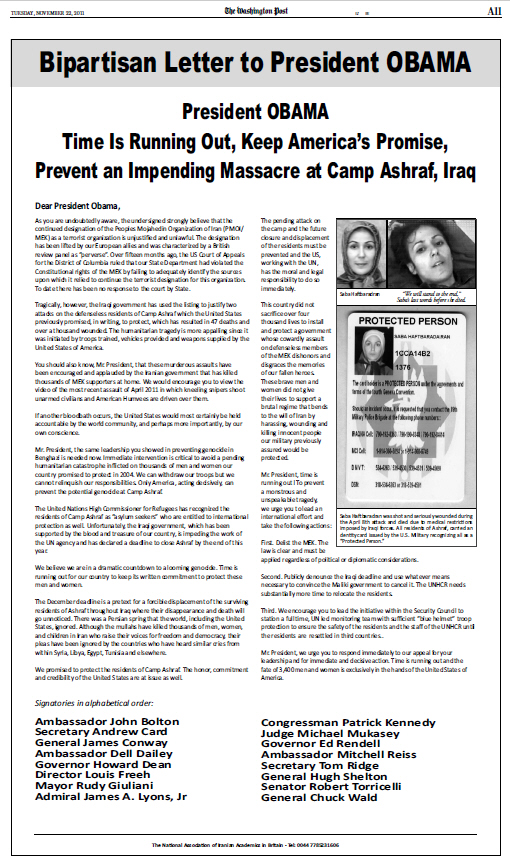
Washington Post: Bipartisan Letter to President Obama

Click on image for PDF

Time Is Running Out, Keep America’s Promise, Prevent an Impending Massacre at Camp Ashraf, Iraq.

Dear President Obama,
As you are undoubtedly aware, the undersigned strongly believe that the continued designation of the Peoples Mojahedin Organization of Iran (PMOI/MEK) as a terrorist organization is unjustified and unlawful. The designation has been lifted by our European allies and was characterized by a British review panel as “perverse”. Over fifteen months ago, the US Court of Appeals for the District of Columbia ruled that our State Department had violated the Constitutional rights of the MEK by failing to adequately identify the sources upon which it relied to continue the terrorist designation for this organization. To date there has been no response to the court by State.

Tragically, however, the Iraqi government has used the listing to justify two attacks on the defenseless residents of Camp Ashraf which the United States previously promised, in writing, to protect, which has resulted in 47 deaths and over a thousand wounded. The humanitarian tragedy is more appalling since it was initiated by troops trained, vehicles provided and weapons supplied by the United States of America.

You should also know, Mr. President, that these murderous assaults have been encouraged and applauded by the Iranian government that has killed thousands of MEK supporters at home. We would encourage you to view the video of the most recent assault of April 2011 in which kneeling snipers shoot unarmed civilians and American Humvees are driven over them. If another bloodbath occurs, the United States would most certainly be held accountable by the world community, and perhaps more importantly, by our own conscience.

Mr. President, the same leadership you showed in preventing genocide in Benghazi is needed now. Immediate intervention is critical to avoid a pending humanitarian catastrophe inflicted on thousands of men and women our country promised to protect in 2004. We can withdraw our troops but we cannot relinquish our responsibilities. Only America, acting decisively, can prevent the potential genocide at Camp Ashraf.

The United Nations High Commissioner for Refugees has recognized the residents of Camp Ashraf as “asylum seekers” who are entitled to international protection as well. Unfortunately, the Iraqi government, which has been supported by the blood and treasure of our country, is impeding the work of the UN agency and has declared a deadline to close Ashraf by the end of this year.

We believe we are in a dramatic countdown to a looming genocide. Time is running out for our country to keep its written commitment to protect these men and women.

The December deadline is a pretext for a forcible displacement of the surviving residents of Ashraf throughout Iraq where their disappearance and death will go unnoticed. There was a Persian spring that the world, including the United States, ignored. Although the mullahs have killed thousands of men, women, and children in Iran who raise their voices for freedom and democracy, their pleas have been ignored by the countries who have heard similar cries from within Syria, Libya, Egypt, Tunisia and elsewhere.

We promised to protect the residents of Camp Ashraf. The honor, commitment and credibility of the United States are at issue as well.

The pending attack on the camp and the future closure and displacement of the residents must be prevented and the US, working with the UN, has the moral and legal responsibility to do so immediately.

This country did not sacrifice over four thousand lives to install and protect a government whose cowardly assault on defenseless members of the MEK dishonors and disgraces the memories of our fallen heroes.

These bravemen and women did not give their lives to support a brutal regime that bends to the will of Iran by harassing, wounding and killing innocent people our military previously assured would be protected.

Mr. President, time is running out! To prevent a monstrous and unspeakable tragedy, we urge you to lead an international effort and take the following actions:

First. Delist the MEK. The law is clear and must be applied regardless of political or diplomatic considerations.

Second. Publicly denounce the Iraqi deadline and use whatever means necessary to convince the Maliki government to cancel it. The UNHCR needs substantially more time to relocate the residents.

Third. We encourage you to lead the initiative within the Security Council to station a full time, UN led monitoring team with sufficient “blue helmet” troop protection to ensure the safety of the residents and the staff of the UNHCR until the residents are resettled in third countries.

Mr. President, we urge you to respond immediately to our appeal for your leadership and for immediate and decisive action. Time is running out and the fate of 3,400men and women is exclusively in the hands of the United States of America.

Signatories in alphabetical order:

  • Ambassador John Bolton
  • Secretary Andrew Card
  • General James Conway
  • Ambassador Dell Dailey
  • Governor Howard Dean
  • Director Louis Freeh
  • Mayor Rudy Giuliani
  • Admiral James A. Lyons, Jr
  • Congressman Patrick Kennedy
  • Judge Michael Mukasey
  • Governor Ed Rendell
  • Ambassador Mitchell Reiss
  • Secretary Tom Ridge
  • General Hugh Shelton
  • Senator Robert Torricelli
  • General Chuck Wald

Tehran’s Anti-MeK Propaganda Machine

THE NATIONAL INTEREST

If disinformation is defined as deliberate and covert efforts to plant false information to bias media reporting and intelligence collection, the UN’s Durban conferences constitute a prime example. Although organized around an “anti-racist” agenda, they focus on ways to delegitimize Israel and are an icon of intolerance.

A participant in the Durban conferences is the Islamic Republic of Iran. Just as it tries to delegitimize Israel, Iran does the same to its opposition while portraying itself as defender of human rights. By releasing American hostages as a “humanitarian” gesture to “improve” the standing of the regime as President Ahmadinejad arrived at the UN, Tehran shows it is a past master of propaganda.

The Islamic Republic treats Israel and Iranian oppositionists in the same way because both are committed to the rule of law rather than to rule by clerics. In research for my forthcoming book on how to facilitate Iranian democracy, I concluded that the Mujahedeen-e-Khalq (MeK), an Iranian opposition group, is genuinely committed to democracy and not pretending just to gain support. My conclusions echoed those of under secretary of state George Ball, who stated in 1981 that the MeK intended to replace the Islamist regime “with a modernized Shiite Islam drawing its egalitarian principles from Koranic sources rather than Marx,” and of a State Department report of 1984 asserting: “The Mujahedeen unsuccessfully sought a freely elected constituent assembly to draft a constitution.”

The Iranian regime also misinforms publics, delegitimizes and seeks to destroy the MeK because it challenges clerical rule. By contrast, other dissident organizations, such as the Iranian Green Movement faction headed by Mir Hossein Mousavi, accept clerical rule.

Intelligence communities are targets of Iran’s disinformation. Consider a letter of August 2, 2011, called the “Joint Experts’ Statement on the Mujahedin-e Khalq.” One signatory stands out because of his distinguished background in intelligence: Paul Pillar, former National Intelligence Officer for the Near East and South Asia and now at Georgetown University.

The letter repeats false allegations of the Iranian regime, such as, “Widespread Iranian distaste for the MeK has been cemented by MeK’s numerous terrorist attacks against innocent Iranian civilians.” It resembles regime propaganda against the MeK; see an allegation in the Fars News Agency, the Islamic Republic’s radio and television network, which broadcast alleged statements of two MeK members who “confessed” they had planned to set off homemade bombs in Iran during June 2010. The broadcast includes an interview with Intelligence Minister Moslehi. But when recounting “terrorism” of the MeK, he only pointed to the group’s political and public-relations activities, including sending information outside the country, rather than actions against civilians.

A search of the Worldwide Incidents Tracking System for that period fails to link the MeK to the alleged incident described in the Fars Broadcast. Since 2001, there have not been any military attacks by the MeK, even against regime targets, much less against civilians. Consequently, there is growing bipartisan support for removing the terrorist tag on the MeK, e.g., at least 96 members of Congress, including Chairs of the House Select Intelligence, Armed Services and Foreign Affairs committees.

As Iranian-Americans rallied in pro-MeK protests against Ahmadinejad when he spoke at the UN in 2010 and 2011, such well-attended rallies indicate support for the MeK among émigrés, which in turn can be read as evidence of support within Iran. One Iranian specialist who studies the MeK also finds support for the organization in Iran: Patrick Clawson of The Washington Institute for Near East Policy states:

One of the signs that the MEK still has supporters in Iran is that they occasionally provide blockbuster revelations about Iranian clandestine activities. None was more explosive than their revelations about the Iranian nuclear centrifuges at Natanz—revelations that led to inspections by the International Atomic Energy Agency (IAEA) and the subsequent unraveling of Iran’s eighteen-year tissue of lies about its nuclear activities, repeatedly condemned by the IAEA and the U.N. Security Council.

More recently, based on similar MeK sources, there was an August 2007 revelation about how the Islamic Revolutionary Guards Corps (IRGC) dodged international sanctions by using front companies to import nuclear enrichment equipment and take over the Iranian oil and gas sectors, mainstays of the economy. In October 2007, the U.S. Treasury imposed sanctions on the IRGC.

Another revelation on October 14, 2011, exposed the role of the IRGC-Quds Force (QF) in a plot to assassinate the Saudi Ambassador to the United States and blow up the Saudi Embassy in Washington. That disclosure reinforced additional sanctions Treasury placed on the IRGC-QF three days earlier.

And what is Tehran’s response to evidence of complicity in the assassination plot? The regime blames Israel and the United States and asserts MeK involvement. The State Department promptly denied MeK responsibility and accused Tehran of “fabricating news stories” and spreading “disinformation” to exploit skepticism about the plot.

In its efforts to suppress dissent, the Iranian Ministry of Intelligence and Security (MOIS) shapes opinion about the MeK throughout the world. The MOIS also targets the American intelligence community. The ministry plants false stories in the media; then they are used by U.S. intelligence to justify a false narrative against the MeK.

On September 12, 2007, the Mehr News Agency, a MOIS news outlet, announced that before one of the bombings in Karbala, closed-circuit cameras around the Imam Hossein shrine caught a woman and a youngster gathering information from various entrances of the shrine: “After their arrest, it became clear that they had been sent by the Mojahedin Khalq Organization [MeK] to locate ways to sneak into the shrine for terrorist operations, ”states Mehr.

Iran’s Habilian Society, a regime-sponsored group posing as a human-rights organization, published a U.S. Federal Appeals Court’s description of declassified American documents. One carried Iranian stories alleging MeK involvement in Karbala. Several state-run media reproduced the report. On August 14, 2010, Fars wrote:

According to reports recently published by the U.S. intelligence community, the Monafeqin [MeK] maintain their readiness to conduct terrorist attacks and resort to violence; based on recently declassified documents, the U.S. intelligence community emphasized…that…[the MeK] claim regarding having voluntarily renounced violence in 2001 was nothing but a hoax, and this organization maintains its capability to conduct terrorism.

The U.S. intelligence community classified a news account that had been planted in the media by the Iranian regime, allowing it to complete a disinformation cycle—a news-intelligence-news loop. The MOIS plants false allegations in its media, which become classified U.S. documents in the middle and end with Tehran reporting declassified U.S. intelligence as “proof” of MeK involvement in terrorist planning. But during this time period, the MeK in Iraq was under U.S. or Iraqi electronic surveillance. Thus, the MeK could not secretly plan or implement attacks on Karbala without being detected.

Under pressure of the Federal Court order, the State Department on May 20, 2011, released additional classified documents relevant to the terrorist designation of the MeK. One was an AP report of February 9, 2008, about alleged MeK involvement in Karbala plotting. In addition to the irony of classifying a public report later used to justify redesignating the MeK, the report also recalled statements about MeK training of suicide bombers placed in the media by Tehran.

General James Conway, U.S. Marine Corps (retired), former commandant of the Marine Corps who participated in the 2003 invasion of Iraq and the first battle of Fallujah, paints a picture of disinformation by the Iranian regime against the MeK:

The MOIS plants stories in the press of potential threats faced by American military commanders. And then the MOIS goes to those individuals and says, ‘You know, Camp Ashraf, where MeK members reside in Iraq, is a den for suicide bombers. The MeK is training them, and that’s a threat to American forces.’

Regarding Paul Pillar, he is a noted critic of “politicization of intelligence”—and thus it is surprising to find his name among those who wish to keep the MeK listed as a terrorist group. Because the absence of terrorism or terrorist activities during a legally relevant period of two years prior to a redesignation decision does not support maintaining the MeK on the list and there is hard public evidence of a political motivation for the listing, those who oppose politicization of intelligence should also support removal of the MeK from the Foreign Terrorist Organizations (FTO) list.

As Secretary of State Hillary Rodham Clinton makes her decision whether to remove the MeK, there is also a need to encourage others to act against bona fide terrorists. So long as the MeK is on the terrorist list despite its absence of terrorism and terrorist activities, the list is politically suspect. And if a decision to redesignate a group as terrorist were made on political grounds instead of evidence, the list would become a political instrument and reduce counterterrorism utility.

Finally, as the State Department dithers in its decision to remove the MeK terrorist designation, Tehran delegitimizes its main opposition, and the Islamic Revolutionary Guards Corps-Quds Force pressures Baghdad to destroy members of the MeK in Camp Ashraf Iraq near the Iranian border.

Monday: Muhammad Sahimi, lead political columnist for Tehran Bureau, responds to Dr. Tanter.

Raymond Tanter served on National Security Council staff and as personal representative of the Secretary of Defense to arms control talks in the Reagan-Bush administration. A professor emeritus at the University of Michigan, he is currently an adjunct professor at Georgetown University. His most recent book is Terror Tagging of an Iranian Opposition Organization (Iran Policy Committee, December 2011).

http://nationalinterest.org/commentary/tehrans-anti-mek-propaganda-machine-6097%3Fpage%3D2?page=1

Iranian Americans call on U.S. to protect Iranian exiles in Iraq

THE WASHINGTON POST

Hundreds of Iranian Americans rallied outside the White House on Saturday, saying they’re worried that the Obama administration’s newly announced plan to withdraw U.S. troops from Iraq by year’s end will leave 3,400 Iranian exiles vulnerable in a settlement outside Baghdad.

The protesters also called on the Obama administration to remove Mujahedin-e Khalq, or MEK, the group affiliated with the exiles, from the State Department’s list of foreign terrorist organizations. The designation, protesters said, gives the Iraqi government an excuse to persecute residents of Camp Ashraf, which has been more like a small city, 40 miles north of Baghdad, since the mid-1980s.

Supporters from the Washington area and across the country said Iraqi forces are not allowing medicine into the 10-square-mile Ashraf compound and have twice attacked its unarmed residents since July 2009, killing about 45 people and injuring hundreds. Many protesters said they fear a massacre there after U.S. troops leave Iraq.

Former Secretary of Homeland Security Tom Ridge speaks to a crowd of hundreds protesting in front of the White House in Washington Saturday, Oct. 22, 2011. Ridge spoke in support of the call for the de-listing of an Iranian opposition group, Mujahedin-e Khalq (MEK) from the U.S. terror list. The group also called on President Barack Obama to protect Ashraf, the Iranian refugee camp in Iraq. (AP Photo/Jose Luis Magana)

“Whenever the U.S. says ‘Don’t execute these people’ or ‘Don’t send them back to Iran,’ they [Iraqi authorities] can say ‘Why not? We’re killing terrorists for you,’ ” said Amir Emadi, a graduate student from San Diego. His parents and 19 relatives live in Ashraf.

MEK formed in Iran in the 1960s to overthrow the U.S.-backed shah, and in the 1970s it assassinated several U.S. military personnel and American civilians working in Tehran, according to a 2007 State Department report. It also “supported the violent takeover in 1979 of the U.S. Embassy in Tehran,” the report said.

In the mid-1980s, the group moved to Iraq, where it helped Saddam Hussein’s regime fight in Iraq’s war against Iran.

After the 2003 invasion of Iraq, the United States agreed to protect the residents of Ashraf if MEK gave up its weapons. The United States transferred Ashraf to Iraqi control in 2009. Iraq’s government, eyeing MEK’s past affiliation with Hussein, has tried to make the Ashraf residents leave.

Obama administration officials have said the MEK, headquartered in Paris, has been listed as a foreign terrorist organization since 1997 because of its history of violence. The State Department reportsaid “MEK’s leadership and members across the world maintain the capacity and will to commit terrorist acts in Europe, the Middle East, the United States, Canada and beyond.”

On Saturday, joined by former Homeland Security secretary Tom Ridge and former Pennsylvania governor Ed Rendell, several protesters said recent allegations of an Iranian plot to kill the Saudi ambassador to Washington prove that the Obama administration needs to take a harder line.

“You cannot negotiate with Iran!” Ridge exclaimed to cheers, beating drums and chants of “MEK, yes. Mullahs, no! They are terrorists. They must go!”

Since renouncing violence in 2001, protesters said, MEK has not been linked to any attacks.

Demonstrators chant during a march in Washington after rallying in front of the White House Saturday, Oct. 22, 2011. Hundreds of people rallied, demanding that an Iranian opposition group, Mujahedin-e Khalq (MEK) be removed from a U.S. terror list. (AP Photo/Jose Luis Magana)

At Homeland Security, Ridge was given a daily list of terrorist threats, he said. “Never once did I see a threat to the people of the U.S. from the people of Camp Ashraf,” he told the crowd.

A similar protest outside the State Department in August drew thousands. Saturday’s protesters on Pennsylvania Avenue hoisted yellow flags saying “De-list MEK” and “Protect Ashraf,” as curious tourists looked on. The rally was organized by the Iranian American Professionals and Scholars of Maryland.

Rally leaders said the United States should protect Ashraf with its own troops or urge United Nations security forces to guard it until the exiles can be repatriated.

“We gave our word to protect these people,” Rendell said.

Majid Sadeghpour, a pharmacist who lives in Falls Church, said his brother was executed in Iran in 1989 after being imprisoned for carrying an MEK newspaper. The MEK’s listing as a terrorist group undermines the work of those who want to see Iran governed by a secular democracy, he said.

“We can’t do that,” Sadeghpour said, “when our most organized, capable resistance has been tagged as terrorists.”

http://www.washingtonpost.com/local/iranian-americans-call-on-us-to-protect-iranian-exiles-in-iraq/2011/10/22/gIQAJotj7L_story.html

Hundreds Rally For Iranian Opposition

WAMU Radio

Hundreds of Iranian Americans rallied in front of the White House Saturday demanding the Obama administration do more to help the Iranian resistance movement.

The protestors are asking the U.S. government to take the Mujahedin-e Khalq (MEK) off the State Department’s list of terrorist organizations. The group was once allied with Saddam Hussein’s Iraqi regime, but MEK officials say they renounced violence a decade ago.

Former Homeland Security Secretary Tom Ridge was among the protesters. He says U.S. officials haven’t been helping the process.

Demonstrators chant during a march in Washington after rallying in front of the White House Saturday, Oct. 22, 2011. Hundreds of people rallied, demanding that an Iranian opposition group, Mujahedin-e Khalq (MEK) be removed from a U.S. terror list. (AP Photo/Jose Luis Magana)

“The State Department has been horribly naïve – not just this administration but the previous administration – thinking that you negotiate with Iran,” says Ridge.

Amir Emadi traveled to D.C. from San Diego to pressure the administration to assist protestors in Iran.

“I think that the Iranian people deserve a lot more attention than does the Iranian government,” says Emadi.

International attention came back on Iran after U.S. officials foiled an alleged plot to assassinate the Saudi Arabian ambassador at a restaurant in D.C. But for these Iranian Americans their native country never left their minds.

http://wamu.org/news/11/10/23/hundreds_rally_for_iranian_opposition