October 26, 2026

Don’t abandon Iran opposition

 THE BOSTON HERALD

U.S. leaves cooperative dissidents hanging

Tom Ridge, the former U.S. secretary of Homeland Security.

The just-released International Atomic Energy Agency report on the Iranian nuclear weapons program should be the final warning to the West: Iran must be dealt with now, before its advanced nuclear weapons program is operational, and while the United States still has viable options for changing the regime in Tehran. However, the news that Iran is developing nuclear weapons isn’t news at all: Western policymakers have been warned of such plans and intentions for years with exacting intelligence from the main Iranian opposition, the Mujahedin-e Khalq (PMOI/MEK).

In 2002, MEK activists risked their lives and revealed the existence of secret nuclear sites in Iran, notably the uranium enrichment site in Natanz. Since then, these activists have played a key role in the international community’s efforts to catch Tehran in its hide-and-seek escapades.

The MEK revealed in 2008 that Tehran’s scientists were working on nuclear warheads in Khojeyr, and in 2009 they unmasked the site where Tehran was working on detonators for implosion. In their latest revelation this past July, the headquarters for coordination of various aspects of nuclear weapons program that was controlled by the dreadful Revolutionary Guards was exposed.

The MEK established the existence of a secret nuclear site at Qom in 2005 — four years before it was announced by leaders of the U.S., United Kingdom and France jointly in 2009. The fact that Iran, under Mahmoud Ahmadinejad, is moving more advanced centrifuges to this underground site has compounded the concerns. And when the now defunct National Intelligence Estimate in December 2007 claimed that Iran had stopped the nuclear weaponization process, the MEK insisted its information proved the opposite. Time revealed the truth.

The warnings by the Iranian dissidents — most of whose information was at some point corroborated — resulted in precious little action in the West, which lumbered between sanctions and empty threats against the mullahs in Tehran. And instead of showing gratitude, Washington has marginalized the MEK and relegated them to an uncertain future, which may end up in their mass slaughter.

In 1997 the MEK, which at one time advocated the forceable overthrow of the regime in Tehran, was placed on the State Department’s Foreign Terrorist Organization (FTO) list as a “goodwill gesture” to open dialogue with the mullahs. Yet the MEK, which had subsequently disarmed and renounced violence against Iran, kept providing first-hand intelligence on Iran’s inner workings, particularly in the nuclear area. The U.S. Court of Appeals for the District of Columbia Circuit in July 2010 strongly challenged the designation and ordered the State Department to review it.

Dozens of senior former American officials from the past three administrations have urged Secretary of State Hillary Clinton to revoke the MEK’s designation. In their call, they have joined more than 100 members of Congress and more than 4,000 parliamentarians around the world. Yet the State Department is still procrastinating.

The unjust designation of MEK as a foreign terrorist organization has set the stage for humanitarian crisis. It has provided an excuse for Iraq — at the behest of the Iranian regime — to oppress, and even massacre, those among the 3,400 Iranian dissidents residing at Camp Ashraf in Iraq who are “protected persons” under the Fourth Geneva Convention.

After two armed assaults by the Iraqi Army on the camp in 2009 and last April — when 36 people were killed and 300 injured — the Iraq government led by Prime Minister Nouri al-Maliki set Dec. 31 as the deadline for the camp to close. His only excuse for murdering Iranian dissidents is the blacklisting by the U.S.

Last month, when the Iranian regime was caught plotting to assassinate the Saudi ambassador in Washington, President Barack Obama vowed to impose the “toughest sanctions.” Now, the prospect of Tehran’s terror masters being equipped with the most dangerous weapons looms as close as ever.

Given the current state of affairs, sanctions alone would not suffice. The U.S. should adopt a contingency plan, applicable immediately that would include the following steps:

  •  Removing the shackles from the Iranian opposition by removing the terror tag.
  •   Extending the deadline on the residents in Ashraf and preventing any Iraqi action on them.
  •   Imposing sanctions on the Iranian central bank.
  •  Organizing a campaign by our European allies to embargo Iranian oil to choke off the lifeline of the Revolutionary Guard.

Three years ago, then President-elect Obama said, “Iran’s development of a nuclear weapon I believe is unacceptable. We have to mount an international effort to prevent that from happening.” The time for action is now, Mr. President.

Tom Ridge is the former U.S. secretary of homeland security.
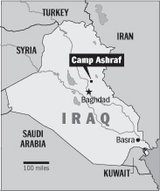
http://bostonherald.com/news/opinion/op_ed/view/2011_1115dont_abandon_iran_opposition_us_leaves_cooperative_dissidents_hanging

A matter of honor

THE WASHINGTON TIMES

America has a duty to protect Camp Ashraf residents from Iran’s vendetta

Camp Ashraf - Washington Times

On Oct. 7, 1997, during the Clinton administration, the People’s Mujahedeen of Iran (POMI/MEK) was designated as a Foreign Terrorist Organization (FTO) by then-Secretary of State Madeleine Albright. The MEK represents the main opposition group to the Iranian theocracy and has been the source of key intelligence relating to Iran’s secret underground nuclear sites. According to a senior Clinton administration official, the designation of the MEK as a terrorist organization was intended as a “goodwill gesture” to Tehran and its newly elected “moderate” President Mohammad Khatami. Such a goodwill gesture coming on the heels of the Khobar Towers bombing in Dhahran, Saudi Arabia, where we had proof of Iran’s involvement, resulting in the killing of 19 U.S. servicemen and the wounding of more than 500 was unbelievable.

Such groveling by our government to a fanatical Iranian theocracy should not have been a surprise. After all, when we had proof of its involvement in the bombing of the U.S. Marine barracks in Beirut Oct. 23, 1983, killing 241 of our finest military personnel and injuring hundreds more, we did nothing. Contrary to a recent book citing the incident, the National Security Agency had translated and promulgated the information on a planned “spectacular” attack on the U.S. Marines on Sept. 27, almost four weeks before the bombing. Further, we have known for years that Iran has provided financing, training and weapons to the insurgents we have been fighting in Iraq and Afghanistan, which continues to this day, but has been swept under the rug. Even with their involvement in assisting the Sept. 11 hijackers due to our “hands-off” policy, we have essentially signaled to the fanatical mullahs that they have nothing to fear from us regardless of the atrocities they have committed against us. It is why they had nothing to fear from their attempt to assassinate the Saudi Arabian ambassador in our nation’s capital. That Iran, which has cost thousands of American lives, both military and civilian, has been “off-limits” is a national disgrace.

Now we are faced with another moral situation in which we gave our word to protect the Iranian main opposition group, the MEK at Camp Ashraf, Iraq. In July 2004, we recognized the MEK residents at Camp Ashraf as “protected persons” under the Fourth Geneva Convention. Prior to that, the MEK disarmed in May 2003, turning over all their weapons to the U.S. Army’s Fourth Infantry Division and we signed an agreement with every individual at Camp Ashraf that we will protect them until their “final disposition.” From 2003 to 2009, U.S. forces protected Camp Ashraf from terrorist attacks from Iran and its Iraqi proxies. In 2009, the security of Camp Ashraf was turned over to Iraqi forces.

On Feb. 28, 2009, the Ayatollah Ali Khamenei urged the visiting Iraqi President Jalal Talabani to expel Iran’s main opposition group, the MEK, from Camp Ashraf. According to reports of the visit, the ayatollah stated, “We await the implementation of our agreement regarding the expulsion of the [MEK] hypocrites,” to Iran and areas in Iraq where they will disappear forever.

Using the State Department’s designation of the MEK as an FTO as an excuse, Iraqi forces in July 2009 launched a raid on Camp Ashraf’s 3,400 residents, killing 11 and wounding 300. The latest attack occurred on April 8. Iraqi forces equipped with U.S. armored personnel carriers and Humvees killed 36, including eight women, and injured 345. Most were shot and some were crushed to death. Not surprisingly, Tehran praised the attack and asked Baghdad to continue attacking Camp Ashraf until it is totally destroyed.

Sen. John Kerry, Massachusetts Democrat, chairman of the Senate Foreign Relations Committee, called this latest attack a “massacre.” Sen. Carl Levin, Michigan Democrat, chairman of the Senate Armed Services Committee, sent a letter to Secretary of State Hillary Clinton asking her to ensure the safety of the residents of Camp Ashraf and to accelerate the review of removing the FTO designation of the MEK.

With Iraqi Prime Minister Nouri al-Maliki declaring that Camp Ashraf will be shut down by Dec. 31, action to resolve the situation for the 3,400 residents, including 1000 women, must be taken now. The U.S. Court of Appeals for the District of Columbia ruled on July 16, 2010, that Ms. Albright erred in designating the MEK an FTO. The State Department was ordered to review this designation, strongly suggesting that it should be revoked. Why this review is proceeding at glacial speed is unconscionable, particularly since all our European allies have already removed the designation. Are we still clinging to the hope that we can negotiate with the fanatical mullahs? Such negotiations would be meaningless.

On Sept. 13, the United Nations High Commissioner for Refugees formally announced the recognition of the residents of Camp Ashraf as “asylum seekers” and requested the Iraqi government to extend the deadline beyond Dec. 31 to allow sufficient time for processing asylum applications and relocation to third-party countries. As of this date, Iraq has not changed its position.

To ensure that our word and honor still mean something, the MEK should be delisted as a FTO now. Furthermore, all tools available to us must be used to make Mr. Maliki understand that the Dec. 31 deadline must be extended. We did not sacrifice more than 4,400 American lives and tens of thousands injured in Iraq to create a country so that it can be another proxy for Iran.

Finally, the United Nations must place monitoring teams at Camp Ashraf to insure the safety of the residents until they can be resettled. The Obama administration has a rare opportunity to not only stand on principle but also to send a signal by delisting the MEK that we will support a “Persian Spring” regime change in Iran.

Retired Adm. James A. Lyons was commander in chief of the U.S. Pacific Fleet and senior U.S. military representative to the United Nations.

http://www.washingtontimes.com/news/2011/nov/10/a-matter-of-honor/

A US Pledge of Protection: What Is It Worth?

THE HUFFINGTON POST

The UN sanctioned US/NATO Libya operation to topple Gaddafi was based on a singular premise: where there is a looming humanitarian catastrophe and the international community has the means to stop it, it should intervene to do so. Whether the US/NATO involvement exceeded that mandate is another story. But what is indisputable is the legitimization of humanitarian intervention in such circumstances.

Today, President Barack Obama has available the same rationale that justified intervention in Libya to justify a non-military response to avert a humanitarian disaster in Iraq where 3,400 Iranian dissidents — members of the principal Iranian opposition movement, the Mujahedin-e Khalq (PMOI/MEK) — have been subjected to regular shootings and harassment by Iraqi soldiers. Located at Camp Ashraf, northeast of Baghdad, they are threatened with deportation to Iran. Yet, the Obama Administration seems oblivious to their fate, writing them off presumably as the price of better relations with Iraq or perhaps an opportunity for “engagement” with Iran.

On Dec. 31, 2011, the day that the last American soldier is due to leave Iraq, Camp Ashraf is under orders by the Iraqi regime to close down and for its residents to be dispersed to prisons or concentration camps, or to the tender mercies of Iranian executioners. Two unprovoked armed assaults by the Iraqi Army on Camp Ashraf in 2009 and last April resulted in over forty dead and hundreds injured by Iraqi soldiers carrying US-made weapons. There is no reason to hope that the impending closure will be either peaceful or humane, despite the fact that the Ashraf residents were granted protected persons status under the Fourth Geneva Convention by the US military.

Following the US-led invasion of Iraq in 2003, Ashraf residents were provided with written guarantees by US authorities that, in return for disarming voluntarily, the US would protect them. But, since early 2009, when the US handed over responsibility for the security of Camp Ashraf to Iraqi forces, that guarantee has become a cruel hoax as the Iraqi Army continues to impose a punishing blockade, depriving residents of basic services, including access to medical care.

The hand of Iran’s mullahs is easily detectible in this turn of events. Tehran has reputedly insisted that the Iraqi government of Prime Minister Nouri al-Maliki set Dec. 31 as the deadline for the camp’s closure. Iran, rattled by fears of contagion of the Arab Spring and facing a growing international crisis over its drive to develop nuclear weapons and encouragement of terrorist activities abroad (the most recent being the foiled plot against the Saudi ambassador to Washington), wants Camp Ashraf and its residents eliminated at any cost.

Fortunately, the United Nations has stepped into this cauldron of abandoned concern. In September, the United Nations High Commissioner for Refugees (UNHCR), declared that Ashraf residents are asylum-seekers entitled to international protection, and accordingly urged that, at the very least, Ashraf’s closure be delayed. The government of Iraq has ignored these pleas and insists that the December closure deadline is firm.

Yesterday, in a last-ditch effort to head off the impending humanitarian crisis, the top UN envoy to Iraq offered to broker the closing of Camp Ashraf and to prevent Iraqi officials from forcing its residents out at year’s end. It remains to be seen whether these efforts will bear any fruit. If they do not, it appears likely that Iraq will continue preparations for another onslaught on Ashraf’s defenseless residents, with a bloodbath in the offing.

We are at the eleventh hour. All concerned, and especially the United States, must put press now to assure that the Dec. 31 deadline for the closure of Camp Ashraf is not implemented. Instead, UN monitors should be stationed in Ashraf and the UN should send peacekeeping forces to allow the UNHCR to do its work of peaceably resettling Ashraf’s residents.

Surely, the United States, which has expended so much treasure in lives and money in restructuring Iraq as a friend of the United States retains sufficient leverage to influence a more benevolent approach by the Maliki regime. After all, it was the US military that gave Ashraf’s residents its written assurances of US protection. The failure of the US State Department to remove the MEK from the US List of Foreign Terrorist Organizations (despite the plea of the US Court of Appeals that it act expeditiously to provide a further review based on more credible evidence), is of no consequence: all concede that humanitarian concerns apply equally regardless of any such listing.

What is at stake is not only the fate of the 3,400 residents of Camp Ashraf, but the integrity of US commitments of protection. The fate of the Ashraf residents has become the litmus test of whether American pledges of humanitarian protection can be trusted. For the United States to not do its utmost to ensure that the recipients of US guarantees are not massacred, or dispersed so they can be killed in small groups, is innately incompatible with the moral high ground that President Obama staked out in dealing with freedom and democracy in the Arab world.

The US has the means to intervene without the need for military action — direct or indirect — by US forces. The only thing needed is the political will and courage to ensure that the integrity of what the United States says and does is not dishonored.

Allan Gerson is the Chairman of AG International Law in Washington D.C. He is presently involved with other attorneys in representing the PMOI/MEK in its efforts to be removed from the State Department List of Foreign Terrorist Organizations.

http://www.huffingtonpost.com/allan-gerson/a-us-pledge-of-protection_b_1076369.html

What’s Next for Iran?

On Wednesday, Democrats and Republicans on the House Foreign Affairs Committee unanimously approved harsher penalties against Iran, citing the regime’s plot to assassinate Saudi Arabia’s ambassador on American soil.

This latest Iranian provocation signals an alarming escalation by a terrorist regime that has been complicit in killing U.S. soldiers through its proxies, the Taliban in Afghanistan and Shia radicals in Iraq.

What evil can we expect next from the Mullahs’ brutal regime?

In a word, the wholesale slaughter of 3,400 unarmed Iranian dissidents whom the U.S. government has sworn to protect…a looming humanitarian catastrophe we are honor-bound to prevent.

There’s no doubt that December 31 will be especially joyful this year; a time when families across our country can welcome home the last remaining sons and daughters who fought bravely in Iraq. 

But December 31 will also mark the illegal and arbitrary deadline set by Iraqi Prime Minister, Nouri al-Maliki, at Tehran’s direction, for closing Camp Ashraf and dispersing its residents throughout the country– where they can be tortured or killed quietly out of sight of the international community. This is hardly the “successful” conclusion of the nine-year military intervention in Iraq that Americans will want to remember–or that the American president will want to claim as his legacy in an uphill re-election campaign.

Camp Ashraf, Iraq is home to members of the Mujahedin-e Khalq (PMOI/MEK) who are “protected persons” under the Geneva Convention. 

The MEK is the principal Iranian opposition movement and it is committed to non-violent regime change and a democratic, nuclear-free Iranian future. 

During the past 25 years, this community has transformed Ashraf from a barren piece of land into a modern, vibrant town with universities, libraries and convention centers, parks, pools, and sports facilities. The Mullah’s in Iran consider MEK an existential threat and have vowed to annihilate its members in Camp Ashraf at all costs.

In 2004, the United States gave each and every man, woman, and child living in Camp Ashraf, a written guarantee of protection until they could be relocated safely. But since early 2009, when the U.S. handed over the camp to the Iraqis, Ashraf has been under a suffocating siege. Residents have been subjected to psychological torture and deprived of basic necessities including access to medical services.

Twice — in July 2009 and in April 2011 — defenseless Ashraf residents were brutally attacked by Iraqi troops acting on Tehran’s orders. The result was 36 dead, including eight women, and over 300 injured. And that was while US troops were in the country! Imagine what will happen when the U.S. military presence in Iraq is removed.

Seeking to extend its influence in the region, Iran will most assuredly exploit President Obama’s decision to leave Iraq without any U.S. military presence. And the opportunity to forge a deeper alliance with Iraq finds a willing partner in Nouri al-Maliki who has flouted international outrage over his actions with respect of Camp Ashraf.

In an ominous development earlier this week, Iraqi military and police units in humvees and trucks entered Camp Ashraf around midnight, sounding their sirens and brandishing their weapons in a calculated effort to intimidate and terrorize the residents.

Maliki’s previous attacks on Camp Ashraf were roundly condemned by The Secretary of State, the UK Foreign Office, the EU High Representative, the U.S. Congress, the U.N. High Commissioner for Human Rights, and international human rights groups such as Amnesty International. 

Senate Foreign Relations Committee chairman John Kerry described the raid a “massacre,” calling for a thorough, independent investigation, and emphasizing that Iraqis must refrain from any further military action against Camp Ashraf.

When, shortly thereafter, the European Parliament offered a long-term, peaceful solution to the crisis wherein Ashraf residents would be peacefully evacuated and re-settled in EU member states and other countries (including the US), the Iraqi foreign minister prevented a European Parliament delegation from visiting the Camp.

In June, a senior bipartisan delegation of the House Foreign Affairs Committee also travelled to Baghdad to see Camp Ashraf investigate the April 8th massacre. The Congressmen met Iraqi Prime Minister Nuri al-Maliki. Once again, access to the camp was denied. The delegation held a press conference in the US Embassy after the meeting and called the Ashraf raid a “crime against humanity.”

The need for intervention by the US, EU and U.N. is urgent. American taxpayers, who are funding 27% of the annual U.N. budget for peacekeeping, should demand that the international organization immediately dispatch blue helmet forces to safeguard the unarmed men, women, and children in Camp Ashraf.

In his 2009 Cairo address, President Obama promised a new chapter in U.S. relations with the Muslim world. Make no mistake about it, America’s inaction in the face of a Srebrenica-style massacre at Camp Ashraf will leave an indelible stain on Muslim-U.S. relations–one that will not be easily forgotten or forgiven in the Muslim world.

The amendment to the Iran Threat Reduction Act of 2011 that was unanimously adopted yesterday in the House Foreign Affairs Committee calls on the Obama administration to pressure Iraq to ensure the safety of the camp residents, prevent their involuntary return to Iran, and delay closing the camp until the U.N. High Commissioner for Refugees can resettle them in another country.

Clearly, the United States has a moral and legal duty to uphold the promises it made to the residents of Camp Ashraf, Iraq. To do otherwise would hand Iran a victory, seriously damage American credibility throughout the world and lead to a humanitarian disaster that must be prevented.

Howard Dean is the former Democratic governor of Vermont. He served as chairman of the Democratic National Committee from 2005-09. Tom Ridge is the former Republican governor of Pennsylvania. He served as our country’s first Secretary of Homeland Security in the administration of President George W. Bush.

Read more: http://www.foxnews.com/opinion/2011/11/03/whats-next-for-iran

Opposition group could give Iran trouble


The foiled plot by agents of the Iranian regime to assassinate the Saudi ambassador to the United States has officials in the Obama Administration furiously scratching their heads for an “ appropriate” response.

All too often with Iranian provocations, U.S. policy options swing ineffectually between the uncreative (economic sanctions) to the unrealistic (military strikes). One option sure to get the attention of the ruling mullahs in Tehran — and that could help set the stage for a future democratic transition there — is to unleash Iran’s main opposition group, the Mujahedin-e Khalq (MeK), which remains constrained by an ill-advised U.S. policy.

The MeK was put on the U.S. list of “Foreign Terrorist Organizations” during the Clinton administration as a well-intentioned but naive attempt to gain the confidence of Iran’s new and, it was hoped, reform-minded President Khatami. However, Iran continued to be the world’s No. 1 state sponsor of terrorism and continued to develop its nuclear program.

The Bush administration followed suit, fearful that the delisting of the MEK would prompt Tehran to send IEDs to murder U.S. soldiers. That decision was also ill-advised, as the Iranian regime not only sent the deadly explosives to Iraq, but has continued to train, arm and finance an assortment of terrorist groups, which have been responsible for hundreds of U.S. service members being killed or wounded.

Today, 3,400 members of the MeK sit in Camp Ashraf, attacked and massacred as recently as this April by Iran’s proxies in the Iraqi military, useless to America’s larger strategic objective to contain and neutralize Iran’s radicalism.

A large number of prominent former national security officials agree that not only is the MeK not a security threat to the U.S. (the group has dedicated itself to secular, democratic governance in Iran), it has already proven an able and willing partner to the U.S. by providing critical intelligence on Iran’s nuclear program, and the regime’s role in attacks on U.S. troops in Iraq.

So what’s the hold up?

While the Federal Court of Appeals in Washington, D.C. ruled in July 2010 that the U.S. government had erred in not delisting the MeK and remanded the case to the State Department for a thorough review, the department has yet to announce its decision.

A well-organized lobbying effort, again by proxies of Iran operating freely in the U.S., has mischaracterized the MeK as a cult with terrorist intentions. But this runs counter to all of the experience by the top brass of the U.S. military as well as intelligence officials who have worked closely with and studied the MeK over the years. It also flies in the face of eight different court rulings in the United Kingdom, the European Union and France, which have resulted in the group’s delisting in those countries.

The still-unraveling plot against the Saudi ambassador demonstrates the skill and reach of the Iranian regime in attempting to threaten and destabilize the U.S and our allies. It is somewhat ironic that while Tehran’s agents are running loose in this country, hatching terrorist bombings and assassinations of foreign diplomats, our government has shackled the main opposition, which the mullahs fear the most.

It is time to revisit this policy. While the administration, obviously caught off guard, is scrambling to find the proper response, delisting the MeK is the strongest signal the U.S. can send to the mullahs of Tehran. The timing could not be better.

Gen. Hugh Shelton is the former chairman of the Joint Chiefs of Staff. This article was originally published in The Charlotte Observer.

http://www.dispatch.com/content/stories/editorials/2011/10/24/opposition-group-could-give-iran-trouble.html

Protesters rally against Iranian leader outside UN

THE ASSOCIATED PRESS

Demonstrators rally outside the UN headquarters to protest against controversial Iranian president Mahmoud Ahmadinejad before he is scheduled to speak at the UN General Assembly, Thursday, Sept. 22, 2011, in the Manhattan borough of New York. Former Homeland Security Secretary Tom Ridge and former UN Ambassador John Bolton were among the speakers at the event. (AP Photo/John Minchillo)

NEW YORK, (AP) — Former United Nations ambassador John Bolton said Thursday that the Obama administration is doing “almost nothing” to protect Iranians from the violence of their own regime — as represented at the U.N. by President Mahmoud Ahmadinejad.

Minutes before Ahmadinejad addressed the annual U.N. General Assembly, about 1,000 Iranian-Americans staged a protest rally in nearby Dag Hammarskjold Plaza.

Children stomped on a poster of Ahmadinejad among banners that covered the pavement. “Down With the Islamic Republic of Iran,” read one.

Bolton, who served as ambassador during George W. Bush’s presidency, told The Associated Press that the United States had failed to stop Iran from torturing and killing its own people.

“We expect that our commitment to the people of Iran is going to be upheld,” he said. “Right now, the Obama administration is doing almost nothing.”

Former UN Ambassador John Bolton speaks to the crowds at an anti-Ahmadinejad rally outside the UN headquarters before the controversial Iranian president is scheduled to speak at the UN General Assembly, Thursday, Sept. 22, 2011, in the Manhattan borough of New York. (AP Photo/John Minchillo)

He said this week’s release of two American hikers held for years by Iran was what he called “just Broadway theater.”

Some protesters were draped in the Iranian flag, while others hoisted yellow flags representing Iran’s political opposition led by Maryam Rajavi, head of the Paris-based National Council of Resistance of Iran.

Protesters say tens of thousands of the opposition group’s supporters in Iran have been executed by the regime.

Speaking live from Paris via satellite on a giant television screen, Rajavi told the crowd that Ahmadinejad does not represent the Iranian people.

She urged the U.N. and the U.S. to stand with the Iranian people and their organized opposition, including more than 3,000 U.N.-defined refugees in Camp Ashraf in Iraq, which was attacked twice, with 47 killed and about 1,000 wounded.

“There is no doubt today that the United States has clearly abandoned its international obligations toward Camp Ashraf,” Rajavi said.

Former Homeland Security Secretary Tom Ridge speaks to the crowds at an anti-Ahmadinejad rally outside the UN headquarters before the controversial Iranian president is scheduled to speak at the UN General Assembly, Thursday, Sept. 22, 2011, in the Manhattan borough of New York. (AP Photo/John Minchillo)

While addressing protesters, former Homeland Security Secretary Tom Ridge said he agreed with Bolton that the U.S. government’s policy toward Iran is inadequate — especially in how it treats the MEK, or People’s Mujahedin of Iran that is the main component of Rajavi’s resistance group.

The U.S. State Department lists it as a terrorist organization, while supporters say the group opposes Ahmadinejad.

As the nation’s first head of homeland security after the Sept. 11, 2001, attacks, Ridge said he started every day with a list of potential threats against the United States.

“Never, not once, among hundreds and hundreds and hundreds of potential terrorist threats, did I ever see the MEK as a terrorist organization,” said Ridge, who also served under Bush. “It’s about time we took them off the list.”

That position was echoed by many of the protesters, including one group busy assembling cardboard rolls into a “cage” symbolizing the one that held former Egyptian President Hosni Mubarak at his trial. Inside was a man wearing a mask resembling Iranian Supreme Leader Ayatollah Ali Khamenei.

Demonstrators rally outside the U.N. headquarters to protest against controversial Iranian president Mahmoud Ahmadinejad before he is scheduled to speak at the U.N. General Assembly, Thursday, Sept. 22, 2011, in New York. Former Homeland Security Secretary Tom Ridge and former U.N. Ambassador John Bolton were among the speakers at the event. Demonstrators hold pictures of Massoud Rajavi, president of the National Council of Resistance of Iran, and his wife Maryam Rajavi. (AP Photo/John Minchillo)

“We hope that Khameini will be in a cage like this soon, to be tried for crimes against humanity,” said Farid Ashkan, 55, an Iranian-born New York dentist.

At the entrance to the plaza, a same-sex “wedding” was staged mocking the alliance of Syria and Iran. A protester posing as ousted Libyan leader Moammar Gadhafi presided over the ceremony, with yellow cake served to onlookers, representing the uranium used to make nuclear weapons.

Read more: http://www.sfgate.com/cgi-bin/article.cgi?f=/n/a/2011/09/22/national/a102622D80.DTL#ixzz1YoUmDyMN

Will U.N. Chief Ban Ki-Moon Do the Right Thing and Protect Iranian Dissidents?

FoxNews.com

Each September, like clockwork, a bestiary of the world’s worst rogues and criminal heads of state arrive at the U.N. building on First Avenue to join in the organization’s opening of the 193-member United Nations General Assembly.  

Protestors gathered outside United Nations headquarters in New York to protest the appearance of Iranian President Mahmud Ahmadinejad at the UN General Assembly. New York, USA. 22nd September 2011

This season, the winner of the contest for “greatest rogue with diplomatic immunity” is, once again, Mahmoud Ahmadinejad of Iran – a president with blood on his hands and nukes in his dreams who will get his 8″ by 10” glossy photograph of a handshake with U.N. Secretary General Ban Ki-moon–and a P.R. platform supported by U.S. tax dollars. 

Despite Ahmadinejad’s infamy as a Holocaust denier and his wild-eyed claim that the September 11 terrorist attacks were a Western conspiracy, it’s a banner year for the Mullahs’ regime, with the Iranian ambassador soon to be seated as vice president of the U.N. General Assembly.

Unfortunately, such diplomatic bon-bons are available only to heads of state, and not to their victims.For the grieving relatives of thousands of Iranian dissidents who have been killed by the Iranian Mullahs — both in jail and during peaceful demonstrations in the streets of Teheran — there will be no photo opportunity at the U.N.

Other Iranian dissidents, in the United States and Europe, are also shut out of these rarefied U.N. precincts — despite their high status in the West as university professors, medical specialists, and entrepreneurs.

The reason is simple: these successful Iranian-American and Iranian-European dissidents have asked that the world organization and its Secretary General protect their less fortunate relatives who are currently held captive at a threatened place in Iraq called Camp Ashraf.

They are, quite simply, trying to prevent a bloodbath, but that is not high on the U.N. agenda. Twice in the last 14 months, Iraqi military forces have attacked the 3,400 unarmed residents at the Ashraf camp — using U.S.-supplied military equipment — killing dozens of unarmed protesters and wounding hundreds more. Iraq will likely soon attack again, and use their cache of automatic weapons originally supplied by the U.S. to build the Iraqi army, to finish off the camp inhabitants — despite the 2004 U.S. promise to them of a protected status as unarmed civilians under the Geneva Conventions.

The reason for this crime is simple: Iraq’s Shia prime minister Nouri al-Maliki wants to prove his usefulness to Teheran, and the Ashraf residents are anti-Mullah activists. Despite this imminent danger, the American family members of Ashraf victims have not been allowed to see the U.N. Secretary General — even for a symbolic moment — amidst his chockablock schedule of handshakes and photo-ops with creatures like Ahmadinejad.

The rebuff comes even though the Ashraf residents and their allies have supplied the international community with much of the key intelligence about the location and progress of the Iranian regime’s program to build a nuclear bomb.

How would the Secretary General explain to these desperate families why the U.N. diplomatic mission in Iraq rarely visits the camp and does not bear witness when attacks are mounted against the unarmed residents, including young women and children? 

Maliki has now announced that after December 31, Iraqi military forces will dismantle Camp Ashraf and scatter the dissidents around Iraq – for a fate easily imagined.

The Secretary General has an opportunity to use his moral platform wisely at the General Assembly, to show some courage and demand that Maliki postpone this “drop dead” deadline, so that the international community has time to work out a happier solution than the one Maliki and Tehran are preparing for the residents of Camp Ashraf, Iraq.

The United States Congress has been aghast at the U.N.’s inaction, on both sides of the aisle. House of Representatives Foreign Affairs committee chairman Ileana Ros-Lehtinen of Florida cut her teeth fighting Fidel Castro and has made Camp Ashraf a personal issue. Texas Congressman Ted Poe has linked UN appropriations to the demand for protection of Ashraf. 

Congresswoman Sheila Jackson Lee — who hailed from Jamaica, Queens, across the river from the United Nations, before she moved to Texas — is equally adamant. Senator John Kerry and Congressman Howard Berman have also condemned the violence against Camp Ashraf in the strongest terms.

The U.S. currently contributes over $6 billion a year to the U.N. at a time of record-high unemployment, skyrocketing deficits, crushing debt, and great economic challenges to our citizens. Ban Ki-moon’s obtuse snub of the Ashraf victims may provoke the Congress to snub the delivery of U.S. dollars to Turtle Bay. Even as the Secretary General talks about the “responsibility to protect” as the U.N.’s new motto, he has refused to give it teeth.

Yet it is within Ban Ki-moon’s power, by the stroke of a pen, to appoint a U.N. Special Representative for Ashraf who will travel to the camp and report on its daily condition.

It is within his power to demand an immediate meeting with Iraqi prime minister Nouri al-Maliki, not to exchange diplomatic niceties but to deliver a warning that the international community will not tolerate another attack on the camp.

And it is within Ban Ki-moon’s power to openly express his support for the dissidents in Iran and Iraq who have opposed the brutal regime of the Mullahs.

The American relatives of the Ashraf hostages are also asking the Secretary General and the U.N. mission to hire private security guards — which they will pay for — in order to protect the camp’s residents and escort the Secretary General’s representative for Ashraf. Though the U.S. pays 27 percent of U.N. peacekeeping bills, this will not require any financial contribution from the U.S. or the U.N.

And finally, it is within Ban Ki-moon’s power to tell Maliki that the December 31 deadline for the relocation of Ashraf camp residents must be postponed, for so far, they have nowhere else to go. And let’s be clear: when Maliki says deadline, he emphasizes “dead.” Ban Ki-moon could do all this. The question is whether he has the fortitude and simple decency to act boldly and to save the lives of these unarmed men, women and children of Ashraf.

Michael B. Mukasey, a former federal judge, served as Attorney General of the United States from 2007-09. Ruth Wedgwood is a member of the Hoover Institution Task Force on Law and National Security and a former member of the United Nations Human Rights Committee.

Read more: http://www.foxnews.com/opinion/2011/09/22/will-un-chief-ban-ki-moon-do-right-thing-and-meet-with-iraqs-maliki/#ixzz1YodX8VmB

Keep Tehran in check

The Hill (Congress Blog)
By Rep. Ted Poe (R-Texas)
August 10, 2011

The Middle East is experiencing its most tumultuous wave of political change in decades. From Egypt to Syria to Yemen, the people of the Arab World are rejecting the status quo dictatorships and demanding democracy. Those who have been silenced for their whole lives are standing up to their oppressive leaders. Their cries for democracy, human rights and dignity are ringing loud throughout the Middle East and we hear their voices loud and clear. The United States must stand with the freedom fighters in the Middle East and support their desire for the basic values and principles that Americans enjoy every day.

However, there are legitimate reasons for concern about the rise of political unrest and instability in the Middle East. Paramount among them is the fear of the establishment of an Islamic Republic instead of a democratic government. For example, in 1979 popular discontent with an authoritarian Iranian ruler was exploited by Islamists who ultimately imposed their own cruel brand of tyranny. In a chaotic political environment riddled with popular loathing of the status quo and lack of ingrained democratic institutions, free elections provide the ideal setting for even a small group of organized and well-financed Islamic radicals to take control. The rise of a new radical Islamic regime would be dangerous for the Middle East and the rest of the world.

We must not underestimate the threat of Iran. While most Muslims in the region are Sunnis and Iran is ruled by Shiite fundamentalists, we must not oversimplify the situation by assuming that Tehran could have no influence. Exporting Islamic extremism is a pillar of Iran’s foreign policy. It is even enshrined in the regime’s constitution that Islamic rule recognizes no borders, and it should include the entire nation of Islam. Make no mistake; the little tyrant in the desert would jump at the opportunity to conquer a damaged or weak nation. Tehran’s covetous plans were evident in a February 4 speech by Ali Khamenei, the regime’s leader. He called for an Islamic regime to be installed in Egypt, saying the wave of Arab revolts is an “earthquake” triggered by the 1979 Iranian revolution. “Today, developments in North Africa — (including) Egypt, Tunisia and some other countries — have a special meaning for the Iranian nation,” Khamenei said.  “This is what was always referred to as the Islamic awakening created by the victory of the great revolution of the Iranian nation.”

In reality, the mullahs were the first to witness the rolling thunderstorm of change through massive anti-government demonstrations in 2009. Khamenei fully realizes that the cry of millions of Iranians, particularly the youth, is freedom and that any opening in Iranian society will lead to an immediate explosion. The outward looking policy of Khamenei is his line of defense to keep the crisis away from his turf.

On the same day, Ali Khamenei, the regime’s supreme leader revealed his attempt to usurp the popular uprisings in the region and leading them towards fundamentalism and exploiting them to the interests of the clerical regime. While calling the popular movement in Egypt “the Islamic movement of Egypt,” he said the unity of demonstrators should be preserved based on Islam and according to Tehran: “this movement has been initiated from the mosques and its slogan is ‘God is great’ and people of Egypt would allow this Islamic movement be derailed.”

The real question for the West is: How do you support a sudden change in the Middle East while at the same time making sure it does not fall in the hands of Islamic fundamentalists? 

One answer is to keep a close eye on Tehran. As long as Tehran does not have to focus on quashing a movement for democratic change in Iran by the Iranian people, the precarious prospect of Tehran fulfilling its policy of dominating the Arab World looms on the horizon. Stopping the evil tyrant in Iran does not entail empty verbal condemnations of his conduct, providing concessions or negotiations. It requires a heavy hand and the exertion of stronger pressure on Tehran. For the West, in general, that certainly includes firm steps to curtail Iran’s nuclear program. There is a need for more sanctions on the regime, particularly regarding the purchase of its oil, to prevent it from attaining the means to finance and support its fundamentalist agenda. Actions, not words, will stop Iran.

The United States must also recognize and support the freedom fighters in Iran who are faced with this oppressive dictatorship. Their drive for freedom is the only viable policy in the long run, one that will stop Tehran’s drive to acquire nuclear weapons. Western nations should be much more vocal on the rights of Iranians and in condemning the grotesque human rights violations by the regime. The regime does not protect human life; they destroy anyone who dares to get in their way. Three political activists from the Mujahedin-e Khalq (MEK), the primary opposition group, who were charged with playing a role in the popular 2009 uprisings, were hanged in March. Many more are on currently on death row.

Finally, the United States must remove the MEK from its list of terror organizations. Placing it there was done to placate the mullahs at a time when appeasement seemed to be an option. The fallacy of that approach is now obvious. Stifling the work of the MEK has blocked the process of change in Iran, enabled the execution of dissidents, and provided an excuse for the mullahs to put inhumane pressure on residents of Camp Ashraf, where 3,400 of its members reside in Iraq. On April 8, 36 unarmed residents were murdered by Iraqi soldiers who invaded the Camp out of acquiescence to Iranian pressure. Last month, the House Foreign Affairs Committee unanimously adopted my amendment to the Foreign Relations Authorization Act to oppose any plan to relocate the group within Iraq, which would all but guarantee further persecution, and make sure the United States does all it can to protect the residents.

With Tehran waiting for the opportunity to hijack the Arab world’s rejection of Islamic fundamentalism, it would be wise to realize that the United States policy on Iran must move to a new phase that pushes hard for democratic change in Iran.

And that’s just the way it is.

Rep. Poe is a member of the House Foreign Relations Committee. He sponsored H.Res.60 urging the Secretary of State to take the MEK off the FTO List. He also sponsored an amendment to HR 2583 Foreign Relations Authorization Act, Fiscal Year 2012 that passed unanimously to make it the policy of the United States to protect the residents of Camp Ashraf, prevent the forced relocation of the residents inside Iraq, and to facilitate the robust presence of UNAMI inside Camp Ashraf.

http://thehill.com/blogs/congress-blog/foreign-policy/176367-keep-tehran-in-check


Abandoned allies?

THE NEW YORK POST

Don’t betray Iranian refugees

Some 3,400 innocent Iranian dissidents now living in a camp in Iraq are in imminent danger of being slaughtered. These men, women and children — members of Mujahedin-e Khalq, or People’s Mujahedin, a longtime Iranian opposition movement — trusted America’s promise to protect them. But the gradual US withdrawal from Iraq leaves that promise in doubt.

As a former base commander of Camp Ashraf, the official name of the MEK’s besieged refuge, I’d like to make one thing clear: Despite charges that the MEK is a terrorist organization, these people are American allies. It would be foolish, as well as wrong, to abandon them.

As America pulls back, Iranian influence is on the rise in Iraq — notably in Diyala Province, where Camp Ashraf is located. As Iraqi Prime Minister Nouri al-Maliki and Iran’s President Mahomoud Ahmadinejad grow closer, the MEK’s situation becomes more critical.

These innocents’ vulnerability was made tragically clear on April 8, when elements of the Iraqi army used US-supplied vehicles and equipment to raid the camp, killing 34 defenseless people and wounding nearly 350.

In videos of the event, we witness the courage of the residents of Ashraf. Despite knowing they may be the next to die, they rush to rescue their fallen comrades.

Courage under fire is an admirable trait. Killing unarmed people is murder. Yet the State Department has done nothing of substance to address these attacks or the overall Ashraf situation.

Sadly, the State Department even now continues to list the MEK as a terrorist group — a listing made 14 years ago to placate the rulers in Tehran in yet another failed diplomatic outreach. (A court has now ordered State to review the listing.)

As the former antiterrorism/force protection officer for all of Iraq, I know the “factual” basis for the listing is false. For example, Hoshyar Zebari, now Iraq’s foreign minister and the longtime head of international relations for the Kurdistan Democrat Party International Relations, has repeatedly confirmed that the MEK did not attack the Kurds in the 1990s. Yet State still cites such supposed attacks in its annual report on terrorism. And just last month, State’s point man on Ashraf, Ambassador Lawrence Butler, repeated the canard again in a New York Times interview.

The real benefactors of the fall of the MEK will be Ahmadinejad and the Iranian regime — which has long sought custody of these refugees in order to eliminate them as enemies of the state.

The MEK surrendered to the US military without firing a shot, turned over all its weapons, accepted consolidation at Camp Ashraf, formally renounced terrorism, accepted protected-person status under the Fourth Geneva Convention and provided the Free world with crucial intelligence, including vital data on Iran’s development of a nuclear weapons program. They met every requirement we placed on them.

Yet in early 2009, we turned the protection of Ashraf over to the Iraqis — despite numerous warnings that too many elements of Iraq’s government are eager to curry favor with Iran. This is like putting the Mafia in charge of the FBI Witness Protection Program.

As validated in the April 8 videos, the “protectors” murdered Ashraf residents. Now, the United States wants Ashraf residents to accept relocation to a different, more remote site in Iraq. The refugees see this as an invitation to a massacre — not unlike the 1995 slaughter of Bosnian Muslims in Srebrenica.

The MEK has fulfilled its end of commitments. The United States has come up very short, and the residents of Camp Ashraf are paying the price. It is long past time for us to make things right.

For starters, that means removing the MEK from the US terrorist list and moving Ashraf residents to third countries where their safety can be guaranteed.

Col. Wesley Martin US Army (Ret.), served as the senior antiterrorism/force-protection officer for all Coalition forces in Iraq during Operation Iraqi Freedom.

http://www.nypost.com/p/news/opinion/opedcolumnists/abandoned_allies_HCjcM8v310sbGvMaIUVrhM