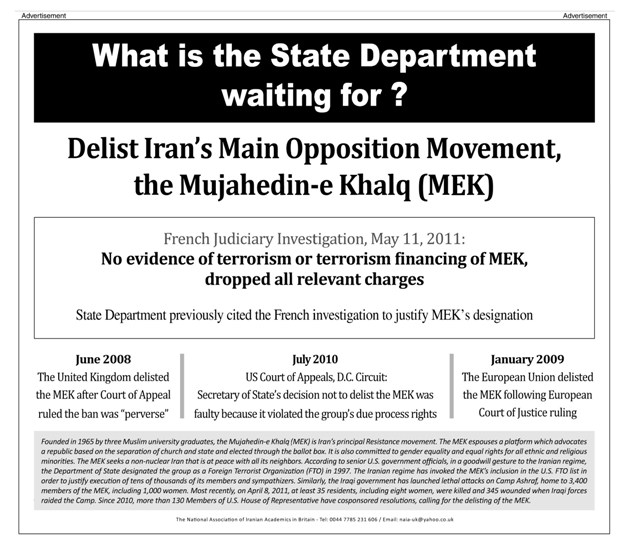
Washington Post, June 22, 2011: What is the State Department Waiting for?
MEK strives for a democratic republic in Iran based on the separation of religion and state.
Washington Post, June 22, 2011: What is the State Department Waiting for?
Houston Chronicle
June 16, 2011
Rep. Ted Poe is urging the State Department to remove an Iranian group from the department’s Foreign Terrorist Organizations list.
The Texas Republican said Mujahedin-e Khalq, also known as the People’s Mujahedin of Iran, is now a peaceful organization dedicated to regime change in Iran.
“I have not been convince they should remain on the list,” Poe said, adding that he has received both classified and non-classified briefings from the State Department and has yet to see evidence that marks the group as a terrorists.
The group, founded in 1960s by Iranian Marxists who opposed the Shah of Iran, is credited with several terrorist attacks that killed Americans in the 1970s, according to the State Department. Poe said MEK’s past may be spotted but the group is now peaceful.
“Iran wants them on the terrorist list. That should be a red flag,” P0e, R-Humble, said, adding that the group’s removal might help “move the country [of Iran] into a freer nation.”
Poe introduced a non-binding resolution in January that urged Secretary of State Hillary Clinton to remove the group from the terrorist organization list.
The Texan is not alone in his efforts to remove the MEK from the terrorist list. The Iranian-American Community of North Texas hired diGenova & Toensing to lobby on the issue earlier this year. The top lobbying firm based in Washington has been reaching out to members of Congress, a partner at the firm said.
“The MEK had denounced violence, disarmed and embraced a free market economy and embraced the declaration of human rights,” Victoria Toensing, a partner at the firm, said.
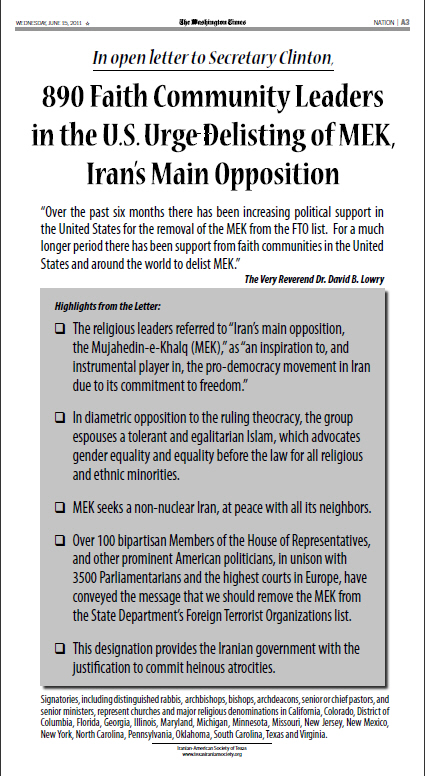
Washington Times, June 15, 2011: 800 Faith Community Leaders Call on Secretary Clinton to Delist MEK
PR Newswire
June 6, 2011
WASHINGTON, June 6, 2011 /PRNewswire-USNewswire/ — Several former U.S. Government officials spoke to the need for the Obama Administration to focus more on the Persian Spring as the administration is calibrating its new Middle East initiative to adapt to the realities in the region, during a symposium in Washington, DC, entitled “New U.S. Middle East Initiative and the Policy on Iran,” organized by Human Rights and Democracy International.
P.J. Crowley, Assistant Secretary of State for Public Affairs until March 2011, said, “Change is going to occur from the bottom up. It’s not going to be imposed from the outside in but we have to be in a position where we can help shape change and support people and institutions that can bring democratic governance to the region as a whole, including to Tehran.” Addressing the protection of Camp Ashraf, where 3,400 members of Iran’s main opposition, the Mujahedin-e Khalq (MEK) reside, he said, “It is up to the international community…beginning with the United Nations, supported by the United States and the European Union, to begin a process to find a solution that allows people at Camp Ashraf to depart Iraq and take up residence in other countries and that should be the policy of the United States and it should be under the leadership with the intervening protection of the United Nations as the international community works to resolve this crisis.”
Nancy Soderberg, former U.S. Ambassador to the United Nations, concurred. “The government of Iraq absolutely must stand by its obligation to protect those in that border and U.S. must push it harder to do so,” she said, adding, “I am confident the Obama administration’s current review [of MEK’s designation] will be decided on the merits. Having spoken to a variety of people in the administration, I do think this will be decided on the facts.”
Ambassador Stuart Eizenstat, former Deputy Secretary of the Treasury, said in part of his remarks, “It is important to strengthen the democratic opposition. It is Iran which is the terrorist state. That’s where the terrorism emanates. The State Department is going through their process as the Court of Appeals for the District of Columbia required them to do and I hope as they do so they will expedite their decision and that they will reflect on the fact that the UK and the EU to which I was an Ambassador, have both lifted their restrictions with respect to the MEK.”
“It’s long past time for this country to act based on its principles, to delist MEK and thereby encourage those in Iran who are struggling for regime change and to make certain that the residents of Ashraf are either permitted to remain where they are with security provided by international force or that they are permitted to leave Iraq for other countries,” Judge Michael Mukasey, former United States Attorney General emphasized.
Former CIA Director, Porter Goss said, “We can’t kick down the situation on the MEK anymore. We’ve got a deadline coming up… [W]e have to encourage our Department of State to come up with the answers on what they are going to do to finish this review. The FTO designation is an impediment to the final solution of relocation and I think, therefore, the sooner we get a judgment on that, that is what I think where common sense will lead us….There’s not any justification based on what I’ve seen… I think if the case is adjudged that they should no longer be on the list, it will make it simpler to deal with the relocation question [of Camp Ashraf residents]… I think the first thing to do is get the FTO question resolved and the second thing to do is say these folks [Camp Ashraf residents] deserve a future.”
“There is nothing that is likely to be more decisive and more influential in reducing the strategic threats from Iran’s current regime than having a vigorous democratic opposition in Iran. It should be a central goal of EU policy to support the democratic opposition in Iran and the U.S. should be prepared to do so with as much aid as is required and without any concessions,” stressed John Hillen, former Assistant Secretary of State for Political-Military Affairs.
SOURCE Human Rights and Democracy International
PRNewswire
May 20, 2011
WASHINGTON, May 20, 2011 /PRNewswire-USNewswire/ — The following is being issued by Iranian-American Society of Texas:
As President Barack Obama laid out his vision for a new chapter in American diplomacy in dealing with the new realities of the Middle East, in a briefing on Thursday, May 19, 2011, former senior U.S. government officials urged the removal of Iran’s main opposition movement, the Mujahedin-e Khalq (MEK), from the U.S. list of terrorist organizations as an absolute prerequisite to be consistent with the facts on the ground. The panel demanded urgent U.S. action to protect 3,400 Iranian dissidents in Camp Ashraf, Iraq and strongly rejected the State Department’s draft proposal to relocate Iranian dissidents from Camp Ashraf to other places inside Iraq.
General Hugh Shelton, Chairman of the Joint Chiefs of Staff (1997-2001), Howard Dean, former DNC Chairman; Tom Ridge, Homeland Security Secretary (2003-2005); Ambassador Dell Dailey, State Department Coordinator for Counterterrorism (2007-2009); Patrick Kennedy, Member of the House of Representatives (1995-2011), and Col. Gary Morsch, M.D. (USAR), addressed the symposium, chaired by Professor Raymond Tanter, former National Security Council staff.
“Our own State Department [is party] to the inhumane treatment of MEK members [in Camp Ashraf] because in spite of numerous recommendations it has received from very prominent Americans to take the MEK off the FTO list, it continues to slow roll that issue. By keeping the MEK on the list we, in fact, weaken the support of the most vital organization that could bring about change internal to Iran,” General Shelton emphasized.
Secretary Ridge said, “If we are going to support …freedom-loving movements around the world, we have to include in that vision the pro-democratic forces in Iran — the MEK, and Camp Ashraf. Political, military, law enforcement, and diplomatic leaders throughout this country, Republican and Democrat, liberal and conservative, have been united in their public support of MEK, and have urged this administration to delist them. The silence in face of the brutal retaliation against Iranian dissidents at Camp Ashraf in 2009 and 2011 is certainly inconsistent and one might argue hypocritical, given the administration’s public support for the dissidents, the resistance and the protestors in Tunisia, Libya, Egypt and Syria.”
Governor Dean said, “The MEK must be taken off the list right now. There is no evidence… The District of Columbia Circuit Court found there was no due process and there was no evidence. Our State Department needs to comply with the laws of the United States of America and take them off the list. This is a struggle for the soul of America.” “Two senior State Department officials said… delisting wouldn’t help Ashraf and that the U.S. hoped to move them to another Iraqi location. What are they smoking in the State Department? For God’s sakes… if any harm comes to one of the residents of Ashraf, these so-called senior officials should resign at once… this relocation plan is a disaster…We have an obligation as human beings and as Americans to make sure that doesn’t happen…We can get people out now.”
Ambassador Dailey underscored, “Careful prudent and thought-out support to the organized, effective, and ever present opposition in Iran, the MEK, is essential. Camp Ashraf has been attacked twice as they had no weapons. They just locked their arms, ten killed the first time; 35 killed the second time. Clearly, this shows no intent and no capability to conduct terrorist activities. Currently, U.S. diplomats are recommending an internal relocation of the MEK and the Camp Ashraf residents. This will allow Iraq to continue to harass the residents with the eventual elimination of all the residents. This is totally unacceptable and should not be part of the U.S. foreign policy.”
“The reason MEK is still listed as a terrorist organization is that our policy in the past has been one of appeasement. MEK is the biggest threat to the Iranian mullahs. If the mullahs are manufacturing and exporting systematic destabilization, systematic support for sponsoring terrorism, fundamentalism and the weapons of that war, the IEDs, we want to be on the side of the people who want to stop them,” said Rep. Kennedy.
Having served at Ashraf, Col. Morsch said, “Let’s stop the siege of Ashraf. Let’s allow doctors and nurses to go in there. Let’s ask the UNAMI to go in and to protect the people of Ashraf. Let’s delist the MEK. They are part of that spring awakening, except they started many, many springs ago. And the rest of the world is just catching on.”
SOURCE Iranian-American Society of Texas
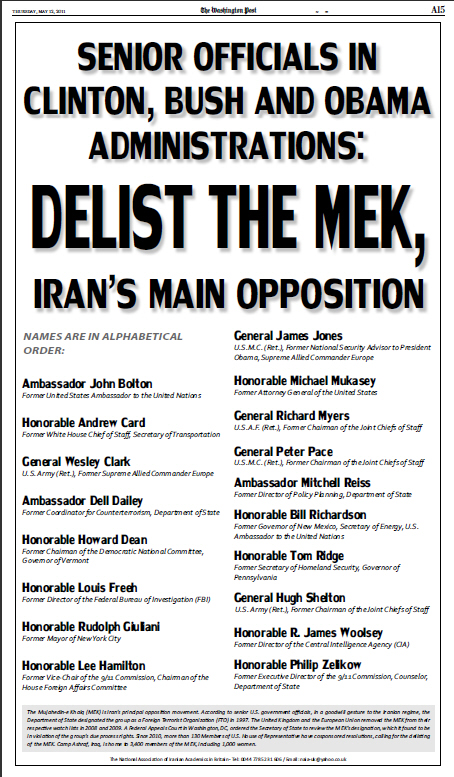
Washington Post, May 12, 2011: Senior US Officials Call on Secretary Clinton to Delist MEK
OpEdNews.com
A transatlantic rift in policy towards Iran seems to be closing rapidly as a momentum takes shape in different policy making circles in Washington to close the gap due to recent developments in North Africa and Middle East. The momentum emanates from a call to reposition the West in support of newly forming democracies across the region, rather than the old approach of engaging tyrants for economic reasons and turning a blind eye on actions of governments towards their own people. Simply, the West wants to be on the right side of history as developments continue.
A major shift, pivotal in realizing this policy change is considered to be the approach towards a leading resistance movement from Iran, the National Council of Resistance of Iran and the Mujahedeen-e-Khalq organization or MEK.
Black listed by the United States back in late 90s as a foreign terrorist organization, in order to win favors with the Iranian regime, the MEK has recently been the subject of a tug-of-war in Washington DC as many top ranking personalities including some former officials of past and present administrations continue to call on the State Department to delist them. An action that would be perceived as a sign of extending US support for the Iranian people against Tehran’s theocratic rulers and a major policy change toward democratic movements in Iran and the rest of the region.
President Maryam Rajavi, the leading exiled Iranian opposition figure of the National Council of Resistance of Iran, who has spent the past thirty years trying to replace the Iranian regime with a secular democratic government, addressed a conference in Berlin last Saturday to lay down her plans for the future of Iran, to “establish freedom and democracy at any price.”
Rajavi told the conference that, “The Barbarism that kills people for attending demonstrations must end.” On the type of the future government in Iran she said, “The Iranian people want a pluralistic republic,” and that, “They want to choose all officials by their own direct vote.”
Rajavi also highlighted the importance of separation of religion from government and promised that freedom of religion will be respected in the future Iran and “No religion will have advantage over any other.”
On the subject of the MEK designation Rajavi criticized past American administrations to have helped the survival of the Iranian regime by blacklisting the MEK. “A policy that has continued in the current administration as well,” complained President Rajavi.
Another speaker at the conference was former European Commissioner, Gunter Verheugen. Referring to recent developments in the Arab world, he said, “Democracy and human rights are not demands specific only to the people in the West,” and uprising in Iran proved that, “The quarrel is not between Islam and Western Democracy but it is between freedom loving people and those who oppress them.” In these circumstances, he added, “The best representative of oppressed people is that country’s democratic opposition.” He concluded, “The rulers in Tehran have no right to speak for Iran,” and pointing to president Rajavi, Gunter continued, “As those who resist them, truly represent the Iranian people. ”
Rejecting MEK terrorist allegations, Gunter remembered Nelson Mandela and the ANC in South Africa, “They labeled him a terrorist for many years. ”
At the Conference speakers seemed to agree that a firm policy towards Iran and a serious sanctions regime along with delisting of the MEK from the US FTO list would show a new approach towards these developments. Some called for official recognition of the MEK and the National Council of Resistance of Iran as a legitimate resistance movement and an alternative to dealing with the Iranian regime.
“We must recognize a democratic provisional government. We do not recognize any governments in Iran right now,” Said Howard Dean, former head of Democratic Party and 2004 US presidential candidate. “I propose that we do recognize a government in Iran. You have just heard from the president.” He continued refereeing to Mrs. Maryam Rajavi.
Former Congressman, Patrick Kennedy, called for the repeal of the MEK listing as a terrorist organization as it “only serves the current regime.”
General Peter Pace, Chairman of the US Joint Chiefs of Staff during the Bush administration, noted that from what he knows and can understand, “the MEK should not be titled a terrorist organization.” He also referred to an obstacle that he did not fully understand that kept the MEK on the FTO list. He called for an open discussion to resolve the issue.
“The enemy is not the MEK,” said General Hugh Shelton, Chairman of the Joint Chiefs of Staff during Clinton administration, “The enemy is the current regime in Iran,” he continued and stressed that the current regime in Iran has to be dealt with as it “attempts to impost control over the entire region.” He described the current Iranian regime to be the “largest exporter of terrorism in the world,” which is seeking nuclear capabilities and criticized the listing of the MEK as it “weakened the support of the best organized internal resistance movement to counter a terrorist oriented, anti-Western world, anti-democratic regime in the region.”
Other participants in the conference included, former FBI Director, Louis J. Freeh, State Department’s Policy Planning Director, Mitchell Reiss, and former Attorney General, Michael Mukasey.
http://www.opednews.com/articles/Delisting-Iranian-Oppositi-by-Nima-Sharif-110409-542.html
The National Review Online
The material-support statute is fine; the designation is the problem.
The moral of this story may be that sometimes it’s better not to have friends, especially the sort with easy access to the op-ed page of the New York Times, or “The Newspaper of Record,” as it sometimes bills itself.
About a week ago, in the guise of defending us against an imagined prosecution for materially assisting a foreign terrorist organization based on our comments at a conference where we urged that Mujahadin e Khalq (“MEK”) be removed from the State Department’s list of such organizations, Prof. David Cole of Georgetown Law School took to the op-ed page of the Times with a bit of rhetorical jujitsu designed to enlist us in his campaign to change the federal statute that bars such assistance. The liberal blogosphere salivated at the suggestion that four conservative Republicans were providing material support to a terrorist organization, notwithstanding Professor Cole’s tongue-in-cheek defense.
MEK, which opposes the current regime in Tehran and has provided valuable intelligence to the United States on Iranian nuclear plans, was placed on the State Department list during the Clinton administration as a purported goodwill gesture to the mullahs, in aid of furthering dialogue. Regrettably, it was kept on during the administration of George W. Bush, in part out of fear that Iran would provide IEDs to our enemies in Iraq, which of course the mullahs are doing anyway. Both the European Union and the United Kingdom have removed the organization from their lists, with the result that MEK is now designated a terrorist organization by only the United States and Iran. More than 100 members of Congress have supported a resolution to undo this designation. We appeared at a conference two weeks ago and described why we thought the designation was anomalous and unwarranted.
Professor Cole’s arch suggestion that our conduct raises a question under the material-support statute is undone by the text of the law itself. The statute barring material assistance to organizations on the State Department’s list of foreign terrorist organizations (“FTO”) says that although “material assistance” includes “personnel,” and although “personnel” may include the person providing the assistance — here, the four of us — the “personnel” have to be working “under that [FTO’s] direction or control.” And then, just to make explicit what is already obvious, the law continues: “Individuals who act entirely independently of the [FTO] to advance its goals or objectives shall not be considered to be working under the [FTO]’s direction and control.” As a result, we felt quite secure, thank you, in relying on the protection Congress placed in the statute, backed up by the First Amendment.
Professor Cole commendably if somewhat unnecessarily insisted in his article that we “had every right to say what [we] did,” but then added — misleadingly — that he “argued just that in the Supreme Court, on behalf of the Los Angeles–based Humanitarian Law Project” in the case he lost in that tribunal last June. Well, no. He argued that the statute should be rewritten to provide that the two activities the self-styled humanitarians wanted to engage in — “training” in negotiation, and “expert advice and assistance” in filing claims, both quoted activities specifically barred by the law — should be permitted unless they involved directly a terrorist act. The Court refused to do that, or to find that the quoted terms were either so vague as not to provide notice to a person of reasonable intelligence or gave the government unlimited latitude in applying the law. Further, the Court found that insofar as these terms could be imagined to reach activities shielded by the First Amendment, they were not activities these humanitarians were seeking to engage in and therefore need not be considered by the Court. That is, Professor Cole and his client lost.
He then went a bit beyond us, and beyond his unsuccessful lawsuit, and called for revising the statute also to permit provision of food and shelter via terrorist organizations, apparently based on the disclosure in the Times that corporations have been permitted by our government to sell — at profit, no less — chewing gum, popcorn, and cigarettes to state sponsors of terrorism. The reasoning here is apparently that if it’s okay to sell chewing gum to terrorists, it’s okay to give them concrete they can use not only for shelter but also to fashion bunkers, or to give them the spigot controlling the flow of food and medicine so they can enhance their power and prestige. For what it’s worth, we do not believe that Professor Cole has unearthed an insufferable anomaly in the law or in its administration. Notably, neither in his lawsuit nor in his op-ed did Professor Cole challenge the designation FTO as applied to the proposed beneficiaries of his client’s ministrations. We have challenged, emphatically and with reasoned argument, that designation as applied to MEK.
The material-support statute doesn’t need revision to accommodate non-existent defects. What it does need — and does not often enough get for fear of offending some Muslim organizations — is rigorous enforcement against accurately designated organizations, of which MEK is not one.
Why, you may ask, did this critique not appear in the pages of The Newspaper of Record (TNOR)? Good question. The editors of TNOR deemed a much shorter version of this article too long for their letters column, and declined to publish it as an op-ed article because, they claim, TNOR has a policy of not publishing op-ed articles in response to other op-ed articles. We are grateful to the editors of National Review for the privilege of this space, and of course to Professor Cole for his unsolicited support, even though we decline to enlist in his crusade.
— Michael B. Mukasey was attorney general of the United States from 2007 to 2009; Tom Ridge was homeland security adviser to Pres. George W. Bush from 2001 to 2003, and homeland security secretary from 2003 to 2005; Rudolph W. Giuliani was mayor of New York City from 1993 to 2001; Frances Fragos Townsend was homeland security adviser to Pres. George W. Bush from 2004 to 2008.
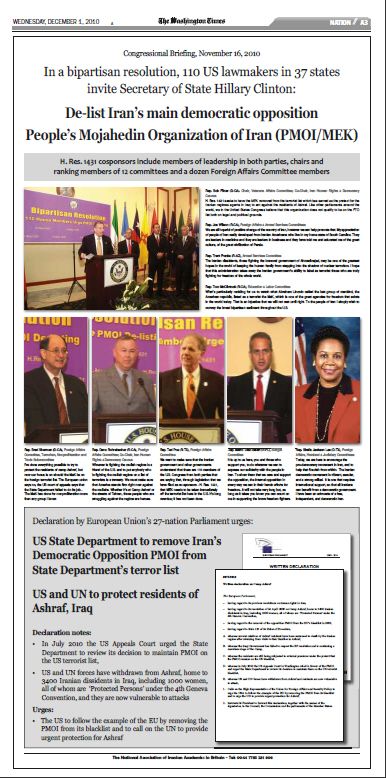
Washington Times, December 1, 2010: US Lawmakers Call on Secretary Clinton to Delist MEK
REUTERS NEWS AGENCY
Who says that the United States and Iran can’t agree on anything? The Great Satan, as Iran’s theocratic rulers call the United States, and the Islamic Republic see eye-to-eye on at least one thing, that the Iranian opposition group Mujahedin-e-Khalq (MEK) are terrorists.
America and Iran arrived at the terrorist designation for the MEK at different times and from different angles but the convergence is bizarre, even by the complicated standards of Middle Eastern politics. The United States designated the MEK a Foreign Terrorist Organization in 1997, when the Clinton administration hoped the move would help open a dialogue with Iran. Thirteen years later, there is still no dialogue.
But the group is still on the list, despite years of legal wrangling over the designation through the U.S. legal system. Britain and the European Union took the group off their terrorist lists in 2008 and 2009 respectively after court rulings that found no evidence of terrorist actions after the MEK renounced violence in 2001.
On July 16, a federal appeals court in Washington instructed the Department of State to review the terrorist designation, in language that suggested that it should be revoked. But Hillary Clinton’s review mills appear to be grinding very slowly.
A group of lawmakers from both parties reminded Clinton of the court ruling this week and drew attention to a House resolution in June — it has more than 100 co-sponsors and the list is growing — that called for the MEK to be taken off the terrorist list. Doing so would not only be the right thing, the six leading sponsors said in a letter, it would also send the right message to Tehran. Translation: using the terrorist label as a carrot does not work, so it’s time to be tough.
Come January, when a new, Republican-dominated House of Representatives begins its term, Clinton and President Barack Obama are likely to come under pressure from hawkish members of congress to act tough towards Iran, further tighten economic sanctions and ensure that those already existing don’t erode.
The influential House Foreign Affairs Committee will be headed by Ileana Ros-Lehtinen, an enthusiastic MEK-backer, who said in a recent interview with Reuters correspondent Pascal Fletcher that the West must make clear it means business about implementing sanctions against Iran. “If…we convey a sense of weakness and a lack of resolve, the centrifuges (in Iran’s uranium enrichment program) keep spinning.”
GROUP BLEW WHISTLE ON NUCLEAR PROGRAM
Ironically, it was the MEK which gave the first detailed public account of Iran’s until-then secret nuclear projects at the cities of Natanz and Arak, in 2002. The disclosure greatly turned up the volume of the international controversy over Iran’s intentions. (Iran’s leaders firmly deny that work on nuclear bombs is underway).
Iran’s nuclear program is likely to rise close to the top of Obama’s foreign policy agenda in the second half of his mandate, particularly if there are no signs of progress in the on-again, off-again attempts to break the present stalemate. The next talks are scheduled for Dec. 5, between the so-called P5+1 (U.N. Security Council members Britain, France, Russia, China and the United States, plus Germany) and Iran.
Other than getting the United States in sync with its Western allies on their assessment of the MEK, what would taking it off the 47-strong American list of Foreign Terrorist Organizations change? In the United States, it would unfreeze frozen funds and allow the group to reopen its office and operate freely as an advocacy group.
In Iran, it would deprive the government of an all-purpose scapegoat to taint all reformists with the MEK brush. In arresting alleged members or sympathizers, Iranian authorities routinely mention that even the United States considers the group terrorist. In their letter to Clinton, the legislators argued that the U.S. designation allowed Iranian officials to “further justify their draconian punishments”.
How much support the MEK, whose leadership is based in Paris, enjoys in Iran is a matter of dispute and many experts rate it as insignificant. But there is no dispute over draconian punishments for Iranians judged to be members or sympathizers. That prompts charges of “waging war against God”, which is punishable by death.
The MEK’s appeal to the Washington court in summer was its fifth petition. It remains to be seen how long the United States. and Iran will stay on the same page on the matter.