October 26, 2026

New Push For Resistance

The Washington Times (Embassy Row)

U.S. supporters of unarmed Iranian dissidents in Iraq are mounting a campaign to persuade the State Department to remove the exiles from its terrorist list and protect them from retaliation by pro-Iranian officials in Baghdad.

Prominent Iranian-American professors, doctors, scientists and scholars from Los Angeles to Miami last week appealed to Secretary of State Hillary Rodham Clinton. They asked Mrs. Clinton to order her subordinates to comply with a year-old federal court ruling that ordered the State Department to justify keeping the Iranian resistance on the terrorist list.

On Monday, two top officials appointed by former President George W. Bush and one named by former President Bill Clinton accused the White House of “turning its back on the Iranian exile group whose network supplies key operational intelligence on the [Iranian] Mullahs’ Islamic nuclear bomb project.”

Allen Gerson, a former counsel to the U.S. delegation to the United Nations and now an attorney for the exiles defended his clients in an article on the Huffington Post, which carried an earlier article calling the resistance a terrorist group.

Members of Congress also are urging President Obama to appoint retired Army Gen. Wesley Clark, a Democrat and former NATO commander, to serve as an envoy to the Iraqi government to negotiate the fate of 3,400 Iranian dissidents in Camp Ashraf, a compound about 40 miles from Baghdad.

Gen. Clark is among the former U.S. officials who support removing the resistance from the terrorist list.

The State Department has accused the resistance of terrorist acts for killing U.S. officials in the 1970s. The department also says it is preparing a response to the court order. President Clinton added the resistance to the terrorist list in 1997, when he was trying to open talks with the Iranian regime.

U.S. forces disarmed the resistance in 2003 after toppling the regime of Iraqi dictator Saddam Hussein, who had given the dissidents safe haven to undermine the Iranian regime.

The new campaign is the latest development in a growing effort to take the Iranian resistance off the list. Britain removed the dissidents from its terrorist list in 2008, and the European Union dropped the resistance from its list a year later. In April, French courts dismissed terrorism-related charges against resistance supporters, many of whom live in Paris.

Fifty-eight Iranian-Americans professionals last week appealed in a letter to Mrs. Clinton to remove the People’s Mojahedin Organization of Iran (PMOI) from the terrorist list.

“The continued designation of the PMOI is unfounded, unjust, inhumane and to the detriment of the Iranian-American community,” they said.

They noted that any U.S. citizen who aided the resistance in any way could face charges of supporting terrorism, and that the Iranian regime uses the U.S. terrorist designation as an excuse to arrest and execute domestic opponents.

They also warned that Iraqi Prime Minister Nouri al-Maliki is determined to shut the camp this year and move the residents to another location. They fear Mr. Maliki, in his efforts to build relations with Iran, could deport them to Tehran, where they would be executed. Iraqi forces repeatedly have attacked the residents of Camp Ashraf, killing dozens and injuring hundreds.

Former Attorney General Michael B. Mukasey and former Homeland Security Secretary Tom Ridge – both Bush appointees – and former FBI Director Louis Freeh – a Clinton appointee – defended the resistance in an article Monday on FoxNews.com.

They complained that the State Department has “slow-rolled” the U.S. District Court for the District of Columbia by taking more than a year to meet the court order and “infuriated the Congress.”

Writing in the Huffington Post last week, Mr. Gerson called the charge of terrorism “spurious.” He criticized an earlier article as a “mind-boggling attempt” to defame Mr. Mukasey, Mr. Ridge and Mr. Freeh for defending the resistance.

He said the earlier article “makes the sensational charge that the [resistance] is, indeed, a terrorist organization and that former top U.S. national security officials are willing to prostitute themselves by saying the opposite.”

• Call Embassy Row at 202/636-3297 or email jmorrison@washington times.com. The column is published on Monday, Wednesday and Friday

My Brother Is Not a Terrorist

This article was originally published in CampAshraf.org

Born in Iran 2 years following the Islamic Revolution, my brother Ali Reza Hassani was only three years old when my parents fled Iran for Greece and ultimately immigrated to Canada to seek a better life for their children. Upon graduating from high school with honors, a then 17 year-old Ali made a difficult and life changing decision. He could study and go on to medical school at home in Canada or he could dedicate himself to the cause of bringing democracy to a country he remembered very little about.

Highly educated on the plight of youth in Iran and uncomfortably aware of the tragic execution his uncle faced at the innocent age of 27, my brother was determined to help rid his homeland of the theocratic regime abusing its people in any way he could. That is when Ali decided to join the People’s Mujahedin Organization of Iran (PMOI) a decades-old resistance movement based in Ashraf Iraq, with the sole aim of overthrowing the regime in Tehran in favor of democracy, secular government and gender equality.

What my brother did not know then is that his life and the life of 3400 of his fellow comrades would be used as bargaining chips under the Clinton administration. As part of a goodwill gesture to Tehran, the Clinton administration added the PMOI to the State Department’s list of Foreign Terrorist Organization in 1997. The United States naively believed that in doing so they could appease the then President of Iran Khatami who had promised various reforms to the people of Iran and feared the existence of an organized opposition movement, namely, the PMOI.

Fast-forward to nearly 14 years later, the United States has seen their policy of appeasement fail time and time again. Today, Iran poses a perilous threat to international security with its pressing nuclear program and following the 2009 student uprisings the world audience seldom doubts their brutal ways. Moreover, this past month Secretary of Defense Panetta recognized the need to end deadly Iranian interference in Iraq.

The listing of the PMOI went so far as to be deemed unfounded by the U.S Federal Court of Appeals for the D.C Circuit in July of 2010 following their de-listing in both the United Kingdom and European Union. How, then, can U.S foreign policy reconcile the assertion that Iran is one of the world’s leading state sponsors of terrorism meanwhile hold that PMOI-who tirelessly oppose Tehran’s radical agenda- are terrorists as well?

The answer is as clear as it seems, they cannot. What remains logically inconsistent is the United States government’s unwillingness to remove the terror-tag unlawfully placed on a group of law-abiding, freedom loving and democracy-espousing individuals like my brother.

The unsubstantiated terrorist label has already cost the lives of nearly 50 unarmed dissidents in Ashraf, Iraq since 2009 and it must not continue. Upon the list’s review this August, I urge Secretary of State Clinton to remove the PMOI granting them the lawful recognition they deserve. Amidst a wave of anti-authoritarian movements sweeping the Middle East now is the time for the U.S to side with the people of Iran and not those who silence them. The very cause to which my brother devoted his life, is in their hands.


The Rule of Law and MEK’s FTO Designation

By all indications, Secretary of State Hillary Clinton is about to release the result of her Department’s court-mandated review of the January 2009 designation of the Iranian opposition MEK, as Foreign Terrorist Organization (FTO). Legal experts agree that the mere observance of the Law, subtle suggestions of the US Court of Appeals, and the statuary requirements, would lead her to one and only one outcome: End the MEK’s designation. This could very well explain the State Department’s delaying tactics to announce the review.

It also explains the impetus behind the frantic outburst of the anti-MEK Tehran-instigated propaganda campaign in recent weeks. The main goal of this campaign, orchestrated by well-known Tehran lobbies in Washington and implemented by a web of similarly well-known advocates of the status quo in Iran is to shift the focus of Sec. Clinton’s review from a “Rule of Law” foundation and prevent the de-designation.

The truth – very hard to swallow by this anti-MEK crowd – is that the Sate Department does not have even an iota of credible evidence satisfying the statuary requirements. Members of Congress are at awe why the State Department does not remove the group from its blacklist or why it is so reluctant to even share its credible evidence – if it has any – with the Congress.

Congressman Brad Sherman (D-CA), the Ranking Member of the House Foreign Affairs Subcommittee on Terrorism, Non-Proliferation and Trade noted last year when he chaired the Subcommittee that:

“I have been an advocate year after year for having the State Department explain what are the criteria under which the MEK has been put on the terrorist list … I have difficulty understanding what has the MEK done, anything remotely, in recent times, that causes the MEK to be on that list. I do know there is no entity more feared, more hated by the mullahs who run Iran than the MEK, which is perhaps the finest compliment that could be paid to that organization.”

Later in 2010, he remarked that:

“Our focus is on: Should the MEK be on the foreign terrorist list? The European Union says no, the US Court of Appeals says that the State Department failed to do its job, and sent them back to do their job… I asked the State Department for a classified briefing on this issue. Any of you who have gotten to know foreign policy from a congressional standpoint will understand when I say, “sometimes you learn more from the classified briefings they won’t give you than from the classified briefings they do give you.”

“The refusal to provide this not just to me, but to the relevant subcommittee was received just yesterday. I therefore asked the intelligence community to provide such a briefing… I’ve been pressing for this briefing for over a month and the variety of different excuses that I got shows that creativity is alive and well in the State Department…

Rep. Sherman, well-known for his anti-terrorism credentials and expertise, offers a very illuminating explanation for the State Department’s foot-dragging. “What it comes down to is that the State Department doesn’t know which way they want to slant the facts before they present it to us because they haven’t figured out what they’re going to do.”

Congressman Ted Poe (R-TX) has also echoed similar dismay about the non-existence of terrorism-related evidence in the “classified” documents of the State Department. Late last year he told a Congressional briefing that:

“Why has the State Department refused to brief the Subcommittee chaired by Mr. Sherman on the delisting of the MEK?… I want to know what information the State Department has that it’s so relentless on your part that they should remain on this list. Do you know that information?”

The Texas lawmaker, after months of delay, eventually received the “classified” information and in June told the Houston Chronicle that “I have not been convinced they should remain on the list,” adding that he has received both classified and non-classified briefings from the State Department and has yet to see evidence that marks the group as a terrorists. “Iran wants them on the terrorist list. That should be a red flag,” Rep. Poe added.

Many respectable and die-hard patriots in America’s national security circles, from four-star generals to former heads of Departments of Justice, Homeland Security, and the Federal Bureau of Investigation, have gone on the record to say the MEK is not a terrorist entity, far from it; it is an ally and a regional partner for fight on terrorism and the Islamic fundamentalism.

Against this backdrop, Secretary Clinton must de-designate the MEK. To maintain the designation would constitute a travesty of justice and the Rule of law and would be viewed as a clear sign of submission to the pressure brought upon by the anti-MEK Tehran-apologists and their anti-Iranian sinister campaign against the MEK.


Tom Ridge Calls for Delisting of MEK

Tom Ridge Calls for MEK Delisting

Time for America to drop ‘terror’ tag on Iranian group

THE FINANCIAL TIMES

Sir, As an Iranian woman who has lost her husband for freedom and democracy in Iran and as the director of the Association of Anglo-Iranian Women in the UK, I was disappointed to see the article “Iran exile group should stay on terror list” (August 11) and the publication of an antagonistic statement by 37 so-called experts on Iran policy against the removal of the People’s Mojahedin Organisation of Iran from the US foreign terrorist organisations list (FT.com, August 10).

The reason the PMOI was put on the terror lists has always been crystal clear. The west did it to appease the Iranian regime and in return Tehran would stop nuclear enrichment and stop sponsoring real terrorists such as Hamas and Hizbollah. Jack Straw who first placed the PMOI on the UK terror list has stated on various occasions that he did so when home secretary in return for Tehran stopping its support for terrorist groups. He also told the BBC in February 2006 that he did what was agreed but the Iranians never kept their promises!

The unfair terror tag was later removed both in the UK and the European Union by order of the courts. It is time for the US to do the same and side with millions of Iranians and their organised resistance movement led by the PMOI for democratic regime change in Iran.

Laila Jazayeri,

London W4, UK

American Credibility at Risk On Foreign Policy Front, Too

FoxNews.com

The Obama administration’s economic policy has suffered some recent highly publicized disasters. But the setbacks of “Obamanomics” should not obscure the administration’s equally critical foreign policy missteps toward Iran and Iraq that threaten to downgrade American credibility in yet another arena.

In particular, the White House seems to be turning its back on the Iranian exile group whose network supplies key operational intelligence on the Mullahs’ Islamic nuclear bomb project. This group – called the MEK – has pointed out the concealed sites of Iran’s nuclear enrichment that were otherwise unknown to the United States. 

Despite this, in a panicked haste to exit from Iraq, the Obama White House is abandoning the 3,400 members of the MEK – including young men, women and children – who are living in exile in a camp near Baghdad and intends to leave them to the indelicate mercy of Iraq’s new Shia prime minister, the Mullahs’ good friend Nouri al-Maliki. This is more than a local issue: the people of “Camp Ashraf,” as it is called, have relatives in the United States and Europe who care about their fate.

Until now, the MEK dissidents have lived in the Iraqi camp, 40 miles from Baghdad, with a guarantee of Geneva Convention status as “protected persons” – a promise made in writing by a United States general in 2004 after the MEK disarmed. But now, abandoning America’s solemn promise and undercutting the West’s fight against the Iranian nuclear breakout, the White House is acquiescing in the plans of Maliki to tilt towards Iran by sending the MEK dissidents to face death in the Iraqi desert.

The State Department recently sent a functionary to the camp whose diplomatic skills would have qualified him to sell beer for Al Capone in Prohibition-era Chicago. Accompanied by a New York Times reporter (who was given exclusive news access to the one-sided meeting by agreeing to pose as a member of the diplomatic staff), Deputy Assistant Secretary of State Lawrence Butler told the beleaguered Iranian exiles that “you only have me” and callously proposed that they should agree to be scattered in small groups around Iraq where they can be killed quietly and out of sight. This, U.S. ambassador James Jeffrey has helpfully added, would be a “a bit safer” than remaining in the Ashraf camp.

Only in the most macabre sense is that true. Rather than use American economic and diplomatic muscle with Baghdad, the Obama White House has meekly surrendered to Maliki’s ambitions. Maliki’s troops, trained by the United States and using American weapons and vehicles, recently made two deadly assaults against the unarmed residents of Camp Ashraf – the first in July 2009, and the most recent attack in March 2011, killing 34 and wounding hundreds of others, shooting them and running them down with armored vehicles.

The intended humiliation of U.S. power was evident; both attacks occurred during official visits to Iraq by then Defense Secretary Robert Gates, who murmured only mild words of concern. Attempts by members of Congress and the European Parliament to visit the camp after the attacks were defiantly rebuffed by Maliki.

The Obama administration is, of course, eager to complete a formal agreement with Prime Minister Maliki concerning the status of American troops remaining in Iraq after 2011. But the rush to please Maliki undermines the credibility of our promises around the world and is an affront to the sacrifices of countless U.S. service men and women who died for a free Iraq.

At the same time, as if to frame the stage for an imminent Srebrenica-styled slaughter, the Obama administration has failed for over a year to answer the challenge of the U.S. Court of Appeals for the District of Columbia Circuit. The federal judges said that there was no evidence to sustain the State Department claim that the MEK should be listed as a “terrorist” group when the group has foresworn the use of violence. Rather than ending this inappropriate listing – as our European allies have – the State Department has slow-rolled the Court and infuriated the Congress.

The administration’s weak-kneed accommodation to the wishes of Prime Minister Maliki has little to show for it. Unique among all his neighbors, and in defiance of U.S. policy, Prime Minister Maliki has also openly supported Syrian president Bashar al-Assad in the slaughter of pro-democracy dissidents in Syrian towns such as Hama and Latakia. Malaki’s axis with Iran will help to destabilize the whole region.

The MEK, on the other hand, enjoys bipartisan support in both the House and Senate as a group that shares a key objective of American foreign policy – namely, changing Iranian nuclear policy and dislodging the radical rule of the Mullahs. As a matter of supporting their own American constituents who are heart-sick at the impending slaughter of family members at the camp, the Congress has also pressed an unresponsive administration to make sure that the Ashraf residents are not led like lambs to the butchery.

In evaluating the bona fides of the MEK movement and its public commitment to a democratic and liberal Iran, the American people and the Congress have never had the benefit of hearing from its charismatic Paris-based leader Mrs. Maryam Rajavi. She has not been permitted a visa to visit the United States. But perhaps the time has come for a first-ever Congressional “Skype” hearing – allowing Senators and Representatives to put directly the questions that administration skeptics have floated for an answer by this intelligent woman who has endorsed a liberal democratic future for Iraq.

The recent decision by Standard and Poor’s to downgrade America’s credit rating and subsequent stock market plunge are symptoms of a new loss of confidence in America’s ability to live up to its commitments – an assessment in no small measure caused by congressional rancor and stalemate. American credibility is equally at stake on the foreign policy front as the U.S. military mission in Iraq draws to a close.

But this time, Congress is united about what needs to be done. Unfortunately, the Obama administration seems not to be listening – and the result may be the further downgrading of American political credibility, with deadly and tragic consequences for the Ashraf residents and their U.S. families who relied on our word.

Michael B. Mukasey, a former federal judge, served as Attorney General of the United States from 2007-2009. Tom Ridge, a former governor of the state of Pennsylvania, served as the first Secretary of Homeland Security from 2003-2005, and is now president of Ridge Global. Louis Freeh, a former federal judge, served as the Director of the Federal Bureau of Investigation from 1993-2001, and is now senior managing partner of Freeh Sporkin & Sullivan.

Read more: http://www.foxnews.com/opinion/2011/08/15/american-credibility-at-risk-on-foreign-policy-front-too/#ixzz1V79koavA

“All the News That’s Not Fit to Print”: USCCAR Condemns New York Times’ Malicious Hit-Piece

PRNewswire

WASHINGTON, Aug. 15, 2011 /PRNewswire-USNewswire/ — The US Committee for Camp Ashraf Residents (USCCAR) deplores Elizabeth Rubin’s unfounded and malicious assertions against the main Iranian opposition movement, the Mujahedin-e Khalq (PMOI/MEK) and its 3400 members in Camp Ashraf in Iraq. The piece appeared in the Review and Outlook section of the Times on August 14. 

The latest in the venomous anti-MEK smear campaign by the pro-Tehran lobby inside the Beltway, the piece represents a desperate, albeit futile, attempt to block, in contravention of the Rule of law and the statutory requirements, the removal of the MEK from the State Department’s list of Foreign Terrorist Organizations (FTO).

At a time when Camp Ashraf residents are facing the specter of another slaughter at the hands of Nuri Al-Maliki, Ms. Rubin has provided fodder for Tehran and its Iraqi proxies to again attack and murder our loved ones there.

For a person who admittedly spent only a few hours in Camp Ashraf back in early 2003, and opted to use the notorious agents of Tehran’s Ministry of Intelligence and Security (MOIS) as her source, Rubin’s shedding of crocodile tears for the residents of Camp Ashraf appears disingenuous given the absence of a mere criticism, let alone condemnation, of two deadly attacks on defenseless residents in July 2009 and April 2011, which Chairman John Kerry of Senate Foreign Relations Committee described as a massacre. 

By recycling the made-in-Tehran collection of lies and stale allegations, Rubin regurgitates what has been debunked repeatedly by the highest courts in the United Kingdom, the European Union and France. More significantly, U.S. military officers, who have collectively spent years in Camp Ashraf with MEK members, have gone on the record in U.S. Congress to refute these baseless allegations.

Rubin’s August 14 diatribe was preceded three weeks earlier by another New York Times hit-piece, which also demonized the leadership and rank-and-file at Camp Ashraf. It blamed our loved ones for not kowtowing to a plan of relocation to remote Iraqi detention camps – as insisted by a U.S. embassy official – which is tantamount to providing the Maliki government a license to murder. Members of U.S. Congress and thousands of their European counterparts as well as international human rights organizations have vehemently condemned this proposal. 

In breach of basic journalistic and professional standards and principles, the author of that story, Tim Arango, sat in on a confidential and sensitive discussion about the future of Camp Ashraf residents, falsely introducing himself as an Embassy staff member. Instead of publishing even a single one of the many letters to the editor by the MEK counsel, Camp Ashraf family members and Iranian Americans, The Times’ editors published Rubin’s piece without bothering to fact and source check the article.

This unethical and unprincipled modus operandi by a newspaper which boasts of printing “all the news that is fit to print,” only serves to pave the way for another massacre at Camp Ashraf.

SOURCE: U.S. Committee for Camp Ashraf Residents (USCCAR)

http://www.prnewswire.com/news-releases/all-the-news-thats-not-fit-to-print-usccar-condemns-new-york-times-malicious-hit-piece-127752108.html

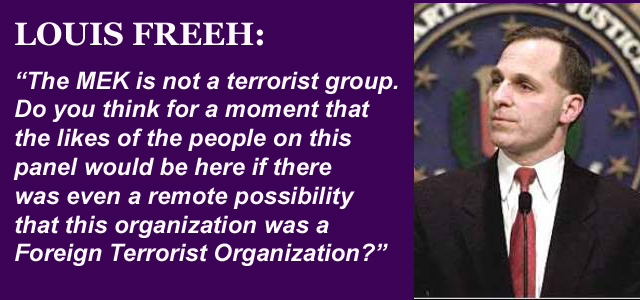
Louis Freeh Calls for Delisting of MEK

Louis Freeh Calls for MEK Delisting

MEK supporters call for de-listing from FTO

In recent weeks, the Iranian American Community of Northern California has been hosting a number of symposiums in Washington shedding light on the need to remove the Iran’s principal opposition movement, the Mujahedin-e Khalq (PMOI/MEK).

These events which feature senior officials from a number of previous administrations, with various backgrounds, ideologies, and areas of expertise are calling on the Obama Administration to change its policy in regards to the MEK, and remove them from the FTO. In response, the National Iranian American Council has launched a full-fledged campaign opposing the de-listing of the MEK, complete with an entire section on their web site dedicated to the issue, and even “tweeting” about it non-stop. Is this really the biggest issue on the table for Iranian Americans? And if so whose side is NIAC on?

The arguments used and recycled by NIAC over and over again have almost nothing to do with the legal process which the State Department is currently engaged in. Instead they weave their own narrative, and devise their own criteria as to what qualifies enlistment of an organization, than proceed to explain how it applies to the MEK.

The first and most blatantly inane argument that NIAC continues to assert is that the MEK is not popular in Iran and do not represent the views of Iranians, and as such should not be removed from the terrorist list. Just to be clear, does NIAC believe that one of the criteria for being labeled a terrorist organization is unpopularity? If conversely a group shows itself to be popular does that somehow absolve them of the terrorist label? If so, does NIAC support the delisting of groups like Hamas, Hezbollah and Al Qaeda based on their perceived popularity in the occupied territories, Lebanon and Afghanistan respectively?

Jamal Abdi, NIAC’s so-called policy director is either very good at distorting an argument or very ignorant as to how the State Department review works in regards to the delisting of organizations. He begins by stating that de-listing them would “free the group to inject violence into Iran’s democratic opposition movement.” Making a de facto statement that MEK is a violent organization, though the evidentiary record contains not one instance or act of terrorism in the last decade.

As an example of how the MEK is a violent organization Abdi cites a story in which MEK supporters in Iran chanted “Death to Khamenei” during the 2009 election uprising. This act, according to NIAC shows the groups propensity of incite violence, despite the reality on the streets of Tehran which saw protesters shot in cold blood and beaten by the regimes thugs. Never mind that these were ordinary citizens chanting what would end up being the most repeated slogan during the 2009 protests. Under this criterion I suppose Martin Luther King and Gandhi were also inciters of violence as their words were inevitably met with brutal repression. NIAC doesn’t bat an eye when attributing the brutal crackdown of the Islamic Republic as somehow being the fault of MEK, a classic smear tactic.

NIAC: Fighting for our rights?

In his attempt at presenting arguments as to why the United States should disregard its normal procedures in reviewing the evidentiary basis for the de-listing of the MEK, Trita Parsi the so called president of NIAC offers the following: “The State Department’s review of their terrorism status, which is due to be completed by August of this year, must be conducted without the essentially illegal pressure tactics the MEK currently is employing through lobbyists, lawmakers and hired former officials.”

So to be clear, Iranian Americans cannot advocate for their own due process and first amendment rights under the constitution, but Parsi and his pals can begin a full-fledged campaign to lobby for the MEK to remain on the list without the slightest hint of irony or hypocrisy?

Parsi seems to forget that the due process rights of this group were violated according to the US Court of Appeals for the District of Columbia, which “ordered the State Department to review its designation of the People’s Mujahedin Organization of Iran as a foreign terrorist organization, strongly suggesting the designation should be revoked.” If the organization’s supporters engage in a campaign to bring attention to the denial of its rights, as is legal under the First Amendment, this amounts to lobbying in Parsi’s eyes. However, NIAC dedicating half its web site, 90% of its tweets and what appears to be the majority of its resources to stone walling this review isn’t lobbying? What is NIAC’s excuse and stake in the controversy?

Lastly, Parsi contends: “Third, de-listing will put the rising Iranian-American community in a state of shock. In the last decade, an impressive civic awakening has occurred in this successful but previously politically silent community, with dozens of new groups being formed with the aim of contributing to the American democracy and providing the Iranian Americans in the U.S. with a voice. A U.S. funded and supported MEK will ensure a return to the pre-1997 era.”

As an Iranian American who has continually advocated on behalf of his community, the Iranian American Community of Northern California, nothing could be more insulting and offensive. Parsi’s absurd argument would have you believe that somehow Iranians will have their minds wiped and devolve into incompetent and apolitical buffoons if the MEK were de-listed. Yet in the same story, he maintains that the organization is loathed by all Iranians, and their delisting would incite anger and protest. Which is it?

A series of questions come to mind when reading the materials NIAC has put out regarding the proper criteria for deciding whether to delist the MEK.

1. Would the State Department remove the PMOI if they were in fact a violent organization?

2. Should one of the criteria for enlistment or removal be popularity?

3. Should the enlistment of terrorist organizations be a political decision, based on cost benefit analysis, or strict statutory guidelines and procedural due process that is guaranteed by the Constitution?

4. If the United States does remove the PMOI, and they do in fact begin a campaign of terrorism in Iran, wouldn’t the State department just as easily re-designate them as a terrorist organization?

5. Why is NIAC launching a full-fledged campaign in regards to this issue, yet dedicates so little energy or focus on the horrendous human rights situation in Iran.

Unclean Hands

Parsi and his group have a checkered past. In 1997, he created Iranians for International Cooperation, which according to its official website, had the objective of campaigning for “the removal of U.S. economic and political sanctions against Iran, and the commencement of an Iran-U.S. dialogue.” Before that Parsi had begun his career working at Congressmen Bob Ney’s office, another outstanding example of integrity who is now in prison for corruption. In Ney’s office Parsi even allegedly acted as courier for Tehran, receiving proposals from the regime to be relayed to Congress.

Last year, dozens of documents including internal NIAC e-mails, were released, as part of the discovery process during a defamation lawsuit. The evidence showed that Trita Parsi, arranged meetings between Iranian regime officials and members of Congress, including Tehran’s ambassador to the United Nations at the time, Javad Zarif.

All one has to do is to read any of the numerous published statements by Parsi to see the line NIAC is trying to push. Regardless of the current situation, he will conclude his elaborate analysis with the two points; that we need to continue to engage Iran, and that sanctions should not be imposed on the regime. What he doesn’t mention is how NIAC and its associates stand to benefit financially from lifting sanctions against the mullahs. The evidence released also indicates policy coordination between Parsi and a Tehran-based company with ties to the Iranian regime.

NIAC has largely ignored the human rights situation in Iran, only after the brutal summer of 2009 was it forced to make a few half hearted statements condemning the violence. In January 2008, during a meeting on Capitol Hill, Parsi publicly denied that NIAC had a human rights role. He said, “NIAC is not a human rights organization. That is not our expertise.” He added elsewhere, “The current choice Iranians face is not between Islamic tyranny and democratic freedom. It is between chaos and stability.” For NIAC stability is a pseudonym for the Iranian regime and chaos a pseudonym for democracy. Just as protesters who chant down with Khamenei are instigators of violence.

A number of other news outlets and reporters have covered this issue. The Spectator, caled NIAC the “de facto lobby” for the Iranian regime in Washington: It opposes sanctions on Iran, soft-pedals any controversial events in Iran, and counsels ‘patience’ regarding Iran’s stance towards its nuclear program. In November 2009, Jeffrey Goldberg of the Atlantic said, “A couple of weeks ago, I retracted my assertion that Trita Parsi, the head of the National Iranian American Council, did “leg-work” for the Iranian regime. … But now I may have to retract my retraction.”

Since the 2009 uprisings in Iran, the group has tried to re-invent its image by trying to paint itself as an advocate of “human rights” and the so called “green movement.” Before that, according to Politico, the majority of NIAC’s internal “minutes include almost no mention of a human rights agenda inside Iran.” Instead the organization seemed adamant to create campaigns such as “send Hillary to Iran” even as the Iranian regime committed horrendous human rights abuses. Not only did the abysmal human rights situation not come up in NIAC’s agenda, it actually worked to silence opposition as much as possible. According to the Weekly Standard, in fact, “the emails suggest that [Parsi] worked to dissuade dissidents from speaking out.”

Learn the Constitution

Apparently the majority of the rights guaranteed in the Constitution have been lost on NIAC and Trita Parsi, though to his credit it may be because he never had a high school civics course in the United States due to the fact that though he is the so-called “President” of the National Iranian American Council, he is a resident alien in the United States and in fact a citizen of Sweden.

Let’s imagine hypothetically that NIAC was a group which sought to defend the rights of Iranian-Americans. A simple glance at its web site and positions seems to allude to the fact that one of its main objectives is to protect the civil rights of Iranian’s residing in America in the post 9/11 era. One would imagine that the ruling of the US Court of Appeals for the District of Columbia that the due process of an Iranian opposition group was violated when they were enlisted as a terrorist organization would be of some significance to their desire to protect the rights and liberties of Iranians.

As a supposed representative body for Iranian Americans, perhaps NIAC might consider the First Amendment rights of free association for Iranian Americans who may want to support the MEK, regardless of their greater popularity. Does NIAC seek to uphold due process and constitutional rights only for those who it agrees with? Or is standing up for the constitutional rights of Iranians not part of the agenda? NIAC might also take it into consideration that the designation of the MEK is a major obstacle to the re-location of 3,400 refugees in Camp Ashraf, Iraq, never mind the fact that this designation is used as the basis to execute and imprison dozens of MEK sympathizers in Iran.

Perhaps Parsi was referring to NIAC when he talked about the delisting of the MEK as a major setback. If so then that is just one more issue in which they share common grounds with the regime in Tehran.

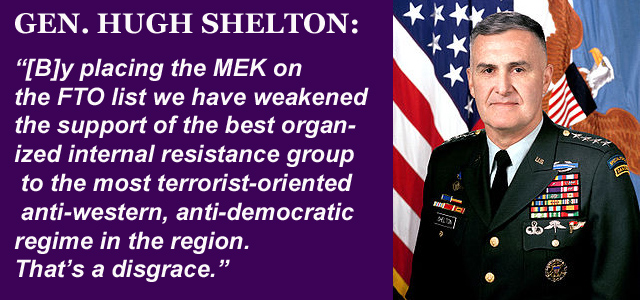
Hugh Shelton Calls for Delisting of MEK

Hugh Shelton Calls for MEK Delisting